


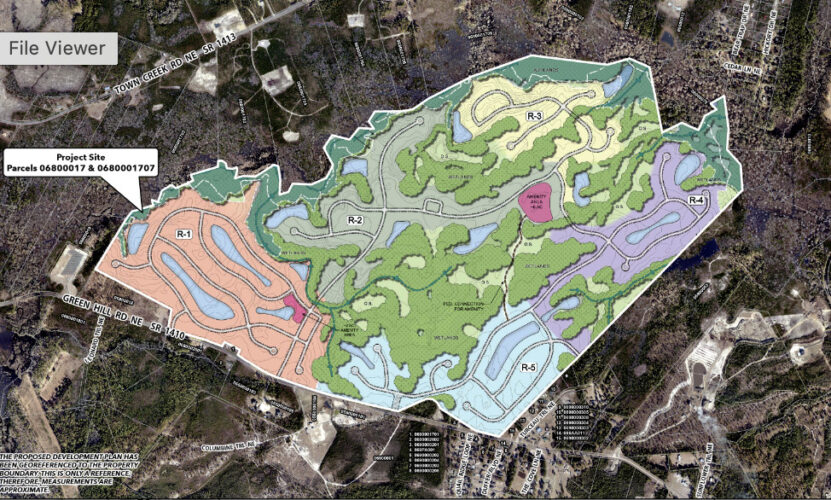
BRUNSWICK COUNTY — A lawsuit filed earlier this month is asking the courts to overturn the Brunswick County Planning Board’s denial of a 1,340-home neighborhood slated for Winnabow.
On May 6, Shipman Wright and Moore law firm filed an appeal to the Brunswick County Superior Court, on behalf of developers HIC Land LLC and CLD Engineering. The development company — behind neighborhoods in Little River, Columbia and Mount Pleasant, South Carolina — wanted to bring Green Hill Planned Development to 784.5 acres.
READ MORE: Infrastructure ‘already under pressure’: 1,340 homes denied in Winnabow
ALSO: State bills propose shake-up in Brunswick development process, some commissioners agree
A planned development encourages preservation of natural and scenic elements, efficient use of land, and other items, and often includes exceptional design elements for more flexibility. The Brunswick County Planning Board voted 3-1 to deny its forward movement in April, despite planning staff recommending approval.
The planning board in Brunswick County is the only one in the tri-county region — and one of a handful statewide — allowed to sign off on final developments rather than commissioners. Though that’s being challenged at the state level currently, as reported on by Port City Daily recently.
The lawsuit states the board’s vote disregarded objective rule applications from the county’s unified development ordinance, of which the planning board is required to follow and base decisions “on competent material and substantial evidence, consistent” within it therein. The UDO is the rulebook for developments in the county; denial, developers allege, was “unconstitutional.”
The board did not indicate what parts of the development were noncompliant with the UDO to base their decision on, according to the lawsuit. Rather, it suggests the board “exceeded its authority by substituting subjective judgment.”
Brunswick planning staff suggested approval due to exceptional design elements, such as 310 acres of open space, beyond the 117.68 required, not to mention inclusion of an Endangered Species Report, drainage assessments and a traffic impact analysis indicating how the development would affect the area or mitigate issues. Among its plans were $4 million in roadway improvements, stormwater ponds designed for a 100-year storm event, and no units built on the 200 acres of wetlands.
The developer also came in at 1.71 dwelling units per acre, under the required density amount in the current Rural Residential zoning allowance, which was 2.9.
“Plaintiffs presented competent, material, and substantial evidence from licensed professionals supporting approval,” the lawsuit details — and even “provides more support and evidence for approval than is required.”
Still, many board members remained concerned by flooding that already surrounds the area, traffic issues and one board member, Richard Leary, was compelled by the Winnabow fire chief’s testimony.
Fire chief Travis Mercer worried more impervious surface would compound the flooding issues already affecting the region and further impact response times to reach residents. He point to traffic already heavily flowing through the area alleging it would further impede public safety and response times.
During April’s meeting meeting the developer’s lawyer, Matt Nichols, detailed traffic patterns near the U.S. 17 intersection at Green Hill Road would include upgraded signal preemptions; basically, smart technology communicates for signals to be green upon detecting a fire truck or emergency vehicle approaching. He countered it would increase safety and response. Nichols added the project would also bring 45 new fire hydrants, installed every 45 feet per the county code.
The lawsuit claims “the Chief had no authority over decisions regarding Plaintiff’s PD application” and noted the team made revisions and updated plans to counter concerns.
The only other planning board member to speak at April’s hearing was alternate Cecilia Herman — the planning board is going through a shapeshift currently as two members exited in March. Herman didn’t specifically address the design of the development but cited issues about water surrounding it.
It wasn’t the first time Green Hill Planned Development was before the board; they first denied it last fall as well. Then last month, developers put forth an amended site plan with 110 fewer units from the 1,400 previously pitched, to be built over 10 years.
Numerous members from the public also spoke to the board both in the fall and spring. All against the development, their concerns centered on traffic capacity, overburdened schools, fire and EMS resources, infrastructure and flooding. The lawsuit adds the planning board should not have weighed insubstantial input.
“Generalized concerns or fears from opposition, without factual support, are insufficient grounds for denial of a PD application,” it notes.
The lawsuit asks the court to mandate the planning board reverse its order and cover the developer’s legal fees to see through the appeal process.
According to Brunswick County spokesperson Meagan Kascsak, the county is aware of the lawsuit but did not answer how they will respond, and if and when the planning board will take up the matter again.
“We are not able to provide anything further since it is an active legal matter,” she wrote in an email to Port City Daily.
It’s the second time Brunswick County has been sued by a developer in the last eight months. In July, Coastal Cornerstone Development, LLC requested approval of the planned development Sailor’s Haven on 117.3 acres of land near Sunset Beach. The planning board denied it but then Sailor’s Haven sued in September, with the planning board reversing course and approving the development in November after slight changes were made to the design.
At Port City Daily, we aim to keep locals informed on top-of-mind news facing the tri-county region. To support our work and help us reach more people in 2026, please, consider helping one of two ways: Subscribe here or make a one-time contribution here.
We appreciate your ongoing support.
