


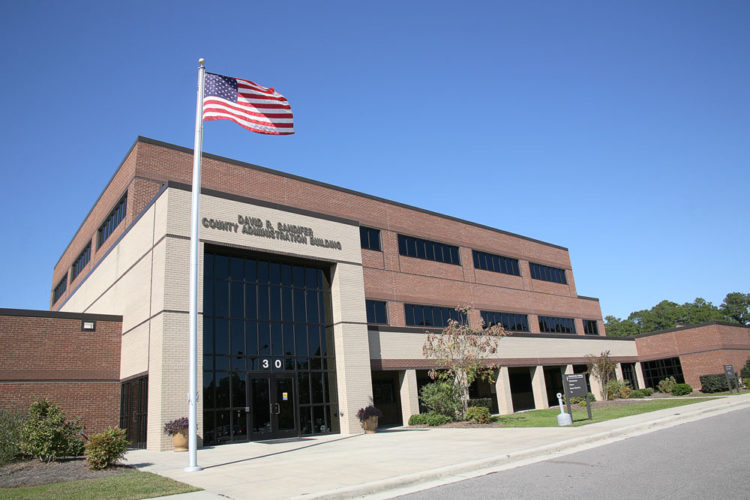
BRUNSWICK COUNTY — The Brunswick County Planning Board will have to find two new members as it’s operating with vacancies following the resignations of Vice Chairman Jason Gaver and board member James “Jim” Board this month.
Gaver, who represented District 4, resigned after moving from Brunswick County to Castle Hayne, according to a March 22 social media post announcing his departure. Board, a District 3 representative and the Mayor Pro Tem of St. James, also resigned, citing frustration with what he described as the planning board’s diminished authority in reviewing development proposals.
READ MORE: Compass Pointe residents fill Leland Town Hall to oppose 150-acre annexation
ALSO: Public water to become accessible to underserved residents in $20M approved water line
The departure of two members from the seven-seat body reduces the board’s voting strength as it heads into the April and May meeting cycles. To conduct business and vote on development projects, the board must maintain a quorum of at least four members. Board alternate Cecilia A. Herman is available to step in if needed.
In Brunswick County, the planning board gives the final say on developments coming to the region. However, the commissioners appoint the members; they will be in charge of voting on replacements for Districts 3 and 4.
Port City Daily asked a Brunswick County spokesperson when the vacancies are expected to be filled, without a response by press. Having served for 18 months, Board’s term would have expired on June 30, 2027; Gaver’s term was set to expire this June.
Gaver’s term was cut short due to a move into New Hanover County. Members of the Brunswick County Planning Board must reside within the county’s borders to serve.
Gaver wrote in his resignation announcement he remains committed to public service and will continue serving in other roles — with Novant Brunswick Medical Center, the Veterans Creative Arts Program, and paws4people Foundation, and in his new role as director of mission advancement for Christian Recovery Centers Inc.
“I believe this is where God has called me for this next chapter,” he wrote. “We will see you around — just because we don’t live in Brunswick County does not mean our commitment will lessen.”
During a March 16 meeting, Commissioner Pat Sykes questioned whether Gaver had already moved out of the county before the March 9 planning board meeting. She was concerned if developments he voted on would be viable. County legal counsel assured Sykes they did not believe any prior planning board votes were affected.
Gaver did not respond to Port City Daily’s interview request, though Board did on Friday. Board, who resigned March 10, said the main reason he stepped off the planning board is due to its lack of authority to manage the county’s growth. The planning board follows the county’s unified development ordinance to approve developments; the UDO was last updated in 2015. In the 10 years since, the county’s population has grown by 50%. Brunswick County has now become the fastest growing county in the state and fifth fastest-growing nationwide.
Board’s frustration stems from what he describes as a narrowing of the board’s discretionary power. If developers meet the technical “competent, material, and substantial evidence” requirements listed in the county’s UDO — such as density limits, required buffering, and drainage plans — they are entitled to approval.
According to Board, this “check-mark” process reduces the planning board’s approval to verify a development that meets technical requirements, already vetted by county staff.
“If the intent for the planning board was just to verify what the planning department had already done in that they say it met the county UDO, why do we even have [a planning board review]?” Board questioned. “It’s an unnecessary step in the process.”
While the UDO technically allows the board to deny a project if it poses a risk to public safety, Board argued the threshold for proving such problems has become functionally unreachable. In practice, resident concerns regarding traffic or infrastructure are often dismissed as speculative unless expert evidence is provided.
Not to mention such decisions about roadway oversight is on the lap of the North Carolina Department of Transportation, which owns and maintains most major corridors in the county. If a project meets NCDOT standards, the planning board can’t simply reject a development unless separate proof shows it’s a risky impact.
The same dynamic applies to flood-related concerns, where projects are evaluated using official FEMA flood maps and engineered drainage models. Should they show no elevated risk, resident concerns alone are typically not enough to justify denial.
“If we can’t inject common sense and public opinion and public safety, what is the purpose of the planning board?” Board asked.
He pointed to the recent approval of Cherrytree Tract, a 1,000-unit development, as a primary example of legal pressure. Cherrytree was initially proposed in September 2025 but was voted down by the planning board due to concerns over flooding and traffic safety. The applicant, Robert Wilfong Jr., revised plans and resubmitted them to the county earlier this year as they were considered for a second time by the planning board on March 9.
During the March meeting, Board made a motion to deny the project, arguing the developer had not adequately addressed the board’s concerns raised in the first hearing. However, his motion failed to receive a second.
Board recalled then-Vice Chair Gaver expressing personal reservations about the project’s traffic impact, but worried a denial would likely result in a lawsuit against the county.
“I thought: ‘Oh, that’s just horrible,’” Board said. “Why are we here, if we’re not allowed for fear of a lawsuit, to vote down something because of common sense reasons?”
His concerns are grounded in reality. In August 2025, Coastal Cornerstone Development LLC sued Brunswick County after the planning board unanimously denied the 299-unit Sailor’s Haven proposal near Sunset Beach based on stormwater and traffic concerns. The developer later filed a lawsuit arguing the project met UDO requirements and state and local technical reviews had already addressed the issues.
Resolving the litigation, the developer resubmitted a revised plan on Nov. 10 that reduced the project to 283 units and added two additional stormwater ponds. Just three days later, on Nov. 13, the board voted 4-1 to approve the new proposal, effectively ending the legal battle.
Board cast the lone dissenting vote.
In August last year, he also wrote a letter to the public about the planning board being beholden to the UDO and how he thought commissioners, the board and relevant stakeholders should meet and fully grasp the needs of the community.
“Your board of commissioners must take the responsibility to care,” Board said then, noting text amendments to the UDO the planning board has suggested were voted down by commissioners. “We need a more restrictive UDO in the county so we can do a better job of maintaining the development of this county without destroying it.”
He echoed the same sentiments to Port City Daily on Friday saying Brunswick County’s current UDO lacks “teeth.” From Board’s point of view, developments are being approved before infrastructure improvements are in place, whether it’s schools being overcapacity, fire and police departments not having enough equipment and manpower, stormwater practices being better aligned with county needs, and etc.
Furthermore, Board pointed to delays for new sewer line extension approvals from the North Carolina Department of Environmental Quality as evidence development is “outpacing the infrastructure by leaps and bounds.” A 2023 state law changed how sewer capacity is calculated in the county, requiring regulators to account for previously approved but unbuilt development in capacity totals.
The switch was implemented in November 2025, resulting in delays and pauses on new sewer extension approvals in Brunswick County as officials determine whether systems meet updated capacity standards. Projects are still able to be approved, though development cannot fully proceed without securing sewer capacity approval and connection permitting.
“It seems silly for the planning board to continue to approve new developments when they haven’t even defined how they’re going to get sewer connections,” he said.
Ultimately, Board said the county should revisit its development standards — and he thinks it should come with being “a little more restrictive for the developers to meet.”
“You got to maybe take some pain in order to get some gain,” Board said.
Call for another board member’s resignation
Also compounding an incomplete board is a public call for the resignation of Chairman Clifton “Clif” Cheek.
At a March 16 commissioner meeting, Commissioner Randy Thompson said he sent a letter to Cheek on March 11 formally requesting he step down from the planning board. He described a potential conflict of interest related to campaign contributions from developers. Thompson and Cheek competed against one another for the District 1 commissioner seat in the March 3 primary election, where Thompson won with 66% of the vote.
“I thought, in the best interest of the county and in sound judgment, that it was the right thing to ask that he consider stepping down,” Thompson said at the meeting.
Thompson’s request had been echoed at a recent planning board meeting as well, when a public commenter also highlighted Cheek’s financial gain from area developers and contractors.
According to the latest campaign finance report, Cheek raised a total of $44,010 during the reporting period from August 2025 to February 2026.
Of that amount, $3,000 came from Robert Wilfong Jr., the developer of the Cherrytree Tract project previously reviewed and approved by the planning board at its March 9 meeting, where Cheek voted in favor of the proposal. Wilfong’s contributions were made to the committee supporting Cheek’s campaign for county commissioner.
In addition, Cheek received contributions from other developers and real estate professionals, including:
- $4,000 — D. Logan, president of Logan Homes
- $1,000 — Ralph R. Teal Jr., co-founder of Pinehurst Builders
- $1,000 — Ronnell Parker Jr., CEO of Parker Homes
Thompson did not name specific donors or projects during the meeting, instead referencing contributions from “a number of developers” tied to projects in various stages of the development pipeline.
Cheek, a local real estate broker, did not respond to Port City Daily’s request for comment, though posted a response to social media on March 18 defending his conduct. In the post, Cheek argued accepting campaign contributions from developers does not create a conflict of interest, and such donations are a routine and regulated part of the electoral process and do not, on their own, suggest preferential treatment.
“A true conflict of interest arises when an official uses their position to secure direct personal financial gain or gives preferential treatment in a way that violates established ethics rules or legal standards,” Cheek wrote. “Simply receiving donations from individuals or entities—such as developers—does not automatically meet that threshold. Elected and appointed officials routinely receive support from a wide range of stakeholders, many of whom may later have interests before governing bodies.”
He added his campaign received contributions from developers, builders, engineers, real estate professionals and other supporters, and argued developers play a key role in the local economy as major employers and contributors to job growth.
More so, echoing Board’s point earlier, the planning board is bound by county-adopted rules in the UDO and must approve projects that meet those standards, regardless of campaign contributions or outside relationships. Cheek added that denying compliant developments can expose the county to costly lawsuits ultimately falling on taxpayers, pointing to the need for updated development rules at the commissioner level as the broader fix.
His term runs through June 2027.
At Port City Daily, we aim to keep locals informed on top-of-mind news facing the tri-county region. To support our work and help us reach more people in 2026, please, consider helping one of two ways: Subscribe here or make a one-time contribution here.
We appreciate your ongoing support.
