


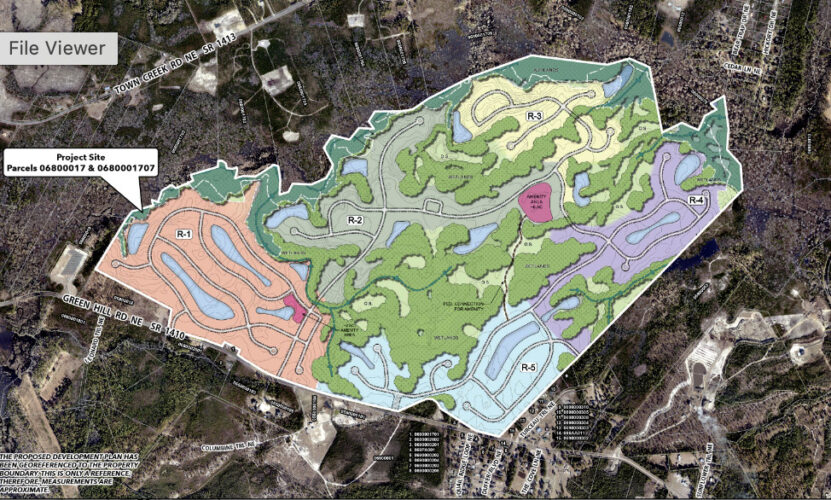
BRUNSWICK COUNTY — There was no swaying the Brunswick County Planning Board Monday night to push through a development of more than 1,000 homes into a small rural town. The project has appeared before the board multiple times in recent months, this time with an amended site plan.
The planning board first rejected Green Hill Planned Development last fall, then expected to build 1,450 homes on Green Hill Road. It was denied this week as well, despite having 110 fewer units, meaning 1,340 single-family units would be built on 784.5 acres, phased in over 10 years.
READ MORE: 1500 new units on the docket for approval in Brunswick County
“You’re not doing us a favor by reducing the house count by 110,” resident Jennifer Gates said during public comment.
Gates lives in the 800 block of Cherrytree Road, affected by another nearby 1,000-home development the planning board passed last month. It’s 5 miles from the proposed Green Hill Road planned development.
“We are still hearing a lot of mights, shoulds, maybes,” Gates continued.
She has spoken to the board before, regarding problems with traffic capacity, overburdened schools, property, fire and EMS resources, infrastructure and flooding.
“But let’s be honest,” she said. “This is not buildable land.”
The 784.5-acre development is made up of roughly 200 acres of wetlands. Developers HIC Land LLC were represented by attorney Mike Nichols Monday. HIC Land has built homes in Little River, Columbia and Mount Pleasant, South Carolina. Nichols confirmed all lots would be built outside of any AE flood zone.
Southern Environmental Group did a drainage evaluation and found some obstructions in the vicinity. For instance, the team located 45 beaver dams and 17 other areas with clogged, incorrectly sized or altogether missing culverts that they proposed to correct.
“That’s just one step to address the issue,” Nichols explained. “We are still identifying problems and working toward solutions, but it won’t happen overnight.”
He added having a large-scale, planned development of this caliber comes with a benefit: cohesion and thoughtful engineering. To Nichols, this is better than breaking up the 700-plus acres and piecemealing multiple neighborhoods on it — with different developers taking varied approaches on their plats, which may not be in harmony with one another.
“That’s not the same as someone coming in and developing it in a cohesive and comprehensive way,” Nichols said.
Alternate board member Cecilia Herman gave credit to the developers for focusing on how they were going to improve their property within the development. However, she had concerns about the water also surrounding it.
“A community can be destroyed in days and take forever to be rebuilt,” she reminded.
Flooding remained a major concern among the public. Cindy Henry, who has lived on a nearby farm for 45 years, said the last time Green Hill Road flooded, it wasn’t even a hurricane and the road to leave her property was surrounded by standing water.
“Green Hill Road flooded,” she said, “Town Creek Road flooded. We rode in a canoe to get over Highway 17 because it was flooded.”
Christine Anthony passed out pictures to the planning board of her home during 2024’s Potential Tropical Cyclone 8.
“Within hours every road in and out was under water and we were trapped,” she said. “Emergency access was cut off. This shows the vulnerability of this area.”
PTC8 is considered a rare occurrence, in that it dropped 20 inches of rain in the area in 24 hours. Weather experts refer to it as a one-in-1,000-year storm event. It left many people stranded on roadways for hours along Highway 17, unable to get home.
Stormwater ponds in Brunswick County are built to 100-year events — meaning roughly up to 11 inches of rainfall in 24 hours has to be captured from the site. Anthony indicated storms are getting stronger and thought the infrastructure in the area is “already under pressure,” and should be corrected ahead of time to accommodate growth.
Emergency response during any flooding event remained a considerable concern for others, even volunteer firefighters and the chief, Travis Mercer. Mercer asked the board to deny the project after having met with developers recently.
“During a rainstorm, we routinely experience difficulty accessing the area from Green Hill Road, Town Creek Road and Rock Creek Road,” Mercer said, worried more impervious surface will compound the issue and affect response times to reach residents.
Winnabow fire department volunteer Glenn Kai told the board the department facility is located a few miles down the road from the planned development and during the last heavy rainfall, water from a retention pond pooled up near the station doors. Not to mention roads near Russell’s Branch and Red Water Bay often have standing water after a heavy rainfall.
The chief also talked about accessibility. A traffic impact analysis indicated 11,814 vehicle trips will be added per 24-hour weekday volume. Roadway construction plans include reduced conflict intersections, signals, additional turn and thru lanes, additional U-turns and more on the U.S. Highway 17 (Ocean Highway), Green Hill Road NE and Cherrytree Road NE, and Rock Creek Road NE and Town Creek Road NE.
Nichols said the developer is planning to invest $6 million in roadway improvements. It could include cutting into the fire station’s property at Highway 17 where a multi-lane turn is being assessed.
“But the intersection at 17 will not receive improvements until they reach 300 homes,” Mercer told the board. “So the current infrastructure remains unchanged while population and development increases.”
Resident Henry questioned if the improvements took into account the 1,000 homes that the Cherrytree Tract development is bringing to the area: “Because those people will be using that intersection as well.”
In defense of the first responders, Nichols assured traffic patterns near the 17 intersection would include upgraded signal preemptions; basically, smart technology communicates for signals to be green upon detecting a fire truck or emergency vehicle approaching. This is to help with increased safety and response.
The developer’s attorney also added the project will include 45 new fire hydrants, installed every 45 feet per the county code.
“That’s a huge public benefit,” he said.
Other concerns brought up included schools being overcapacity. Shannon Curcio spoke with her young daughter by her side.
“I have heard parents have to drive 45 minutes to an hour just to drive their kids to a school that has no room,” she said. “No parent should have to worry about that for the future of their child starting school. … Roads now are a mess and they’re just getting worse. Reminds me of being back in NY where you can’t get anywhere.”
Upon opening the floor to the board, little conversation was had. Cheek asked planning director Marc Pages to clarify what is allowed by-right, meaning the board doesn’t have a say on the development. The developer came in at 1.71 dwelling units per acre, under the required amount allowed in RR.
“Without sewer, they could build 2.2 dwelling units per acre and with sewer 2.9,” Pages said by comparison, noting the Rural Residential zoning allowance.
However, Pages was clear it’s not advisable to do a planned development without sewer and water — to be provided by the county, though all permits are paused currently due to a DEQ change at the state level. If the team decided to do a major subdivision, instead, they would consist of half-acre lots.
“Conceivably they could still get up to 1,340 homes, but I doubt it,” Pages said. “It might be more around 1,000 if you did it as a major subdivision. Another thing about a major subdivision is open space is lower at 3% as opposed to 15% and no buffers.”
Developers planned a 30-foot, 0.6-opacity peripheral buffer using existing vegetation and supplemental landscaping where necessary and a 50-foot wide street buffer along Green Hill Road.
Planning staff recommended approval, as the developer also included exceptional designs such as 310 acres of open space, beyond the 117.68 required.
Planning board member Richard Leary acknowledged while the development before them had many benefits, he thought there were more questions associated with it.
“The fire chief’s testimony makes it hard to deny,” he said and read a motion to deny as well.
It was voted on 3-1 and Green Hill was rejected for the second time in five months by the board.
At Port City Daily, we aim to keep locals informed on top-of-mind news facing the tri-county region. To support our work and help us reach more people in 2026, please, consider helping one of two ways: Subscribe here or make a one-time contribution here.
We appreciate your ongoing support.
