


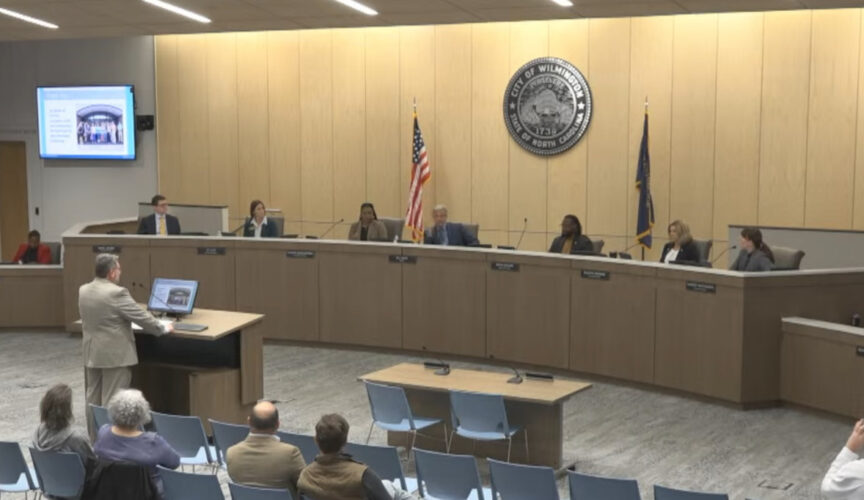
WILMINGTON — Four months after the vote, City of Wilmington staff have yet to identify a city-owned property for a homeless shelter, opting to seek a partner to run the shelter before deciding on a location.
Without a formal vote, Wilmington City Council heard recommendations to solicit proposals from lead partners willing to run an emergency shelter. It would be the first shelter with an “extremely low” barrier of entry, accepting people in active addiction or criminal histories. Director of Housing and Neighborhood Services Rachel Schuler said she imagined a 30- or 40-bed facility.
“Those folks would be able to understand the capacity to take on this no- to low-barrier shelter, coordinating services with resource providers and being able to apply their knowledge to an appropriate site location,” Schuler said at the meeting.
The recommendation was also for council and staff to discuss the location of the shelter as part of a larger facility needs discussion. The city has other plans in the works, including the Greater Downtown Plan and Northern Downtown Master Plan.
Schuler said there are several land use factors to consider, including whether a property would need a rezoning, whether the shelter would mesh with the neighborhood around it, proximity to other resources and transportation, and the point-in-time count, a federally-mandated survey of unhoused individuals in an area.
“Where are people already located? Instead of trying to drive people to some of these services, can we locate those services around where they are already existing?” Schuler said.
The city also plans to conduct a point-in-time count of its own at some point over the summer. The U.S. Housing and Urban Development count takes place every year on one of the last 10 days of January, though many providers have said this timing may not provide the most accurate count because of the cold weather pushing more people inside by whatever means necessary.
Schuler said the city would work with the Cape Fear Continuum of Care, the lead homelessness agency, on the summer PIT count. Because the count doesn’t need to adhere to HUD standards, the city can tailor survey questions and data collection to its needs.
The PIT count has shown a rise in unhoused individuals, from 322 people to more than 500 last year, in the wake of Hurricane Florence in 2018. The increasing population has strained current shelter space, with almost all levels of housing — emergency shelter, transitional units and permanent supportive housing — with very few vacancies as market-rate units become more and more expensive.
Schuler noted several more offerings have opened since the last count or are opening soon, including The Sparrow’s 32 permanent supportive housing beds run by Good Shepherd and The Salvation Army’s Center of Hope, with 75 emergency beds.
“All this to say is that people are moving through this ecosystem a little bit differently than they were a year ago, and will continue to move through it differently,” Schuler said. “Will these permanent supportive housing may free up beds in some of the shelters?”
She also noted the financial terrain is shifting, specifically pointing to HUD. Under the Trump administration, the long-observed “Housing First” model of connecting individuals with permanent supportive housing regardless of other needs has been minimized in favor of “Treatment First” models. HUD has limited permanent housing to 30% of homelessness grants.
Even more recently, HUD withdrew its previously posted Notice of Funding Opportunity amid two lawsuits over changes made to it. The NOFO is what local agencies use to apply for and distribute federal money. While HUD has stated its plan to revise and reissue the NOFO, the timeline and scope of changes are still unclear, putting in jeopardy federally-funded projects across the country.
“At the local level, we continue to move forward with planning, coordination, and preparation so that our providers are ready once the revised NOFO is released,” CoC Homeless Service Director Andrea Stough told Port City Daily. “While the withdrawal introduces some uncertainty, it does not yet impact services currently being delivered, and funded agencies have continued operating without interruption.”
The homeless shelter initiative was voted on at the council’s Sept. 10 meeting. The shelter, along with the directive to hire four social workers to service homeless individuals from within the Wilmington Police Department, was paired with the controversial anti-camping ordinance. The move expanded on the city’s ordinances around camping, loitering and occupying public space.
At Tuesday’s meeting, council member Salette Andrews asked for a status update on the social worker component.
“We’re in the process of still conducting interviews,” WPD Chief Ryan Zuidema said. “I know several of those have been done. We’ve not yet hired any of them. Once the interviews are done, there’ll be a background investigation they obviously have to go through.”
He added he hoped to have them brought on in the next couple months, but said it was dependent on the background investigation’s timeline.
Council member Kevin Spears asked the chief if he’s noticed a calming in problematic homeless activity downtown since the passage of the anti-camping ordinance.
“I wouldn’t say that there’s been an influx in enforcement of that or anything different than what we’ve traditionally seen,” Zuidema said, adding he didn’t have the numbers on hand but could get them to council.
After the homelessness conversation, council also discussed, and ultimately approved, the revival of the Workforce Housing Advisory Committee. New Hanover County pulled out of the joint venture last summer. Mayor Bill Saffo noted he was still holding out hope the county would rejoin the committee.
“I’m not going to let them off the hook either because I think it’s important that we continue to have dialogue, whether they’re with us today or not, but somewhere in the future,” he said.
For now, the city is moving on. The committee has a new name — the Wilmington Housing Affordability Committee — and new membership, the latter at the behest of council member Spears.
“The membership here is just a little too high level for me, for my liking,” Spears said.
He suggested membership include everyday people, particularly ones living in affordable housing. Ultimately, the council agreed to add two seats to the committee for that purpose.
The makeup includes one member each representing:
- Cape Fear Realtors Association
- Developer of affordable housing units in the region
- Wilmington Cape Fear Homebuilders Association
- Cape Fear Housing Coalition
- Wilmington Chamber of Commerce
- Wilmington Housing Authority
- Nonprofit organization that provides housing services to the housing insecure population
- Resident of a designated affordable housing unit
- Commercial lender, preferably one who specializes in affordable housing
The bylaws state the body will meet quarterly.
Tips or comments? Reach out to journalist Brenna Flanagan here.
At Port City Daily, we aim to keep locals informed on top-of-mind news facing the tri-county region. To support our work and help us reach more people in 2026, please, consider helping one of two ways: Subscribe here or make a one-time contribution here.
We appreciate your ongoing support.
