


BRUNSWICK COUNTY — As housing affordability continues to constrain lower-income individuals, one local organization is hoping to expand its shelter operations to temporarily fill in a resource gap that helps domestic abuse survivors get back on their feet.
On Jan. 8, the Brunswick County Board of Adjustment is expected to hear a special use permit for Hope Harbor Home, a nonprofit organization that provides shelter and resources for domestic abuse survivors. The nonprofit is seeking to replace its current shelter with a new, 20-bed facility.
READ MORE: Domestic violence organization gets million-plus boost, helps cushion government funding loss
Nonprofit staff serve roughly 1,000 people a year, between crisis calls, shelter services, and other administrative resources. However, the organization is having a harder time transitioning guests into independent living because often survivors come in without savings or a stable income to secure housing. So, the nonprofit needs more beds.
“Starting a new life means figuring out how you’re going to be a single mom with two kids,” Hope Harbor executive director Karmen Custer said. “You have to find a job that pays for housing while they’re in school because you can’t afford childcare. There were a lot more opportunities to find an apartment for rent at $750 a month; now that’s far and few between. So clients are coming to the shelter with bigger needs, and they’re staying for longer periods of time.”
According to the North Carolina Housing Coalition, the average hourly wage needed to afford a fair market rental apartment in Brunswick County is $24.65 an hour; 51% of renters are considered cost-burdened in the county.
Since clients of Hope Harbor Home are often unable to afford housing, it means they need to stay at a shelter longer to build up reserves. Custer described having to refurbish old supply closets in the current shelter to accommodate more people.
“Sometimes that means calling on all of our interns for the day to kick their heels off and literally assembly-line paper towels, paper plates and toilet paper out of a supply closet, and blow up air mattresses so a client has a safe place to be for a couple of nights,” she said.
The current shelter was donated to the nonprofit in 1988 and consists of four bedrooms, a kitchen, supply closets, and an office for an on-site staff member. It was not intended to house the number of people that it does currently — around a dozen — because it was built to be a beach house with only four refurbished bedrooms.
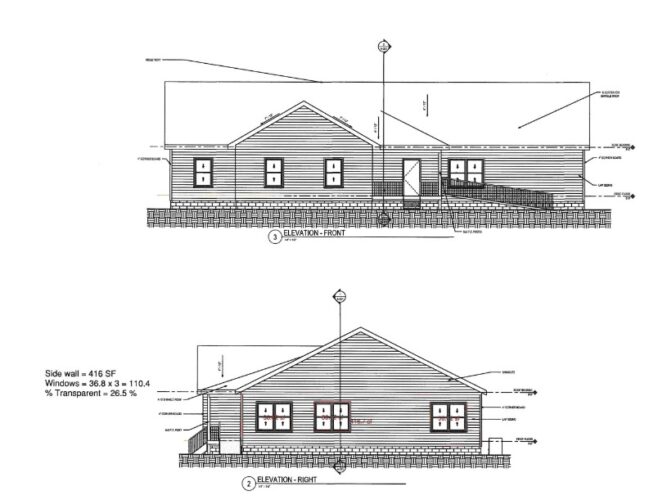
Aside from the current shelter being too small, the layout of the house is not conducive to some of the rules of the shelter, nor for mothers with young children. For instance, the kitchen and playroom are in close proximity in the new plans.
“We require that clients watch their children at all times,” Custer said. “It’s very hard to do that if you’re a single mom, and you’re cooking dinner. Your 3-year-old doesn’t want to sit in the kitchen and watch you cook. So our new shelter is going to have a half wall between the kitchen and the playroom. The kids can be playing and occupied and happy, and mom can be cooking dinner and watching them at the same time.”
Safety measures also will increase. Aside from security cameras and a privacy fence, the shelter will have more secure lighting and keycard access doors.
Over the course of 2025, the nonprofit housed 98 people in its shelter. It has grown significantly since it opened, first with the 501(c)(3) designation, and then the expansion of services to extend beyond just emergency shelter, to include counseling, legal aid, and the like.
Hope Harbor is the only domestic violence shelter in Brunswick County; though the county has a shelter for people undergoing addiction recovery. According to the Brunswick County Homeless Coalition, there is one interfaith sheltering program and one transitional housing option in the county, called Brunswick County Streetreach and Gateway Landing respectively.
Hope Harbor ‘s undisclosed location — to protect survivors from living abusers — is home to its administrative office as well. Staff field crisis calls 24/7 and provide survivors of abuse necessary resources, such as legal assistance and counseling services.
The organization wants to build an entirely new shelter for its guests to be able to host upward of 20 people. There is no time limit for how long clients are permitted to stay in the shelter, as it is on a case-by-case basis, according to Custer, taking into account safety concerns.
Custer said the new shelter project has been in the works at least since she came into the role in 2019. The new building will be 3,200 square feet, single-story with a privacy fence and a playground for children. There will be six bedrooms, with one for overnight staff.
Its development will likely come in at more than $1 million. Construction alone is expected to be in the ballpark of $700,000, without consideration of demolition, including a storage building and the current facility, or furnishing the new shelter. There are plans to install a $20,000 to $30,000 security system.
The project will be funded partially by donations and sponsorships. The rest is financed, which Custer hopes to pay off through community grants.
“The only space right now that we are waiting to get confirmation on sponsorship is the playground, which is going to be $40,000 because it is ADA compliant and handicap-accessible,” Custer said.
America’s Home Place — a custom home-builder based in Leland — is spearheading development of the new shelter; the group has been close partners with Hope Harbor Home for more than two years now for charity events. The engineering firm on the project, RSC Engineering, will be presenting development plans to the board of adjustment on Thursday.
RSC engineer Cliff Braam and Custer estimated the new development would take more than a year to complete. Custer expects the contractor to break ground in the next three months, after necessary permits are obtained and the county’s technical review committee signs off.
The nonprofit has to go before the board of adjustment because the shelter was built prior to the creation of Brunswick County’s unified development ordinance. It didn’t need a special use permit before, but under the current commercial-low density zoning, one is required. C-LD zoning normally allows offices and retail spaces by-right, but emergency shelters require a special use permit, per UDO rules.
Once the new shelter is completed and the residents have moved into the new space, the current shelter, the beach cottage donated to Hope Harbor Home in the ’80s, will be demolished. The nonprofit will continue operating out of the old shelter in the meantime, to not pause services.
Custer hopes the new shelter will open within the first two months of 2027.
Have tips or suggestions for Emily Sawaked? Email [email protected]
At Port City Daily, we aim to keep locals informed on top-of-mind news facing the tri-county region. To support our work and help us reach more people in 2026, please, consider helping one of two ways: Subscribe here or make a one-time contribution here.
We appreciate your ongoing support.
