


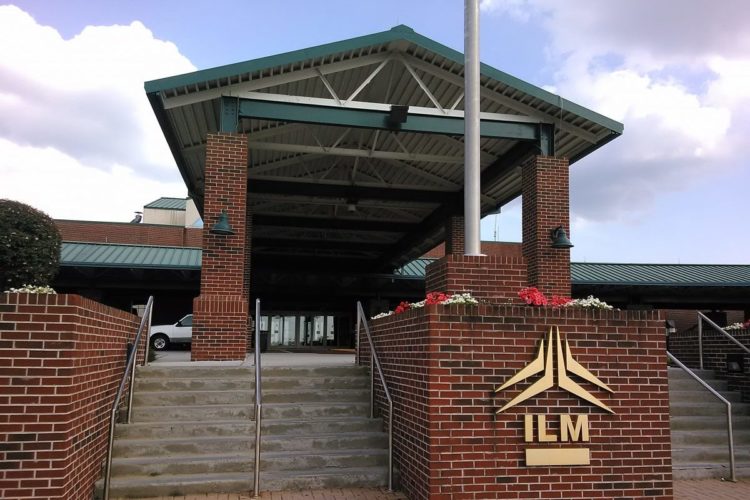
WILMINGTON — Wilmington International Airport is about one year into its Part 150 Noise Study and early results detail some neighborhoods and areas most affected by flight path sound.
“This is a voluntary process that we’re entering into to try to have a positive impact on the noise output from the airport,” Airport Director Jeffrey Bourk told Port City Daily Wednesday during a presentation on the study results so far. “What we know today is what that impact is under the federal law. Up until now, we haven’t known what that is.”
READ MORE: ILM noise study underway, residents concerned about its effectiveness at open house
ALSO: The sound of silence: Military flight noise complaints tanked at ILM following FAA and DOD memo
CATCH UP: ‘IT’S THE SOUND OF FREEDOM’: Here’s why military aircraft love Wilmington airspace
ILM was prompted to conduct the study after residents began complaining of significant aircraft noise — particularly from military flights refueling and landing at ILM during the Covid-19 pandemic. Some downtown residents and others around the Castle Hayne Road area, near the airport’s 23rd Street location, claim the noise rattled their windows and homes.
Though the military is exempt from FAA noise restrictions, a noise abatement memorandum of understanding was put into place between ILM and the military. Since, noise complaints have subsided.
But in 2023 ILM decided to do the roughly $1.2-million study — paid for primarily by the Federal Aviation Administration — which could take up to 24 months, with the goal to wrap by the end of summer 2026. The study will measure all aviation flying in and out of ILM to ensure it meets FAA standards.
Though the military will not be aiding the airport in the study, its aircraft operations are to be included in documentation and analysis. The airport will then hold discussions with the military to discuss a Noise Compatibility Program, the final step in the study and also the guideline for solutions that could mitigate noise exposure.
So far, the study — conducted by Coffman & Associates — found while military aircrafts made the most noise generally, it only included around 11% of operations at ILM, compared to the roughly 40% commercial and 50% general aviation. These include corporate and private aircrafts, single-engine training, and the like, according to Bourk.
Specifically, 14 parcels, on almost 50 acres — including residences and one place of worship — were found to fall outside the permitted threshold, per FAA guidelines. Some of the properties, Coffman and Associates’ Kory Lewis said, were north of Blue Clay Road, three were to the north by N. Kerr Avenue, and one fell east of runway 6-24 by N. Kerr Avenue.
The threshold for the noise starts at 65 decibels DNL, or day-night levels, noise contour. DNL is determined by a formula, with the resulting number measuring how much of a disturbance is caused by the aircrafts taking off and landing at the airport. Anything that falls under 65 DNL — which are most of the surrounding residences — isn’t considered to be impacted.
What this means: The airport is not under an obligation from the FAA to reduce noises for those neighborhoods and zones.
Coffman & Associates are mapping noise exposure levels at night and during the day, so over a 24-hour period. Also considered in the computing are land use patterns and whether flight paths move over zoning for commercial or residential properties.
For example, commercial zones have a threshold of 70 decibels DNL. Flights over commercially-zoned land fell under the threshold, making them unaffected by the flight path sounds per the FAA.
The mapping done by the airport and Coffman is only one piece of the Part 150 Study, which follows the Title 14 Code of Federal Regulations (CFR) Part 150. It was created to regulate and map noise compatibility in relation to “noise sensitive” places, which also includes schools and hospitals. Both were found not to be impacted in ILM’s study.
While Part 150 has recorded decibel levels so far for 2024-2025, it also will continue tracking them for the next five years to account for operational growth at ILM. Coffman & Associates tracked flight operations until 2028 to see what parcels may fall into high exposure noise contours.
“ILM’s one of the fastest growing airports in the country,” Bourk said. “We’ve got 65% growth in the last three years.”
Coffman & Associates have completed the first four chapters of the study so far, including inventory of operations and land, forecasts for operation and growth, what the noise is, and who is impacted. Part of the process was to hold public meetings, with the first taking place in May 2024.
Another meeting was held Wednesday evening. Around 20 people showed up, according to Lewis and Bourk, asking about noise abatement over their homes, though little usable feedback was offered, Bourk said.
“The main purpose of the meeting was to let everybody know where we are in the process,” he told Port City Daily. “It’s not that [feedback] is unimportant.”
The next step in the study is to figure out noise abatement alternatives — or reductions — and land use alternatives, which will prevent the development of future incompatible land uses, like noise-sensitive properties under residential zoning.
Then a Technical Advisory Committee, put together for the study and made up of airport operations and land use experts, will determine the program’s feasibility. Final recommendations will allow for conception of a Noise Compatibility Program — an outline on how to reduce or prevent noise impacts on surrounding communities.
The Planning Advisory Committee, devised for this study as well and made up of airport operations, military personnel, FAA representatives, and members of the public, will review the plans for the program in spring of 2026 — hopefully by May. In all, a draft of the study and noise-impact solutions will be wrapped up by July.
Solutions could include changing flight paths or landing patterns, for instance.
“Some part of the community may say: ‘That’s great because you’re not going to be [flying over] me.’ It’s going to shift that noise to somebody else,” Lewis said of the possibility of changing flight and landing patterns. “So we need to balance that.”
The FAA has the final authority for approval of the plan; neither Bourk nor Lewis are sure how long that will take. They predicted being able to start real groundwork to adopt the Noise Compatibility Program by the end of 2026, though.
The next public meeting is scheduled for April 2026.
Have tips or suggestions for Emily Sawaked? Email [email protected]
At Port City Daily, we aim to keep locals informed on top-of-mind news facing the tri-county region. To support our work and help us reach more people in 2026, please, consider helping one of two ways: Subscribe here or make a one-time contribution here.
We appreciate your ongoing support.
