


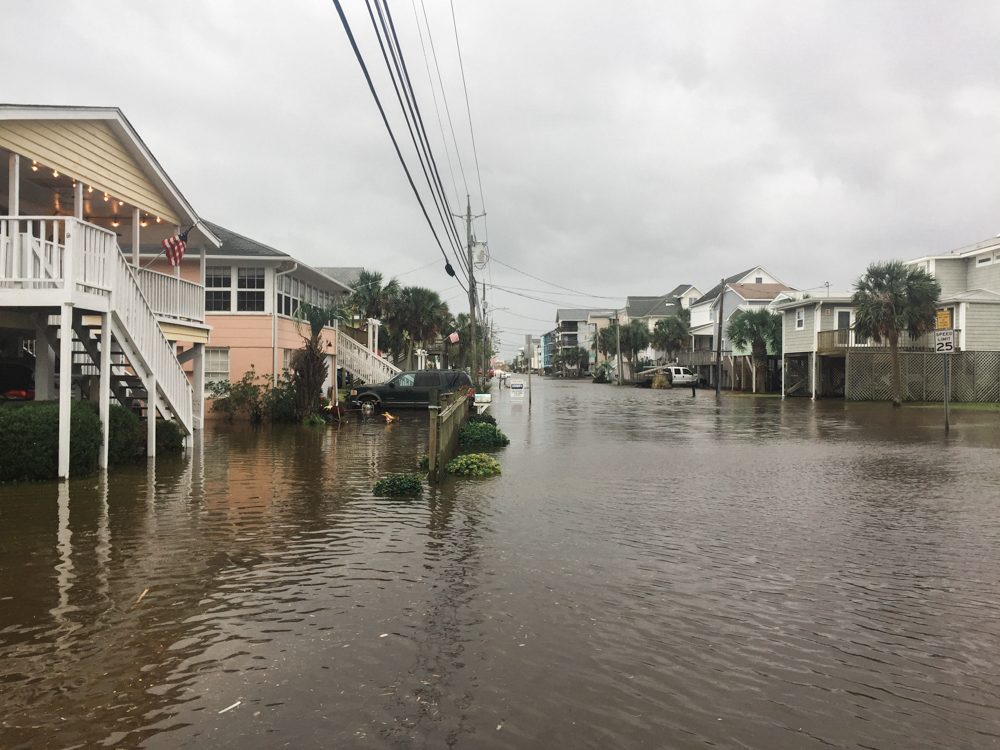
CAROLINA BEACH — A three-and-a-half-year Sunny Day Flooding Research Project from students and staff at N.C. State and the University of North Carolina Chapel Hill has wrapped. The academic results were presented to Carolina Beach Town Council on how to address water-rise issues that continue to plague Canal Drive, though in the end it was clear nothing is foolproof.
Katharine Anarde, a coastal engineer and assistant professor with N.C. State, was at Carolina Beach council’s Tuesday work session to present their findings and suggest mitigation paths forward.
“Our job, as research staff, was to do the modeling and also coordinate a workshop series,” Anarde said, which included area stakeholders and town residents. “And then we had two town staff, Jeremy [Hardison] and Daniel [Keating], who came and they listened to the resident perspectives and also our perspectives on floodplain mitigation.”
The project was conducted by multiple people including Anarde, Max Cawley (director of Climate Research and Engagement at the Museum of Life and Science), Miyuki Hino (associate professor at UNC) and Thomas Thelen (coastal engineering student at N.C. State) — all of whom were in attendance as well.
The team measured flooding over the course of a year in Carolina Beach by placing sensors in stormwater drains and flood hotspots. It determined flooding occurred 70 times, across 65 days, between May 1, 2023 and April 30, 2024. One-third of the events took place outside of high tide and few events included major storms.
However, during that timeframe, there were tropical storms Idalia and Odelia, as well as a nor’easter that came through the area; when extracting those storms, it would bring flooding to roughly 60 days.
On Tuesday, the study team shared more granular details about what flooding can look like in the next five, 15, 25, 45 and 75 years in the area.
“We know what’s going to happen in the next 10 years,” Hino said, noting it can be expected that sea level will rise by 3 inches by 2030 in the area. “And we know sea levels will continue to rise in the future. We just don’t know how much, how fast.”
According to the National Oceanic and Atmospheric Administration Sealevel Rise Viewer for Wilmington — and relative to 2020 levels — there could be a 7-inch increase by 2040, which, in a worst-case scenario, could rise to 12 inches by 2050 and 24 inches by 2070. In a best-case scenario, the team suspects 24 inches can be expected by the year 2100.
In addition to looking at expectations and frequency of flooding, it also assessed abatement efforts that could help recede floodwaters. The team put forth five strategies, culling ideas from public feedback. A survey conducted with 360 residents indicated 40% were impacted by flooding in the Pleasure Island beach town.
The team hosted four workshops altogether, held in June and November 2024, as well as February and May 2025. They modeled the strategies through computer simulation in order to show how their suggestions could help form policies and plans to course-correct flooding in the town’s future.
The team made it clear their goal was not to dictate which method to use or how long out the effects should be measured.
“Scientific evidence can and should inform decision-making,” Cawley said, “but in the end, solutions must align with local values.”
The group primarily addressed Canal Drive at the intersection of Florida Avenue, including effects of both tides and wind on saltwater and freshwater (rainfall) flooding. One mitigation effort included raising 85 bulkheads to a minimum 5 feet — which could cost the town around $4 million. More so, it found, while bulkheads work well against the tides and keep at bay saltwater from overtopping shorelines, it won’t help with rain, even slowing rainfall drainage.
More so, by the end of the century, 5-foot bulkheads would be underwater, the team’s model found.
Downfalls of utilizing this method also include intervening on private property in some instances. Carolina Beach cannot make property owners install bulkheads, as it would interfere with private property owner rights.
This was highlighted during conversation after the project results were presented and Community Development Director Jeremy Hardison presented what the town has done to date to calm flooding. He said Carolina Beach sent letters to many property owners on the north end of the island about how bulkheads help with prevention.
The town attempted to enter a contract with one property owner and offered to cover costs to install a bulkhead. Yet, the property owner wished instead to seek legal counsel rather than move forward.
“That’s a challenge we always deal with as a town,” council member Mike Hoffer said. “We have great ideas with the town, but one person can stand strong against it. It’s not new.”
The Sunny Day Flooding Study team also suggested installing 15 pumps along intersections of Canal Drive. That could cost around $8 million.
“Pumps reduce but don’t completely eliminate your present day saltwater and freshwater flooding,” Thelen said.
The pumps also won’t keep pace with deeper floodwaters or even higher sea levels, he added, mainly as they’re essentially “pumping down the ocean.”
Council member Joe Benson was concerned about the kind of pumps needed, explaining saltwater as brackish and can be hard on some equipment. Though Thelen said cities like Miami utilize stormwater pumps to handle saltwater.
Nearby Oak Island has a dune infiltration system, which cost the town $500,000. Surf City also has pump systems priced anywhere from $350,000 to $750,000.
Benson worried where the water would be discharged — whether into the dunes or under parking lots.
“We avoided the questions where to put water because it was a complex one,” Anarde said. “It’s just too big of a question for us to tackle. Volume of water was our focus and it’s a lot of water.”
As well, wherever the water goes could play into water-quality concerns if it filters back into the ocean, for example. More so, the pumps won’t necessarily drain water that isn’t immediately at an intersection.
A hybrid solution of combining pumps and bulkheads was also put forth. This would eliminate saltwater overtopping low shorelines and reduce flood duration and depth.
“You have a 27% better outcome with present-day sea levels than using pumps alone,” Thelen said.
The combined costs would top out at $12 million.
The team also suggested reconfiguring Canal Drive with a drainage canal. Though it could sacrifice half the roadway, the study team said it’s the most efficient way to move water more quickly.
But this could come with also having to re-envision traffic patterns, driveway connections, underground infrastructure and connecting back to the Yacht Basin with a sluice gate. The gate is a hydraulic structure that can help control the flow of water in open channels.
“It’s good at reducing flood durations by 30 or 40 percent,” Thelen said, though reduction in peak flood depths are minor.
The final and most costly suggestion was to install a flood barrier, which could price out on the low end at $15 million and the high end at $50 million. And this wouldn’t include maintenance costs, expected to be around $500,000 every 12 years.
The team compared it to the Modulo Sperimentale Elettromeccanico — translated to experimental electromechanical module — in Venice, Italy, which they visited for this study. The MOSE includes rows of mobile gates that can open and close to protect Venice and its lagoon from extreme tides, up to 10 feet.
Carolina Beach’s barrier would run from the boat ramp to the marina and cut off water flow from the Intracoastal Waterway to the Yacht Basin. The team said it would stay open most of the time for maritime traffic. But upon King Tides — which are high tides that coincide with a new or full moon — or storm events approaching, the barrier could close to keep ocean water away from the bay.
From a flooding standpoint, it eliminates saltwater flooding, though it’s minimal on freshwater effects. And it disrupts circulation and flushing in the Yacht Basin, which could affect water quality.
As well with sea level rise, the water held off from mitigation efforts eventually could find other ways to reach the island. For instance, water could enter further down the north end from Freeman Beach and marshes.
“Participants asked about lifespans and tradeoffs of these measures,” Anarde said, noting the constituents desired the town having a flood resilience strategy but also wanted to know how well the efforts would work into the future.
Cawley said there was no “silver bullet,” as nothing gives a 100% guarantee against flooding all the time, especially 75 years into the future. Though the barrier at the Intracoastal made a difference in the late-century, according to the team’s models.
The team found five-years from now, in 2030, flooding with pumps will slightly reduce water depth, though by mid-century it will have minimal impact.
“And what you do on the east side won’t affect the west side,” Cawley said.
Still, in the short term, the community told the study group they preferred minimum bulkhead elevation and/or pumps and in the long-term they would like to see a flood barrier, canal under Canal Drive and increased minimum bulkhead and pumps.
“We are not suggesting to what year you should plan to — that’s up to you,” Anarde said. “No single strategy fixes everything … Our project is here to support the town moving forward.”
Though thankful for the team’s insight and approach, a few council members felt the grim reality was a wake-up call.
“It is an eye-opener,” council member Jay Healy said. “It’s devastating. There really is no solution.”
“I think that’s one way to look at it,” Anarde said. “I heard someone ask: ‘But can we buy time with some strategies?’ So perhaps it’s futile to look toward the end of the century, but you may reposition it into a different timeline.”
“If we had to solve every town problem with a 100-year vision, we’re not going to solve many problems at all,” Mayor Lynn Barbee said. “There are so many unknowns, no matter what issue we’re talking about. This is helpful because it gets your brain thinking. … People are not looking for miracles, but what can we do to improve.”
Benson said the suggestions put forth are worthwhile to look into and suggested the town manager, Bruce Oakley, begin assessing costs of some projects.
“It’s our job now to do the right thing and accelerate action,” Benson said, noting the sensors placed by the team “almost always detected water,” indicating their location means the catch basins “are springloaded with water to begin with.”
The mayor mentioned elevating the roadbed of Canal Drive, which he said is insufficient. He inquired how the team thinks it may affect the area, to which Anarde replied raising the road but not adjacent yards would mean water will trap in certain areas.
“All those homes to the west of that road will be sitting in the sound, basically,” the mayor said.
Council member Hoffer also turned to the full house of constituents at Tuesday’s work session, asking if residents were prepared to throw complete support behind the costly initiatives.
“Are you really committed?” he asked. “It’s a $20 million job that won’t even solve anything. My little house in Carolina Beach, it would cost me personally anywhere from $120 to $300 a year depending on how we share that cost. Are there thoughts about the north end prepared to put in more? Or do we expect everyone to pay the same?”
Benson said the town’s stormwater and paving costs plan that was enacted in 2008 came with a one-third property owner and two-thirds town share when the municipality incorporated Wilmington Beach into town limits.
“I paid my last one on my mortgage statement,” Benson said. “$50 or $60 a month on a 15-year debt. There are different funding strategies we would have to be looking at.”
Benson pointed out Canal Drive also is the road that people take to reach Freeman Park, which generates revenue to the town, so he also found it the town’s duty to invest for public safety.
The Sunny Day Fooding Study team suggested other ideas for the town to consider, from having more permeable pavement and storm drains on Carolina Beach Avenue North and more infiltration areas on Canal Drive. It also suggested installing nature-based features and terraced living shorelines; this has often been hailed as an alternative to bulkheads. Some environmentalist have indicated bulkheads can exacerbate erosion by deflecting wave energy to other areas along the shoreline. Numerous beach towns have begun assessing living shorelines, including in Oak Island, which entered an MOU with UNCW recently to install two in its town.
Town efforts to address flooding
After the study team’s presentation, Carolina Beach’s community development director, Hardison, also presented to town leaders leeway it’s making with flood mitigation efforts. Staff has been focusing on infrastructure improvements to bulkheads currently, focusing on ones below 3-feet to bring them up to 5.
He said they reached out to numerous private properties along Canal Drive and Florida Avenue, and some have made improvements, either adding fill, tying a bulkhead into a neighbor’s property, or replacing bulkheads with higher ones. However, he also pointed out others, using timber or rock and rubble, that are still inadequate.
Healy wanted to know if the town had considered discussing with a realtor how bulkhead installation may increase the value of a property and utilize that to compel homeowners.
Hardison said no, but indicated one problem the town faces is not having clear standards and regulations on bulkhead height.
“We need legislation,” Barbee said. “We tried that, but it’s still sitting out there; it hasn’t moved. The town has to be authorized to enforce it and build them and charge residents, but all we can do is public shaming, which doesn’t seem like an effective way to get it done.”
The town also could attempt eminent domain if it was filed in the threshold of public safety, but Barbee said they didn’t have the money to pursue as much with 85 properties.
The town has been making progress in varied ways, building new bulkheads on several street ends and using the 5-foot standard height. Those streets include Scallop, Seagull and Starfish and at the town marina. Some of those costs amount to $575,000.
The town also replaced backflow valves at the marina and Starfish Lane, costing more than $100,000.
It’s also continuing with routine maintenance including tidal traffic control upgrades ($60,000), vactoring stormwater pipes ($40,000), street sweeping Canal Drive ($50,000) and maintaining high tide traffic control staff, in place to deter people from driving through standing water ($30,000).
Hardison said the town has applied for a North Carolina Department of Environmental Quality Resilient Coastal Communities Program grant as well.
Want to read more from PCD? Subscribe now and then sign up for our morning newsletter, Wilmington Wire, and get the headlines delivered to your inbox every morning.
