


LELAND — More consideration is being made on an ordinance intended to strengthen protections for homes built in a floodplain in one Brunswick County town.
READ MORE: Leland planning board backs new flood development rules, now primed for final vote
ALSO: Prohibiting new residences in flood zones? Leland addresses potential ordinance changes
After Town of Leland council members heard from area constituents regarding a change to chapter 26 of its town ordinance, they tabled moving it forward, for now, motioned by Bob Campbell and seconded by Richard Holloman on Thursday evening. It passed 3-2 with Bill McHugh and Veronica Carter dissenting.
The flood damage prevention ordinance proposes:
- Restricting fill to raise a property out of the flood zone
- Expanding restrictions not just to cover a 100-year flood zone but a 500-year
- Reducing density of flood zones to 2 units per acre
- Requiring an additional 2 feet — going from 2 to 4 feet — of elevation
Had the ordinance passed — as unanimously suggested by Leland planning board recently — it would have gone into effect immediately; however, it would not impact homes already built. Though if the structures faced significant damage in the future, homeowners would have to rebuild to the town’s new parameters.
McHugh told Port City Daily the council received a significant amount of calls and emails from the community, both in favor of passing it and many from the development community against the ordinance changes.
According to a letter sent from the Business Alliance for a Sound Economy — a nonprofit advocating for business industries in the region — the ordinance falls short of “sound policymaking.”
“While billed as flood damage prevention, the text amendments would do virtually nothing to reduce the impact of flooding while causing serious harm to hundreds of home and property owners by limiting their ability to improve their homes and property, undermining their property values, and imposing major new costs to home ownership in Leland,” it noted.
The letter indicated changes would cause harm specifically by:
- Creating potentially hundreds of nonconforming homes that no longer meet the elevation standard when raising floodplain regulations
- Severely limiting homeowners’ ability to improve their homes
- Making homes harder to sell and impair property values, due to restrictive covenants when it comes to home improvements
- Impacting insurance complications
“Were one of them to be significantly or completely destroyed for any reason, the homeowner would be personally responsible for the major added expense of elevating the home to the new standard,” the BASE letter indicates.
McHugh said part of the council’s goal with the ordinance was to “protect insurability in the region.”
“But it’s not just the insurability, it’s the safety issue, it’s an environmental issue — it’s just all common sense,” he said.
BASE pointed to the ordinance lacking scientific backing for best practices. Not allowing structural fill, it noted, goes against widely utilized development practices to prevent flooding.
The ordinance proposes a ban on raising land in flood zones for the purpose of building structures. However, it would still allow fill to take place for nonresidential construction, including flood control and stormwater management structures and roads.
BASE indicated this could impede crawlspaces, impact moisture mitigation, as well as insulation. Living in an area with high humidity means it could result in costlier long-term maintenance, potentially in the “five-figure” range if crawlspaces had to be elevated.
Representing eight associations with 9,400 collective members and 65 businesses, BASE also said increasing the freeboard elevation standard from 2 to 4 feet could be a detriment to homeowners with mobility issues.
McHugh confirmed a BASE representative was among many in attendance from the development and real estate community at Thursday’s meeting. No one who took the mic during public comment was in favor of the ordinance changes, with many stating stricter regulations could increase home costs and impact needed workforce housing.
“My biggest fear with all of this, is this idea that, as we continue to grow and the high quality of the developable land is built into high-end homes, eventually they’re going to start wedging these so-called affordable housing and these undesirable flood zone lots will suddenly become more valuable as everything fills in,” McHugh said. “So I want to get ahead of that. I don’t want people to have to choose between renting or purchasing in an area where they’re likely to lose everything and then suddenly being saddled with flood insurance or getting a developer backed loan that doesn’t require it, and all of a sudden … their home floods and they’re on the hook. What do they do? File for bankruptcy and then they lose everything.”
In attendance was Cameron Moore, Wilmington-Cape Fear Homebuilders Association executive director and a planning board member in New Hanover County. He is against the measures put forward by the Leland Town Council.
“Basically, 25% of the regulatory burden that is placed on a house could cost someone another $1,000 to $1,500 a year on their mortgage,” Moore told PCD, referring to the National Association of Home Builders’ data.
Moore added that going from a 2- to 4-foot elevation was “widely extreme,” noting Leland already has a plus-two elevation, paralleling other municipalities in the coastal region. Beach towns are primarily the ones to enforce stricter measures.
“North Topsail is a plus-four — which is a barrier island and actually has CBRA zones,” Moore said, referring to the Coastal Barrier Resources Act, which federally protects certain areas. “It is the only one we know of that actually has a plus-four as the regulatory reference level.”
He said if a plus-four elevation went into effect, it could, by proxy, put other homes in non-conforming use with the town code. Moore believes this would create financial disadvantages in selling a property, which could be viewed as a risky investment with lenders hesitating to issue loans. Insurance companies also could take notice, something the Wilmington-Cape Fear Homebuilders Association believes unfairly penalizes property owners.
The homebuilders association sent a letter to town council as well and indicated more than 280 current residential properties would be affected if the ordinance passed — including in Brunswick Forest, Magnolia Greens, Stoney Creek/Snee Farm, Terrapin and along Sturgeon Creek run. However, the association believed it could actually affect more homes.
Moore cited concerns with Leland staff’s lack of outreach to the potentially affected property owners. He maintained notification of the ordinance changes should have come with a mailed letter and more transparency.
“That’s proper notification of something of this magnitude: changing somebody’s land use,” Moore said. “They’ve done a disservice to the community.”
More so, Moore and BASE suspect that bringing forth the ordinance changes could open up the town to legal challenges, calling it an “across-the-board downzone.” S.B. 382 passed last year and limited local governments’ ability to pursue downzoning regulations. The Wilmington-Cape Fear Homebuilders Association noted in its correspondence to the town that FEMA doesn’t have base-level elevations in 500-year flood zones, nor is there a density cap.
Both associations believe the flood ordinance changes could lead to costly litigation on the taxpayers’ dime.
Regardless, McHugh maintained: “I think we are well within our rights to pass something like this.”
Staff told the planning board last month in its research, it found the law didn’t apply to the flood prevention ordinance. Still, McHugh recognized the need to work with area stakeholders and maintain relationships.
McHugh first brought forth the idea to make changes to the town’s ordinance last fall, two months after an unnamed storm overwhelmed Brunswick County with flooding. His goal was to ensure Leland develops with resilience in mind for its growing population.
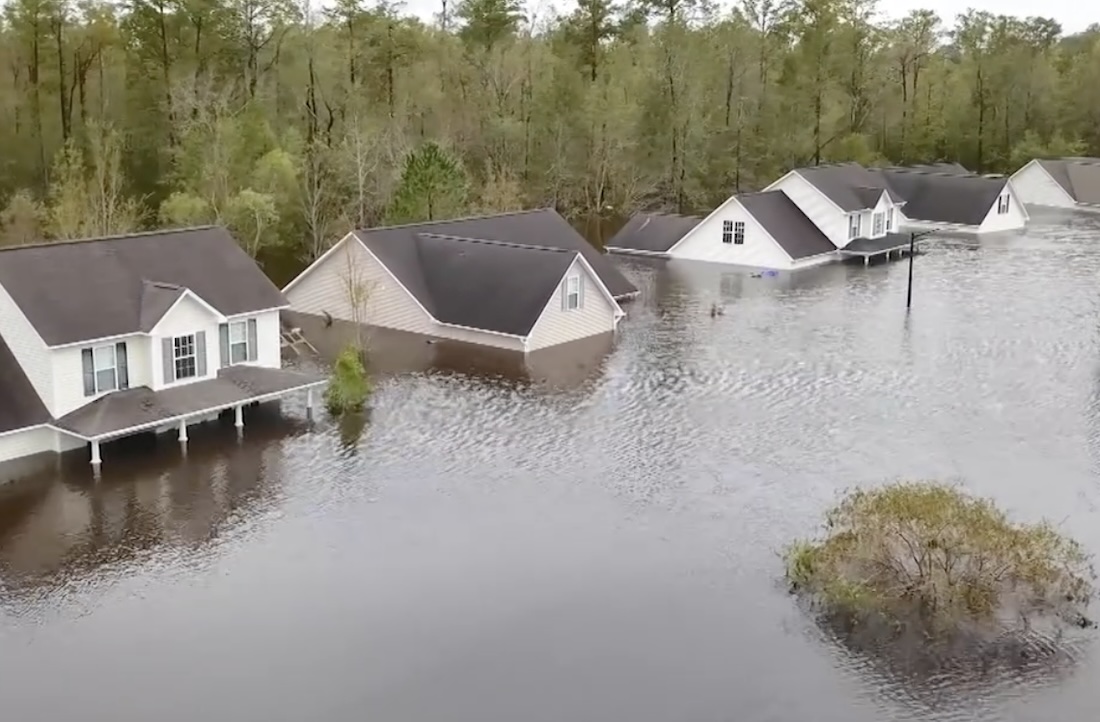
The town’s Stoney Creek development off Hazel Branch Road has flooded multiple times in the last few years, including during September 2024’s Potential Tropical Cyclone #8. Port City Daily reported at least 19 homes were damaged and around 27 residents were rescued by Leland and New Hanover County fire and rescue teams after they were left stranded as floodwaters rose to window height.
Currently, half a dozen of the homes are being bought with FEMA mitigation funds, according to McHugh.
Moore called the current ordinance change reactionary to this flooding event. Though empathetic to the homeowners who endured damage, he didn’t think the proposed changes would mitigate future flooding issues in those areas.
“Those homes were built to code, but they were also built 25, 30 years ago — and maybe the flood maps at the time weren’t the best, maybe the data wasn’t the best, but, nonetheless, they were constructed to code by local, state, and federal regulations,” Moore said.
He agreed Leland’s best course of action to deal with Stoney Creek and Snee Farm was to buy out properties through the FEMA mitigation money — “but passing new regulation of this extent does not help any of those people, those residents.”
When asked if he thought the ordinance changes could help with future developments and flood mitigation, Moore added new homes, such as in Brunswick Forest or Magnolia Greens, don’t experience the same extreme flooding, due to better stormwater controls now in place. A 2018 flood report found Magnolia Greens and Parkview in Brunswick Forest did face stormwater and retention pond issues.
Moore said the developers today are building to state standards for a 100-year storm, which accounts for 14 inches of rain according to the National Oceanic and Atmospheric Administration gauge.
PTC8 was a one-in-1,000-year event, dropping 20 inches of rain in a 24-hour window in some southeastern North Carolina areas.
However, McHugh pinpointed a study from UNC and Advancing Earth and Space Sciences determining that flood events are more commonplace throughout the state of North Carolina today. The study assessed 78 floods from 1996 to 2020 and found more than 90,000 buildings flooded during at least one event. Roughly 43% of them were located outside of FEMA’s designated 100-year floodplains, with 23% flooding more than once.
In Leland, there are currently 3,571 acres in the 100-year flood zone and 279 acres in a 500-year floodplain, according to staff.
“When you tell somebody they live in a 500-year flood zone, they just kind of roll the dice and go, ‘Yeah, well, it’s once every 500 years,’ and it’s like, ‘No, it actually means you have two-tenths of a percent every year of it flooding,’” McHugh said. “We put our first responders at risk when they’re responding to these floods, we put the cost in the affordability of homeowners’ insurance, flood insurance at risk when we continue to build in high-risk areas.”
Though the council tabled the ordinance, Veronica Carter amended the motion to bring it back next month for further discussion. McHugh imagines they will work to make changes, but said he still supported acting with “bold action and bold leadership.”
“So much of what local governments do is negotiation because we just don’t have the teeth to say: ‘No, you’re gonna build this,’ and developers say: ‘OK, we’ll just go build in the county,’” McHugh said. “The next thing we know, we’ve got a huge development, smack in the middle of Leland’s corporate limits that uses our services but doesn’t pay our taxes.”
No other Leland council member responded to Port City Daily’s request for comment.
Want to read more from PCD? Subscribe now and then sign up for our morning newsletter, Wilmington Wire, and get the headlines delivered to your inbox every morning.
