


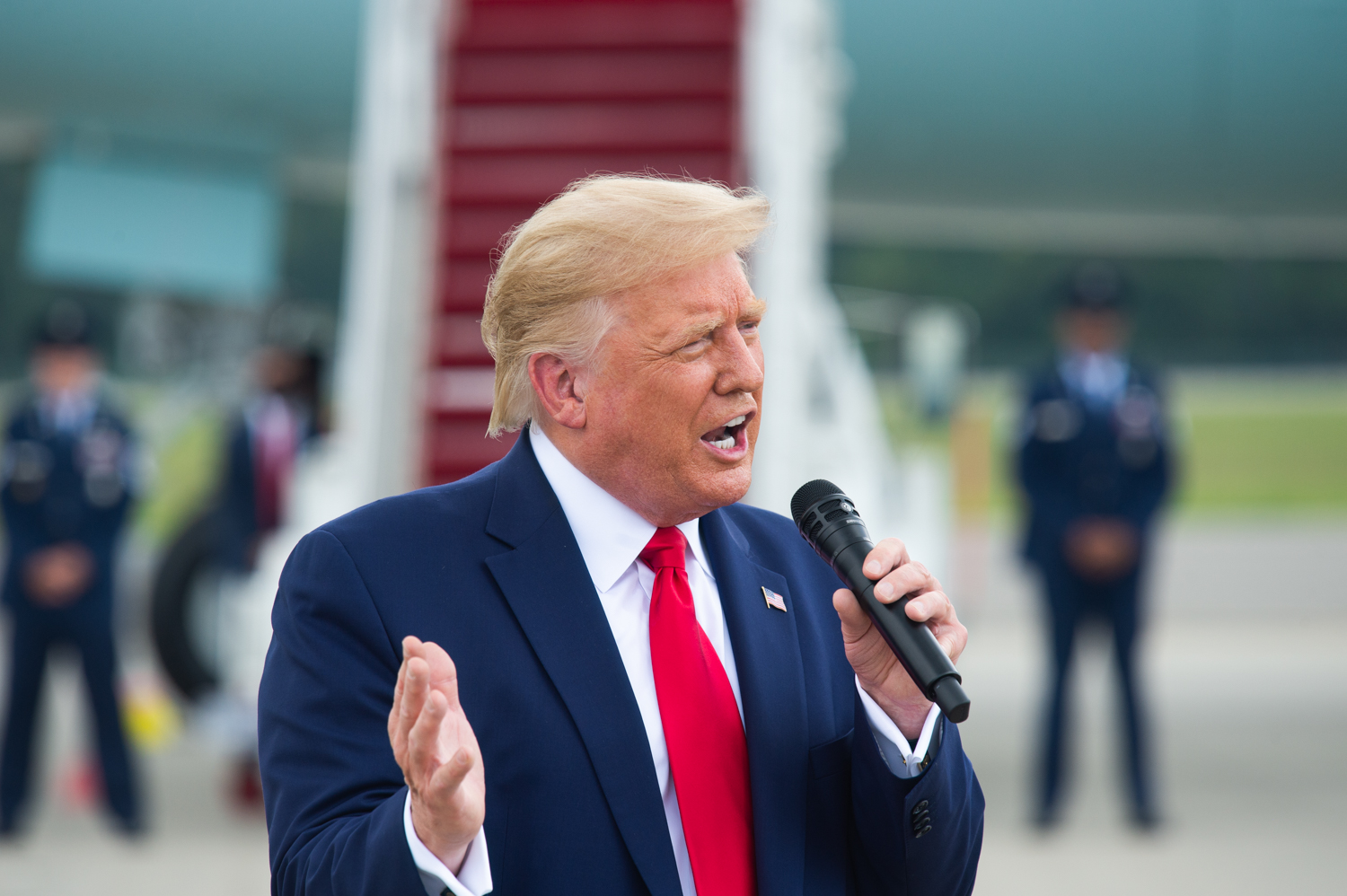
NORTH CAROLINA — The state board of elections has officially approved the list of presidential candidates to appear on the primary ballot in March and to the dismay of at least one North Carolina voter, it does include Donald Trump.
READ MORE: Here is who filed for the 2024 elections
Sandy Ridge resident and former federal attorney Brian Martin, submitted to the state board a challenge for Donald Trump to be dropped from consideration. The board voted 4-1 on Tuesday to deny the request citing it did not have the jurisdiction.
In Martin’s challenge, he said Trump is not qualified as a presidential candidate due to his instigation of and involvement in the Jan. 6, 2021 insurrection. The incident resulted in four deaths and 100 police officers injured. Martin maintains Trump’s inclusion as a presidential nominee violated Section 3 of the 14th Amendment.
“Section 3 is pro-democratic,” Martin wrote in his submission. “It ensures that persons who have violated their oaths of office and have engaged in an insurrection can no longer be trusted with any office.”
The 14th Amendment was originally written to prevent officials who left to join the Confederacy during the Civil War from holding offices of power within the U.S. government after the war. The language centralizes around “the oath of office,” in an attempt to keep anyone who has broken the oath from being seated again.
“Congressional debates surrounding Section 3 make it clear it was intended not as a punishment for crime but to add an additional qualification for public office,” Martin’s challenge states.
He provided a 24-page explanation of how Trump violated the Constitution by encouraging his supporters to “fight” what he believed was a “stolen” election and storm the Capitol.
The state board has a statutory obligation to set a date and time of a hearing for any submitted challenges within five days of receiving the document. Martin’s was received Dec. 18.
However, NCSBOE counsel Paul Cox said state statute does not address challenges for presidential primary candidates, since they do not “file a notice of candidacy.” The political parties decide which names to submit, as opposed to every other position in an election where individuals submit their intention to seek office by a certain deadline.
“There’s no doubt in anyone’s mind that Donald Trump is putting himself forward as a candidate for president,” board member Siobhan Millen said. “So, I’d say, one could argue, we’ve received notice.”
While there is no case law precedent for this instance, board member Stacy Eggers IV pointed to the Minnesota Supreme Court decision from last month. Minnesota Secretary of State Steve Simon petitioned the courts to have Trump disqualified from holding office as president. The courts ruled there is no statute prohibiting a major political party from placing a presidential nomination on the primary ballot who is ineligible to hold office.
Though on Tuesday, the same day as the North Carolina State Board’s decision to keep Trump on the ballot, the state Supreme Court of Colorado upheld a similar challenge, banning Trump from appearing on its 2024 primary election ballot.
In reaction to Martin’s challenge and Colorado’s ruling, State House Speaker Tim Moore told the News & Observer Wednesday he wants to pass a new law banning the State Board of Elections from being able to disqualify any candidates for office.
Since the presidential primary differs from any other primary, in that the parties have the ultimate say in naming their candidate for the general election, challenging a nominee for the primary is not allowed in North Carolina.
Taking it one step farther than Moore, U.S. Sen. Thom Tillis said he’d also file legislation stripping federal elections funding from any state that cites the 14th Amendment as a reason to ban Trump, or any other nominee, from the ballot.
“Our authority is uncertain to hear this challenge?” state board member Kevin Lewis asked at the BOE meeting.
Cox responded since the law isn’t clear, the board must decide whether it has the jurisdiction to act.
“It’s troubling to me,” Millen said at the BOE meeting. “We have a voter who went through the trouble to fill out a facially very impressive challenge form and we’re hiding behind a technicality by saying it doesn’t apply — that we won’t even hear it.”
The board ultimately moved to deny the challenge due to a lack of jurisdiction, with Millen dissenting.
Martin can appeal his challenge to the superior court or court of appeals; he told Port City Daily he is considering his options, but did not elaborate further.
By state statute 163-213.4, the board is required to accept the names provided by political parties to appear on the primary ballot. Primary elections in North Carolina are slated to take place March 5.
North Carolina recognizes five political parties — Green, Libertarian, Republican, Democratic and No Labels. It does not formally recognize Independent or Third Party candidates, though Jill Stein, Robert F. Kennedy and Cornel West are running.
Parties had until Dec. 6 to submit chosen nominees. The North Carolina Republican Party submitted the following candidates:
- Ryan Binkley
- Chris Christie
- Ron DeSantis
- Nikki Haley
- Asa Hutchinson
- Vivek Ramaswamy
- Donald J. Trump
The Green Party chose not to submit presidential candidates. North Carolina Party Chair Wayne Turner told Port City Daily the national Green Party has an approval process setting benchmarks for candidates that support their ability to run. Since none had met the requirements by Dec. 6, no one could be officially recognized by the national party at that time.
The No Labels Party won’t appear on the primary ballot either and has not yet floated a presidential candidate.
In August, the state board voted to recognize No Labels as an official party in North Carolina; however, it can’t participate in the primaries this year.
“Under our state law, during the first general election a new political party is recognized, they do not participate in the primaries,” Cox explained during Tuesday’s meeting. “They nominate only through the nominating convention.”
Political parties use the voter count from the primaries to allocate delegates to the convention. North Carolina has the ninth largest delegation in the nation, with 130 voting members. All but 14 will be pledged to a candidate.
The No Labels Party, formed in 2010, received 14,837 valid signatures from registered state voters, over 900 more than what’s required, to petition to become a recognized party.
The North Carolina Democratic Party submitted only one name for the primary ballot: current President Joseph Biden.
Also in the running are Minnesota Rep. Dean Phillips and self-help author Marianne Williamson, but they will not appear on North Carolina’s primary ballot. North Carolina Democratic Party Chair Amderson Clayton did not respond to Port City Daily’s inquiry as to why it only chose to nominate Biden.
Though Democratic Party spokesperson Tommy Mattocks told WRAL this week it’s because Phillips and Williamson have not campaigned in North Carolina or raised any money from state donors.
Discussion also arose among board members about how candidates are referred to on the ballots. It began after assessing the North Carolina Libertarian candidates:
- Joshua Anderson (Toad)
- Josuha Smith
- David Dunlap (David TrimeTaveler Dunlap)
- Charles Ballay
- Mike ter Maat
- Chase Oliver
- Jacob Hornberger
- Michael Rectenwald
- Lars Mapstead
- Beau Lindsey
Eggers questioned Anderson particularly, who wishes to appear on the ballot merely as “Toad.”
“As someone who goes by an unusual nickname, I’m certainly respectful of that,” Eggers said (according to WRAL, he goes by the nickname “Four”). “However, I believe it’s always been our practice to have a last name and perhaps even a nickname affidavit if they wish for a nickname to appear on the ballot.”
Cox mentioned if the board were to ask for an affidavit from Anderson, it would have to also ask candidates such as Republican Nikki Haley, whose first name is Nimarata, to do the same. Board chair Alan Hirsch pointed out Haley is well known as “Nikki,” who has held office as the former governor of South Carolina and served as ambassador to the U.N.
“We’re required to approve the names submitted by the political parties, but I don’t see anything saying which name we should put on,” Hirsch said.
The board approved moving forward with names as candidates wished to have them appear on the ballot, with the exception of requiring a last name for anyone who only wished to list a nickname.
Therefore, John “Toad” Anderson will appear on the ballot as Toad Anderson.
The state board will have to meet again Jan. 2 to confirm its list of primary candidates. By state statute, the board is required to meet by the deadline to consider any candidates who may have submitted a petition with required signatures, requesting to be added to the ballot.
“I’m not aware of anyone submitting one, but under law we have to recognize that possibly could come between now and Jan. 2,” Cox said.
Tips or comments? Email [email protected].
Want to read more from PCD? Subscribe now and then sign up for our morning newsletter, Wilmington Wire, and get the headlines delivered to your inbox every morning.
