


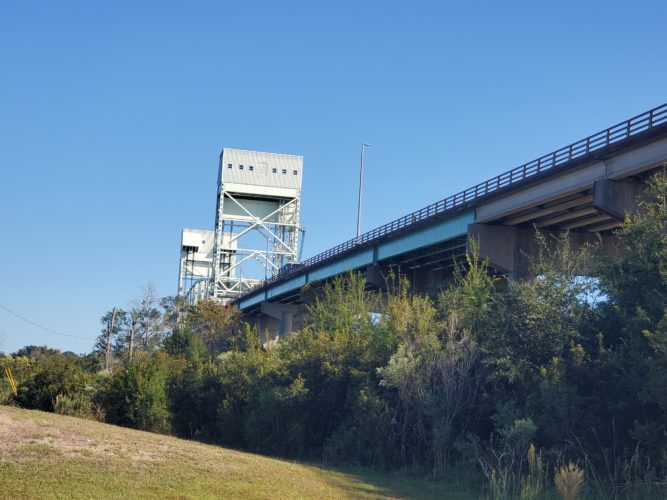
WILMINGTON — The City of Wilmington exhibited three alternatives to the replacement of the Cape Fear Memorial Bridge Tuesday. Its staff argued the project team, including NCDOT and federal agencies, has failed to fully evaluate the two bridge designs currently in contention and moving forward with either one could result in the loss of millions of dollars.
The Wilmington City Council unanimously approved a 52-page document with comments on the bridge replacement to be submitted to the North Carolina Department of Transportation. NCDOT is taking feedback on the environmental assessment of its 65-foot and 135-foot options until Oct. 15.
The completed report includes an assessment on three options that are either cheaper or, in the city’s view, less impactful to downtown Wilmington than the ones under consideration by NCDOT. The first option is a bascule bridge, the second is a twin bridge constructed beside the CFMB; the last option is the long-discussed Cape Fear Crossing.
READ MORE: As NCDOT weighs Cape Fear bridge designs, locals ask: Is there another way?
ALSO: Wilmington hiring consultant to find less costly, impactful CF Memorial Bridge options
However, NCDOT is only considering currently the 65-foot movable span bridge, which can open to 135 feet, while the135-foot bridge would be fixed. Both would be six lanes and a multi-use path to accommodate NCDOT’s projected traffic increases, expected to be nearly 100,000 by 2050.
A new structure is needed, also according to NCDOT, because the 57-year-old bridge’s parts are becoming obsolete, making it very costly to maintain. The agency says it spends an average $500,000 annually in repairs now.
Though the 135-foot fixed bridge will have greater impact the city contends both options have their detriments to downtown Wilmington. Additionally, both cost more than $1 billion, and though the project has $327 million in funding from the state and federal government, the remainder of the price tag is currently on track to be funded by taxpayers, with tolls.
Complicating matters further, the NCDOT is on a time crunch for selecting a design option, as the $242 million in federal funds are to be obligated by September 2027. If the WMPO wanted to rescind the project because it does not want it to be tolled, it would need to make this decision by spring 2027.
Just last month, council voted to hire a consultant to provide feedback on the two bridge designs under NCDOT consideration and search for other options — all in time to meet NCDOT’s public input deadline.
“We should not be backed into rushing a generational infrastructure decision simply because of the timeline associated with a federal grant, particularly when that grant would not even fund a quarter of either of the designs as currently proposed by NCDOT,” LaCaria said Tuesday.
The city hired two firms: KCA to provide input on the bridge structure and traffic disruptions, along with HR&A Advisors to study economic impacts. The representatives from KCA have experience conducting inspections and engineering work on the Cape Fear Memorial Bridge, in addition to high-level and award-winning work from both firms.
“This was not amateur hour,” LaCaria said.
During Tuesday’s presentation of their findings, they noted the first alternative is the building of a bascule bridge, similar to the Isabel Holmes Bridge upriver. Under the consultant’s scenario, the bridge would be 65 feet and open to 135 feet, though it would need to be built across a 200-foot-wide channel to remain cost-effective.
The U.S. Coast Guard currently mandates a channel width of 400 feet at the Cape Fear Memorial Bridge, thus the channel width would need to be reduced to accommodate this type of bridge.
Justin Carter, the city’s director of design and construction, said there is already an on-record willingness from the agency to reduce the channel width. He pointed to a 2022 Coast Guard memo issued for a rail bridge project considered in 2022, included in the city’s submittals to NCDOT.
“They’re looking at a bridge right next to the Cape Fear Memorial Bridge, and they state that 250 feet [in width] would not cause an obstruction,” Carter said. “So what we make with that statement is saying the precedent has been set that the Coast Guard has gone under that 400 foot authorization for a rail bridge. Why are we not doing that here?
Carter also noted a bascule bridge would have reduced maintenance costs compared to a lift bridge, which is what the current CFMB structure is. The consultants have estimated a four-lane bridge to be $540 million and a six-lane at $780 million.
The second option is two lift bridges side-by-side — keeping and repairing the existing CFMB and building another bridge to the south of it with the same number of lanes. Carter explained one bridge would be dedicated to outbound traffic and the other inbound.
The continued utilization of the CFMB would, in the consultants’ estimation, bring down the cost of the replacement project; it estimates the cost of doing this to be $585 million, $125 million being the replacement of the lift portion of the CFMB.
“That is a huge cost difference in what we can do,” Carter said. “We understand that there would be increased maintenance costs there. We would have two lift bridges instead of one, that could drive maintenance costs — but does that cost outweigh what the future maintenance could be?”
Carter claimed NCDOT could just replace the lift portion as a standalone project, and though this would be more than $125 million, the cost would fall under the $242-million grant from the federal government.
However, this could be considered a rescoping of the project, triggering some clawback measures recently put into state law, while the repair and new bridge construction would fall under the project’s current scope, Carter said. It would also raise questions on whether the new structure could be tolled, as state law only allows the tolling of new roads.
Carter also pointed out three bridges, counting the Isabel Holmes, would benefit the city in emergency evacuations or during repairs, pointing to the significant traffic delays any time there is repair work on the CFMB.
According to Carter, the goal is to be able to evacuate a community in 19 hours during an emergency. He said if the city continued to grow with only two bridges at four lanes, the evacuation time starts to look like 27, 28, and 29 hours.
The third option presented to council is a trio of bridges with the revival of Cape Fear Crossing, or the “southern bridge” located closer to the Port of Wilmington. The project, proposed years ago, tanked because of opposition from Brunswick County residents whose neighborhood would be affected; it has not scored high enough for state funding either. The city’s consultants also estimate this third option to cost $6 billion, which includes 9 miles of right-of-way acquisitions.
“We think it’s incredibly important to talk about what the benefits are that that could bring, even though there is a high cost to that,” Carter said.
Not only would the southern bridge avoid disruption to historical properties in downtown Wilmington, Carter said the southern bridge would also improve port access and efficiency.
“The port has been looking at doing a harbor deepening where they quote efficiency, efficiency, efficiency,” Carter said. “This is another way to get that without doing the environmentally damaging things that we were looking at with the port deepening.”
The U.S. Army Corps of Engineers’s $1.3-billion plan to deepen the river includes moving 35 million cubic yards of sediment, which contains PFAS, and transporting some of it to nearby beaches and habitats. The Ports Authority has asked for a pause on the harbor deepenings advance until this concern can be addressed.
Despite its location being allegedly better for impacts to downtown Wilmington, the structure would also be subject to tolls.
Council members did not indicate a preference for any of the three options at Tuesday’s meeting.
In addition to the alternative suggestions, the report includes criticism of the environmental assessment completed for NCDOT’s two replacement options.
Many of the comments allege the project team is assuming the need for a completely new structure without demonstrating how it reached that conclusion.
The city also argues the environmental assessment has not fully analyzed the consequences of either option currently in consideration by NCDOT
While the 65-foot bridge could largely be built in the current bridge’s placement, the fixed bridge would require the bridge’s landing to move from Third Street to Fifth Avenue, where the city and the Cape Fear Public Utility Authority just spent $16 million to improve Fifth Avenue for safety reasons.
Particularly for the 135-foot fixed bridge, many homes and businesses would be, if not taken for right-of-way needs, disrupted through traffic, noise, vibrations and visual impairments.
Director of Transportation Susan Habina-Woolard said many historic building foundations could be disrupted through vibrations from construction and the bridge’s permanent ramps. Noise mitigation measures may be part of construction, but residents would have to live with traffic noise associated with the new ramps and car patterns indefinitely. Additionally, Sabina-Woolard said the environmental assessment does not account for the city’s investment into roadways, multi-use paths and other aesthetic improvements.
In fact, according to the city, the environmental assessment has no accounting of how negative impacts will be mitigated at all. Remedying this is one of the city’s requests, among many others.
“Our message is not that we are asking NCDOT to delay addressing the long-term transportation needs of this region; our message is simply that there is not enough information today to make an informed design selection,” Wilmington Chief of Staff Dennis LaCaria said Tuesday.
The city’s full list of requests include:
- The City notes there is a need for additional due diligence related to the project;
- The City requests that NCDOT pursue maximum flexibility for the Bridge Improvement Program grant to allow for the time required to accomplish the needed analysis
- The City requests a Section 216 review by the USACE to revise assumptions based on a thirty-year-old study. Barring that, the City wishes to proceed with a Section 203 feasibility study of navigable channel widths, depths, and height restrictions based on the current and future waterfront of the City
- The City requests that NCDOT coordinate with the USACE and USCG to determine if there are any possible immediate solutions to reducing the acceptable bridge clearances required to expedite timelines and reduce project costs
- The City requests that NCDOT void the Programmatic Agreement (PA) and complete all Section 106 reviews prior to a FONSI being determined; • The City requests an economic impact analysis of any Designs not maintaining the existing landing location
- The City requests that NCDOT coordinate with the City and NC SHPO to identify an expanded area of impact to be evaluated for historical resource impacts within the Wilmington National Register District
- The City requests NCDOT perform a cost/benefit determination in regard to traffic requirements
- The City requests a review of each of the Designs proposed by the City, as well as any other Designs as may be advanced by NCDOT and FHWA, with a revisiting of Concurrence Point 2 as the means for such review
- The City requests a detailed response if further consideration of any or all of the City’s proposed Designs does not occur
- The City requests a traffic impact study for all Designs and that NCDOT coordinate with the City on what streets should be included
- The City requests that NCDOT Design B be removed from further consideration; and The City reaffirms its position that tolling of the replacement Cape Fear Memorial Bridge is not acceptable, regardless of the Design ultimately selected. The City requests removing tolling as a funding option for the Cape Fear Memorial Bridge
At Port City Daily, we aim to keep locals informed on top-of-mind news facing the tri-county region. To support our work and help us reach more people in 2026, please, consider helping one of two ways: Subscribe here or make a one-time contribution here.
We appreciate your ongoing support.
