


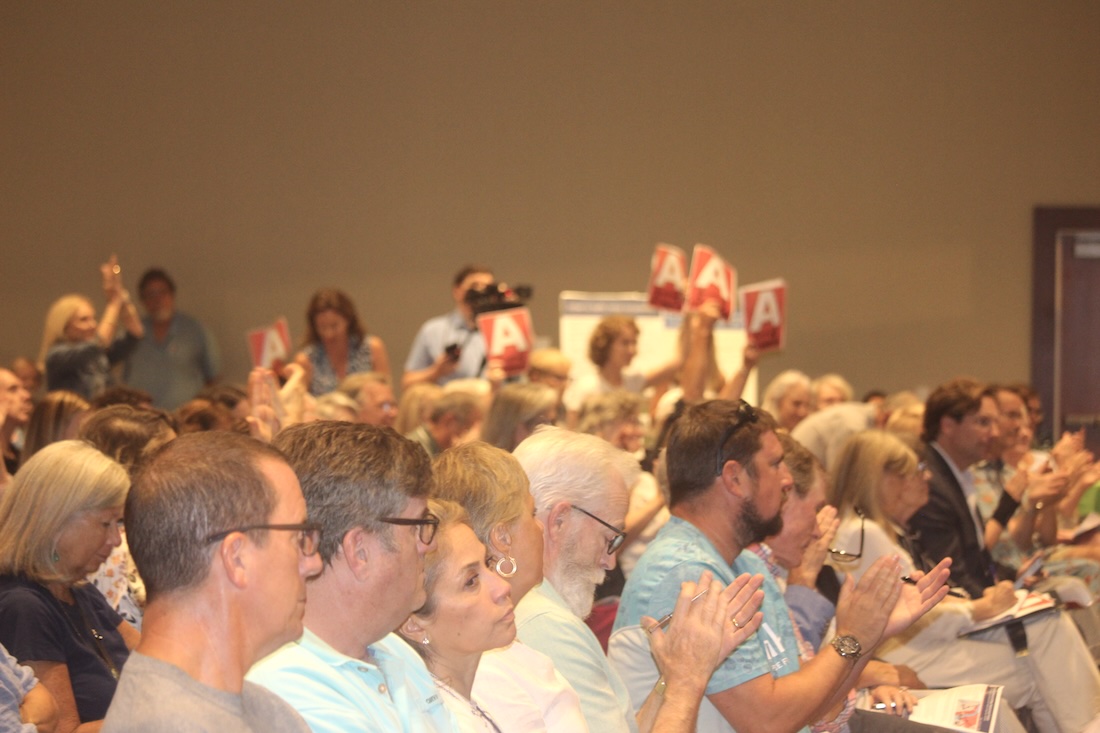
SOUTHEASTERN N.C. — The North Carolina Department of Transportation held two public hearings this week before it chooses its design for the Cape Fear Memorial Bridge replacement, expected by the end of the year. Almost all Wilmington-area residents who signed up to speak called for the 65-foot bridge and no tolls — or another option entirely.
Hearings were conducted at Cape Fear Community College in downtown Wilmington and the Leland Cultural Arts Center, cumulatively drawing in 79 people to speak. Residents, business owners, church parishioners and elected officials brought up concerns related to access, costs, traffic, safety, the environment, and cultural and historical preservation.
The Cape Fear Memorial Bridge, connecting New Hanover to Brunswick county over the Cape Fear River, is set to break ground in September 2027, and NCDOT has presented what it considers two viable options for the design. The first stands at 65 feet — a lift bridge that rises to 135 feet. The second design option is a fixed 135-foot fixed bridge, with six travel lanes and a 15-foot multi-use path. Not a single person at Monday’s hearing in Wilmington spoke in favor of the latter.
READ MORE: Wilmington hiring consultant to find less costly, impactful CF Memorial Bridge options
ALSO: City council backs CFM bridge historic district review, but wants broader study
CATCH UP: CF Memorial Bridge toll decision due by February to keep grant, other funding options stall
The 135-foot height determination was made through a Preliminary Navigation Clearance Determination, which assesses the kinds of ships passing under the bridge to get to industry parcels and downtown. In order to accommodate large cargo or commercial vessels, according to minimum standards by the Coast Guard, the bridge has to be constructed to 135 feet or a bridge able to lift to the height.
The Coast Guard set the standard in its 2024 Navigation Impact Statement, published by NCDOT; however, it used records of vessel types dating back to the ‘90s. Many at this week’s hearings thought this data was outdated to base current designs on.
The 135-foot bridge ramps would extend to Fifth Avenue instead of its current exit on Third Street, bringing with it a permanent loss of two homes and two businesses, noise impacts for 102 parcels and at least 63 parcels impacted by rights-of-way needs, according to the NCDOT’s Environmental Assessment, released July 2026. The assessment is required and determines the full impact of a project and each design or construction option.
Many called for another choice, questioning why the bridge was being built to accommodate ships that did not pass under the Cape Fear Memorial Bridge anymore. For the purposes of the vessels that do require additional space, many officials and residents have pointed out 100 feet is suitable for today’s need. Most traveling through now, officials pointed out, are recreational.
Both bridges cost more than a billion dollars. However, the 135-foot bridge — nicknamed “Option Bad” by naysayers — is less expensive by $80 million; this is because the 65-foot bridge needs additional engineering and materials to make its lift bridge possible.
An additional $773 million is needed for either to come to completion, when accounting for the $85 million NCDOT is putting toward it if tolled and with the grant money. A toll is currently the only viable solution to make up the gap funding, according to NCDOT, since another monetary mechanism hasn’t yet been identified.
“If we do not toll this bridge and an alternative funding source is not identified, the project might not move forward,” NCDOT’s Emily Richards said Tuesday.
At both meetings, NCDOT was explicit the $242-million federal grant will be lost if the Wilmington Urban Area Metropolitan Planning Organization makes a decision to withdraw tolling as an option.
Here’s a breakdown of comments from both hearings.
Officials and candidates
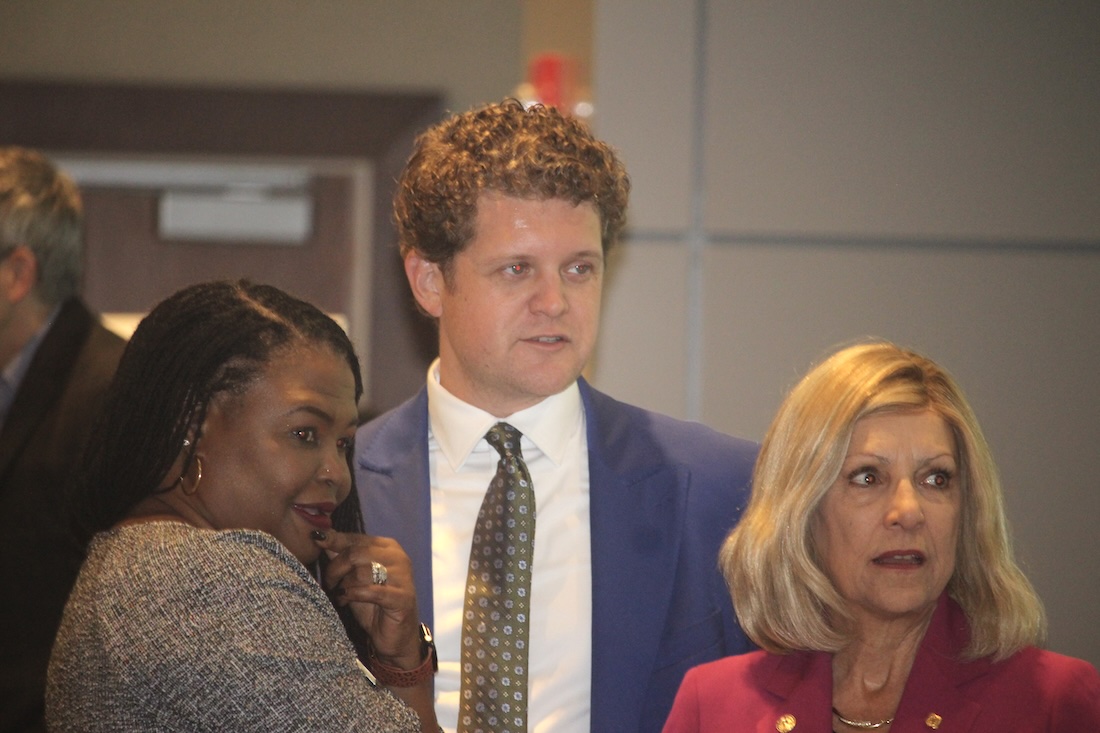
In Wilmington, council member Salette Andrews drew a standing ovation as she spoke against the 135-foot tall bridge on Monday night.
“Which vessels actually require more than a hundred feet? How many are commercial vessels? Where are they going?” she asked.
At the city’s Sept. 1 meeting, staff recommended Wilmington City Council hire a consultant to find another bridge option that would be less costly and less harmful for the community.
Andrews noted shifts and changes in Wilmington’s downtown require the consideration, while Mayor Bill Saffo told Port City Daily Tuesday the Cape Fear Memorial Bridge has been lifted to accommodate ships only 69 times in the past year, mostly recreational. The number has decreased from 381 bridge openings in 2019 to 168 in 2023.
To support her argument that another option was possible, Andrews pointed to an example in Washington and Oregon. The states were being pushed to accept a 178-foot Interstate Bridge over the Columbia River; its Preliminary Navigation Clearance Determination was issued by the Coast Guard in 2022.
However, Andrews informed the states’ legislators reached out to the Coast Guard, and a new evaluation with current numbers was completed. The height of the pacific northwest bridge changed to 116 feet as a result, with construction slated for 2028.
“Now, consider the Cape Fear,” Andrews said. “The Coast Guard 135-foot determination for our bridge is also a preliminary navigation clearance determination. The Coast Guard expressly states that it is not binding and does not constitute final agency action. So tonight, I’m asking NCDOT: Will you prepare an updated navigation impact report and formally ask the Coast Guard to reconsider the 135-foot preliminary determination?”
Andrews pointed out it would not take a legislator to make the same changes; just a conversation. It would include asking the Coast Guard and USACE to reassess the area’s needs so NCDOT can come back with a better option, using updated data from the federal agencies.
On Tuesday in Leland, New Hanover County commissioner Rob Zapple supported the notion. He, too, called for further research on better design options. Noting the 1996 evaluation from the Coast Guard, Zapple suggested a new navigational impact report focusing on the present and future maritime traffic rather than the past.
“We need a navigational assessment to be expanded. That’s what we need,” he said. ”We don’t want to stop anything. Don’t want to lose any money from the federal government. We need that to be expanded.”
Council member JC Lyle called the 135-foot bridge an option “for a Wilmington that does not exist anymore.”
Before 2023, the Cape Fear Memorial Bridge had more vessels passing under it that required the bridge to be lifted because Kinder-Morgan, an energy infrastructure company, operated a facility in downtown Wilmington. The company closed the site in June 2023, which resulted in decreased numbers. The benefit of the 135-foot bridge also accommodated the possibility of another company purchasing the site for a similar purpose, according to the 2024 Navigation Impact Report. Kinder Morgan sold to Tribute Companies, which designs, develops, constructs, and manages real estate, including apartment communities, commercial spaces, and mixed-use properties in Wilmington.
“We did have that industry all up and down the river,” Lyle said. “That’s been replaced.”
Lyle pointed to other amenities on the northern portion of downtown and the Cape Fear River, such as Live Oak Bank Pavilion, the Riverwalk, and convention center. Thus, she thought resurrecting that kind of industry at the old Kinder-Morgan site was mostly obsolete with newer economic development growth in Wilmington.
Council member Chakema Clinton-Quintana, present during both hearings alongside Lyle and Saffo, worried about impacts a toll would have, thwarting customers from local businesses and creating congestion in neighborhoods and main roads, including Fifth Avenue and Third Avenue.
Saffo echoed similar concerns, stating a toll on the Cape Fear Memorial Bridge would reroute vehicles either to the Isabel Holmes Bridge or I-140 to enter Wilmington.
“We know there’s going to be a significant amount of traffic that will go north, which is gonna create a bottleneck, which will create more traffic, which will make people say: ‘Well, I don’t want to go there. There’s too much traffic, too much congestion,’” Saffo said to Port City Daily Tuesday.
Council member Cassidy Santaguida — who also sits on the WMPO board, which will decide whether the tolled bridge will move forward — noted the lack of accommodation for driveway access and rights-of-way needs for properties along Fifth Avenue, near the new 135-foot design bridge landing.
She also brought up the city’s $16 million investment to improve Fifth Avenue for safety reasons, wrapping in December 2025, noting it’s money the taxpayers have already dolled out.
Rep. Deb Butler (D-New Hanover) promised during the Wilmington hearing she would not vote in favor of a toll; state policy requires legislative approval for implementing tolls or establishing toll-backed funding streams for public infrastructure. She asked the residents in the room to watch for local legislative votes.
“So before we spend a billion dollars and commit Wilmington to the next 100 years, we need to ask one question: Are we choosing the bridge that is best for this community or simply the bridge that allows us to keep a federal grant?” she concluded.
Council member David Joyner explained the need for additional funds could be remedied with a tri-county sales tax footing the rest of the bill. This was broached last year by the WMPO, as reported on by Port City Daily; however, the committee has not met since September 2025 and taken no action.
“State government, not local government, has decided that this project will move forward and be paid for on the backs of locals who need to use the bridge every day to get to work, to doctors’ appointments, to care for relatives, and so on,” Joyner said. “If the state government’s expectation is that locals will pay the balance of $700 million, that difference in cost on this piece of state infrastructure should be tied to a local option sales tax, which the General Assembly can choose to do, and put on a referendum ballot, so that we actually have a voice, and we actually have the option in front of us.”
A transit sales tax would have to be voted on by constituents in a referendum, which means it is too late to be on November’s ballot to meet the February deadline.
Kimberly Hardy, the Democratic candidate against Rep. David Rouzer (R-7) in the congressional race, focused primarily on how the bridge benefits the entire state, given its proximity and importance to the ports and other state institutions.
“Asking residents of the Cape Fear region to carry the cost burden of a bridge that benefits the entire state, places an unfair and inequitable burden on one section of North Carolina’s population,” Hardy said.
Hardy also called out Rouzer, who wasn’t in attendance during either hearing, for his inaction in trying to stop the toll despite being the chairman of the Highways and Transit Subcommittee for the U.S. House of Representatives. Hardy believed legislators needed to have the best interest of their constituents in mind since bureaucracy does not — meaning non-elected officials in federal and state departments who do not carry the same obligations as legislators.
“I will end with this: Budgets are priority issues,” Hardy said. “If you cannot afford the project that you’re trying to do without putting it on the backs of others, then you should not be doing the project at all.”
Businesses and churches
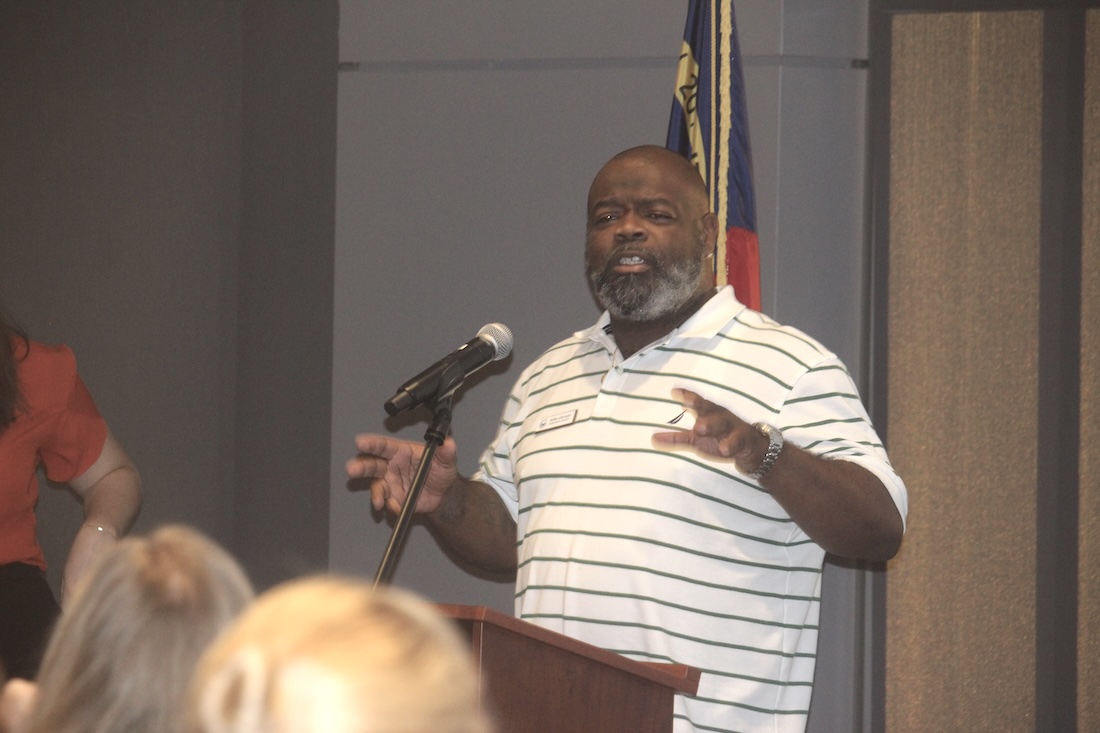
One of the greatest concerns noted Monday evening were how businesses and churches in the downtown area, but especially in the area of Fifth Avenue, would fare during construction, should the 135-foot bridge be chosen.
“There’s a medical clinic on Sixth, one block up, minority-owned,” Minority Chamber of Commerce founder Atiba Johnson said. “There’s also a funeral home.”
Davis Funeral Home owner Javoke Terrell explained Fifth Avenue is a vital part of the typical funeral procession and must be accessible. He worried added traffic and congestion would disrupt proceedings.
The environmental assessment shows 15,000 cars are expected to enter north on Fifth Avenue from the bridge daily, which many residents argued the road could not accommodate.
Churchgoers expressed concern over congregation access but also the community reaching the Basilica of Saint Mary and other local churches for weddings, funerals and special events, due to the bridge construction.
Joseph Poletti, the principal at Saint Mary’s — the oldest Catholic school in the state and home to one of three basilicas in North Carolina — said the safety of students who walk to school along Fifth Avenue are top-of-mind. He also thought a tolling option adds further burden to families, parishioners and employees coming from Brunswick County.
Joe Apkarian, owner of Third Street’s The Eagle’s Dare, as well as downtown businesses Tacobaby and the The Pour House, explained he put his life savings into starting his businesses.
“If this bridge comes, I’m done,” he feared.
Because the 135-foot bridge, if tolled, could divert traffic to the Isabel Holmes Bridge, The Eagle’s Dare, 2 miles away at Red Cross and Third Street, would experience impacts directly. Anyone traveling downtown from Isabel Holmes is directed onto Third Street.
Overall, residents and business owners wanted a thorough economic assessment to be completed before a design is chosen or construction begins.
Residents
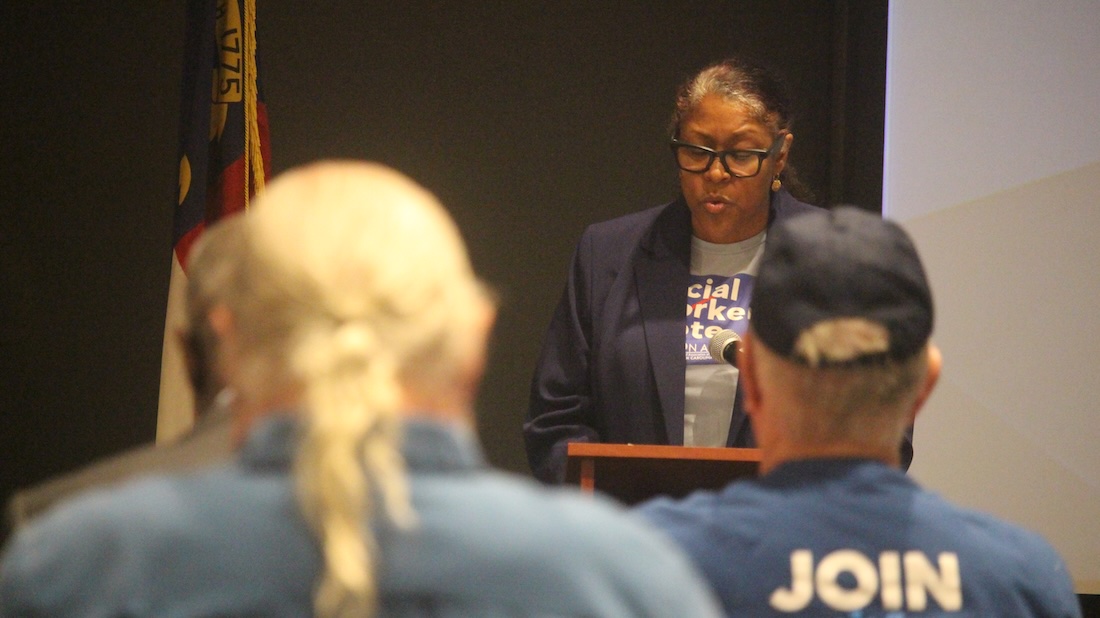
The topic that received the most attention from residents in Wilmington was the preservation of the downtown homes, particularly in historic areas.
According to NCDOT’s estimates, the 135-foot bridge would displace or disrupt 63 residences, compared to the 22 affected by the smaller lift bridge. These homes primarily are located along Fifth Avenue for the 135-footer and Third Avenue for the 65-foot lift bridge. However, many residents argued the accuracy of the numbers.
NCDOT’s coverage area in assessing the potential impacts was not as comprehensive as it could be, residents said. It took into account areas from the bridge to roughly Seventh Avenue, but residents argued the effects of the 135-foot bridge would be felt further down Dawson and Wooster streets. Saffo said Tuesday he spoke with NCDOT about plans to do another assessment with a larger radius.
Jamie Patterson, president of Residents of Old Wilmington, explained preserving the homes in the historic overlay district has been costly for many but worthwhile. The 135-foot bridge would only do a disservice to their property values, due to increased noise from traffic. Varied real estate and economic research analyses have found highway traffic noise can reduce property values anywhere from 5% to 10%.
“For over 30 years, our members have turned a derelict, dangerous neighborhood into a thriving tourist destination with a strong business corps, investing millions of dollars annually in their properties,” she said, referring to historic downtown areas. “A 135-foot bridge threatens every dollar of that investment.”
Historic Preservation Commission Vice Chair Joan Keston said the state’s economic analysis, included in the environmental assessment, did not accurately capture the work residents, businesses and the city would have to do and make up for the damage caused by the 135-foot bridge. While it covered the immediate costs of construction and other consequences directly related to the bridge, residents argued the cost of getting local infrastructure up to speed with the new traffic patterns and possible accidents in historic and residential neighborhoods had both unintended or long-term economic consequences.
“We have spent enormous amounts of money and time in preserving our historic wealth,” Keston said.
She also pointed to the recently completed reconstruction of the Kenan Fountain on Fifth Avenue, which was damaged in a collision in 2023 — and cost $335,000 to repair. She pointed to the dangers of the increased traffic from the 135-foot bridge onto Fifth Avenue, around the fountain in the middle of the intersection at Market Street, one of the main corridors to downtown Wilmington in the city.
“[The bridge is] extremely important downtown for tourism, business, education, for hospitals, for medical,” Keston said. “And you’re putting tolls on this without a full impact statement.”
Less people showed up Tuesday in Leland to speak, though almost all 29 of them were against tolling and the 135-foot height.
Many argued burdensome costs for the 50,000-plus commuters that go to and from work daily, as well as families driving to drop off and pick up kids from school. Not to mention, older generations and retirees living on a fixed income would find it increasingly difficult to pay to cross the bridge for daily activities, appointments and the like.
“I don’t think that after decades of them paying to the tax base, NCDOT and all others involved in the project reward our elders and future generations with the first toll bridge in the state of North Carolina,” Navassa resident Norris Merrick said.
Also brought up both nights were environmental impacts the bridge construction would have on the region. Kelly McConnell, chair of the Sierra Club, said the larger bridge would infringe on wetlands and could further exacerbate flooding. Patterson also worried for the wildlife who call the wetlands home who may be disrupted by the noise from the heavier traffic.
According to NCDOT’s environmental assessment, the 135-foot bridge would impact 10.8 acres of federally protected wetlands and 20.8 acres of 100-year floodplains. The current bridge requires total deconstruction, which would disrupt nearby wetlands, in addition to construction.
The public comment period is still open and will close on Oct. 15. Comments can be submitted here.
Have tips or suggestions for Emily Sawaked? Email [email protected]
At Port City Daily, we aim to keep locals informed on top-of-mind news facing the tri-county region. To support our work and help us reach more people in 2026, please, consider helping one of two ways: Subscribe here or make a one-time contribution here.
We appreciate your ongoing support.
