


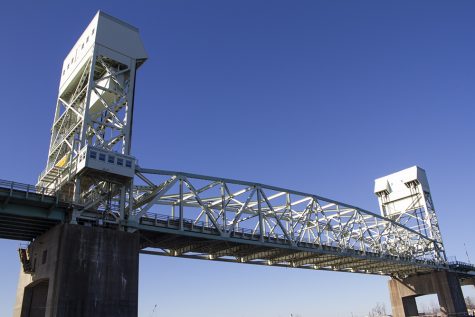
WILMINGTON — The public has a little more than a month to provide feedback before it’s decided whether the Cape Fear Memorial Bridge will be replaced with a 65-foot movable span bridge or 135-foot fixed bridge. However, the City of Wilmington is forging its own plan after determining both options will be a detriment to the city.
The city is seeking a consultant to inform council of any viable options for replacing the 57-year-old Cape Fear Memorial Bridge, other than the two proposed by the North Carolina Department of Transportation.
Of the two options, Alternative A consists of 65-foot bridge with a movable span up to 135 feet — the clearance required by the U.S. Coast Guard — could be constructed in the current bridge’s footprint. Alternative B is a 135-foot fixed bridge that will extend the bridge’s footprint from Third Street to Fifth Avenue.
Both are projected to cost a little more than $1 billion, with around $80 million separating the two price points. The 65-foot bridge comes in slightly higher because of increased right-of-way and construction costs.
READ MORE: CF Memorial Bridge toll decision due by February to keep grant, other funding options stall
ALSO: City council backs CFM bridge historic district review, but wants broader study
NCDOT is currently taking public comment on the two alternatives and their impacts as detailed in an environmental assessment, which was completed last month.
“Rather than simply just saying, “OK, we’ll figure out a way to make alternative A less bad, we’re asking the question: ‘Is there another option that maybe has not been explored to date that can solve everybody else’s needs?’” City of Wilmington Chief of Staff Dennis LaCaria said at city council’s Tuesday meeting.
The city wants to explore other options because it found the two alternatives presented by NCDOT would require a toll unless another funding source is identified. Additionally, construction of a new bridge would take months and be disruptive to downtown residents and visitors.
Though removed from the resolution language, some potential solutions include modernization, operation and ongoing maintenance of the current bridge, forgoing the need for a new bridge at all. Other designs could have lesser spans or involve the reuse of the existing bridge’s ramps or pilings.
The city noted these options are likely to be less costly, thus reducing the dependence on a toll to fund the bridge construction. Currently, a toll is the only way to funding the $773 million remaining after federal grant and state funding for the replacement.
LaCaria told council the city is already working with a consultant. Upon asking how much it would cost, the city clarified to Port City Daily the consultant has yet to be hired and was unable to provide costs. However, the city noted “funding is available” to support the work.
The goal is to present the consultant’s findings to council on Oct. 6, ahead of NCDOT’s deadline to submit public comments on Oct. 15.
In addition to seeking a consultant, Wilmington City Council also approved comments to submit to NCDOT. Before she presented them, Wilmington Planning Director Linda Painter provided an overview of the assessment for council Wednesday.
In general, Alternative B would have a greater impact on the region because it would need longer on- and off-ramps. This 135-foot bridge would impact 63 parcels and potentially require two business and two residential relocations.
Alternative A would impact 22 parcels and potentially require three business locations.
Additionally, the assessment indicates the 135-foot bridge will have a greater impact on traffic patterns due to the new ramps. It also notes that, if the bridge is tolled, more traffic can be expected to divert to the Isabel Holmes Bridge. It is expected that average weekday traffic diverted to the northern bridge would increase by approximately 43% in 2030 and other routes, such as Interstate 140, Martin Luther King Jr. Parkway, U.S. Highway 421 and S. Third Street will also be more heavily utilized as a result of diverting traffic.
Wilmington experienced this two years ago when the NCDOT had to replace stringers and decks to the Cape Fear Memorial Bridge, shutting down all eastbound traffic for a few months before switching to westbound traffic closure. Cars diverted to Isabel Holmes Bridge led to backed-up traffic along Third Street daily, with some drivers reporting sitting in traffic for an hour.
Per traffic noise from the traversing the bridge, the 65-foot bridge is expected to impact 49 residential parcels and one business, compared to 102 residential properties with the 135-footer.
Abatement efforts include noise barriers, such as earth berms and noise walls; the assessment states two would be constructed for the 65-foot bridge, though none are included with 135-foot bridge because it doesn’t meet the “feasibility and reasonableness criteria” to fund.
As for the natural environment, the assessment found the 65-foot bridge will impact 1.2 acres of wetlands while the 135-foot option will impact 10.8 acres. Both options are anticipated to adversely impact two bat species.
The assessment also notes the historical impacts will not be studied in full, per requirements in Section 106 of the National Historic Preservation Act, until an alternative is chosen. This was determined in a programmatic agreement the City of Wilmington signed off on in July.
Earlier this summer, Port City Daily asked NCDOT if both alternatives would be part of the historical analysis; a spokesperson said the programmatic agreement allows for “discussions” for both alternatives, but didn’t say both would be studied fully.
Based on the environmental assessment, council voted on the following comments to be submitted:
- The city should be centered in conversations about the project
- The project team to explore potentially less costly options to meet future transportation needs
- Alternative B, the 135-foot fixed bridge option, should be eliminated from consideration
- The project team should postpone a decision on the bridge design until all activities within the environmental assessment and Section 106 process can be completed
- The chosen bridge design should be exempt from tolling
Council member David Joyner questioned the fourth bullet, asking staff if the project needs to be shovel ready by a certain 2027 deadline.
As first reported by Port City Daily in July, NCDOT pinpointed state legislation needing to pass a toll on the facility by February 2027, in order to meet the September federal grant deadline.
The WMPO would also need to continue supporting the tolled project; if it wanted to stop the tolled project from moving forward, it could vote to remove it from the State Transportation Improvement Plan. However, the most recent state budget stipulated doing so will come at a cost.
LaCaria told Joyner the city believes it can review a different plan and discuss it with the project merger team — not just NCDOT, but various state and federal agencies — within deadline.
“We’re asking during the time of the public comment that we have the space to evaluate and propose potential alternatives to this, and that those then would be available to be considered and evaluated on the same basic playing field as the alternatives that have been identified to this point,” LaCaria said.
Port City Daily asked NCDOT whether it has evaluated other options, including using some of the infrastructure in place to avoid a completely new bridge build or modernizing the new bridge.
NCDOT said it and the merger team explored several replacement options, pointing to the environmental assessment. The document notes a no-build alternative was evaluated and determined unable to accommodate 2050 traffic needs. Additionally, the 100-foot fixed bridge option was eliminated after the U.S. Army Corps of Engineers determined the bridge needed to have 135 feet of clearance.
“These decisions have been unanimous and harmonious to date; the NEPA process is being followed and is driving the results,” spokesperson Veronica Scott wrote in an email to PCD.
Scott added the bridge, built in 1969, is functionally obsolete because it cannot meet current traffic demands and maintenance is costly and disruptive, indicating there is no way to make the current bridge structure work.
However, if the current bridge can be salvaged in some way, it would raise the question of whether the replacement is a “new” facility.
This is important because state law prohibits the conversion of a nontolled existing roadway into a tolled facility. NCDOT’s position is, the replacement bridge is a new facility since it will expand the current road to six lanes and add a multi-use path.
At Tuesday’s meeting, Mayor Pro Tem Kevin Spears pointed out the state still has to vote on approving the toll.
Mayor Bill Saffo and council member Cassidy Santaguida questioned whether the city would be on the hook for improving Fifth Avenue should the 135-foot bridge emerge as the chosen design.
The city just wrapped $15.75-million worth of improvements to Fifth Avenue in December, including the conversion of a driving lane into a dedicated bike lane in each direction. But this is only one downtown improvement paid for by the city.
Additionally, council just passed its Greater Downtown Plan with dozens of desired improvements to downtown, including ways to reduce cars traveling through downtown and greater emphasis on walking and biking.
“My understanding is that hundreds of millions of taxpayer dollars haven’t been invested in downtown, and when we start dumping cars where we don’t have capacity off of a monster bridge, I think we start to put at risk the economic investment that the taxpayers in this city have made in this city,” Santaguida said.
According to the environmental assessment, 15,000 cars are expected to be diverted north on Fifth Avenue from the bridge daily. LaCaria said Fifth Avenue cannot accommodate those trips as the road is currently configured, though the environmental assessment indicates the road would eventually be expanded to four lanes. The city doesn’t currently have plans to do this.
LaCaria said conversations would need to be had on whether the road becomes an NCDOT road, shifting costs to the state, or if the city will need to essentially reverse its Fifth Avenue project.
As he did in July, Mayor Saffo again brought up a “southern bridge,” or Cape Fear Crossing, which was tabled after it didn’t score high enough in the State Transportation Improvement Plan to move forward. In 2019, the bridge was estimated at $1.1 billion, thus the price could be higher today.
Saffo also pointed out the project received intense pushback from Brunswick County residents; he indicated Wilmington residents deserved the same deference.
“We’re going to be taking the brunt of 95,000 cars eventually through this community every single day, how that traffic is moved through this city will determine what the city is going to look like,” Saffo said. “Because it’s not only going to affect Wooster and Dawson, it’s going to affect Oleander Drive and Third Street. People getting to and from the beaches, getting to and from the airport, getting to and from where their places of business. So this is a very important decision for all of us.”
Council members JC Lyle, Salette Andrews and Chakema Clinton-Quintana were less enthusiastic about pushing forward a third option, but all agreed the 135-foot bridge should not be advanced. Joyner said he would consider a concrete plan for a third option, but questioned whether the powers that be would reverse course and consider other options at this point.
“I agree with the spirit of, we don’t really like option A or option B — we would prefer a third bridge, we would prefer all of these other options and alternatives,” Joyner said. “But as somebody who has responsibility to actually get something done in this community, I don’t believe that our partners are going to engage with us in good faith to go back and revisit some of these decisions that were made without us, that were made against the input that we put.”
To Joyner’s point, the WMPO — who made the decision to submit the tolled version of the Cape Fear Memorial Bridge to the state — now has a different makeup due to elected leader changes across the tri-county. Over half of the 13-member board is newly appointed.
Additionally, the WMPO was exploring a local alternative tax — essentially an added sales tax to go toward the bridge and other transportation projects in the tri-county. But the committee for this effort stopped meeting a year ago. Its members are also largely gone due to leaving office or rotating to a different post.
Joyner said he would like to see the sales tax option be revisited.
“We’re talking about a 700-something million-dollar delta that the state of North Carolina has chosen not to fund, but rather to put on the backs of the people who live in this community,” Joyner said. “And so the people of this community, ultimately in my view, should be able to choose: Is that going to happen through a local option sales tax that’s put up to a referendum, or is that going to happen by the legislature and the WMPO saying we’re voting for a toll?”
Santaguida stressed the current public comment period is the last chance for people to be heard before a decision on the bridge decision is made.
As part of the public comment period, NCDOT is hosting two in-person sessions on Sept. 14 in Wilmington and Sept. 15 in Leland. Details about attending the sessions and submitting comments online can be found here.
At Port City Daily, we aim to keep locals informed on top-of-mind news facing the tri-county region. To support our work and help us reach more people in 2026, please, consider helping one of two ways: Subscribe here or make a one-time contribution here.
We appreciate your ongoing support.
