


NORTH CAROLINA — A unanimous decision made by the U.S. Court of Appeals earlier this month will uphold federal protections against PFOA and PFOS, categorized by the Environmental Protection Agency as hazardous substances. Three judges determined numbers petitioners used in its arguments were overall inaccurate, outdated, conflated or arbitrary, with some uncontextualized and based on discussions with industry leaders rather than empirical evidence.
The U.S. Chamber of Commerce, American Chemistry Council, the American Fuel and Petrochemical Manufacturers, the Associated General Contractors of America, Inc., the National Waste and Recycling Association, the Institute of Scrap Recycling Industries and the American Forest and Paper Association challenged the EPA’s designation of PFOA and PFOS. The agencies argued the cleanup costs to industry was higher than EPA said it would be.
The EPA designated PFOS and PFOA as hazardous substances in 2024 based on findings the two strains are mobile, persistent, can bioaccumulate in people and organisms, cause health problems, like liver and cardiovascular issues, and have been detected in the environment and human blood. They are strains of PFAS, known as forever chemicals.
READ MORE: ‘Industry is winning’: State budget funds PFAS research, but some balk at lack of regulatory teeth
ALSO: ‘EPA has abandoned NC’: Local stakeholders dismayed by Chemours, feds’ settlement
“This hazardous substance designation? We fought hard for that,” Clean Cape Fear co-founder Emily Donovan said. “We petitioned the EPA to establish that along with the drinking water standards.”
Clean Cape Fear was one of many organizations who, with representation from environmental law group EarthJustice, intervened in the appeal. EarthJustice spoke on behalf of the National PFAS Contamination Coalition, formed of environmental groups in communities impacted by PFAS across the country.
Clean Cape Fear is part of the coalition and Donovan has been pushing for drinking water standards for PFAS and holding perpetrators accountable for contamination.
It is the second time the chamber has tried to appeal the ruling and failed, with the first attempt filed in 2024. It failed then because the court ruled similarly as it did this month; that the EPA had statutory authority to designate PFOA and PFOS and gave adequate notice of its analysis.
In August this year, the multiple agencies asked for the two strains of PFAS to be removed as hazardous substances and instead remain “pollutants or contaminants.” The EPA designation would make reporting the presence of the strains mandatory and put the cost of cleanup and relief on the perpetrators, whereas the previous categorization could put the cost burden on taxpayers. For example, customers experience increased rates from utility companies that treat wastewater against PFAS.
First, the agencies argued the EPA misinterpreted what a hazardous substance designation should be.
The designation is defined by a substance that may pose substantial harm or danger to the public. The U.S. Chamber of Commerce said the EPA’s definition of what “may” present a danger was not based on real or existing risks and was too broadly defined. However, according to the Comprehensive Environmental Response, Compensation, and Liability Act, the EPA does not need to prove past or ongoing harm to secure this designation and is allowed to use scientific studies to assert a chemical or byproduct is hazardous.
There are two ways for a hazardous substance to be considered under the act:
- One: Chemicals already designated hazardous substances under other laws like the Clean Water Act and the Clean Air Act;
- Two: It allows the EPA to designate hazardous substances outside of these existing designations. To do so, the EPA needs to conduct scientific studies, risk assessments, exposure modeling, and must inform the public, providing enough time for a public comment period.
Though, there was one argument missing from the chamber: They did not refute that PFOA and PFOS are dangerous.
“Even the industry challengers to those designations were unable to deny the severe harms posed by PFOA and PFOS,” EarthJustice senior attorney Jonathan Kalmuss-Katz told Port City Daily. “Instead, they challenged the procedures that EPA relied upon, arguing that the agency had to provide a more specific definition of substantial danger and to conduct more analysis of the designations’ economic costs.”
The law does not mandate the EPA provide specifics about harm and measurements, despite the chamber wanting them.
“More to the point, this case does not require rigidly defining the precise boundaries of the term ‘substantial danger.’ That is because, for all their verbal debating, petitioners tellingly do not dispute that PFOA and PFOS qualify as substances that may pose a substantial risk to public health, welfare, and the environment if released,” Judge Patricia Millett, one of the three who ruled on the case this month, wrote. “Nor could they.”
Also, the chamber claims the EPA underestimated and miscalculated costs of cleanup, adding in some areas the price tag would be 43,000% higher.
The EPA predicted companies would have to spend somewhere between $10 million and $60 million for cleanup at National Priorities List sites or Superfund sites — the latter being locations recognized under the act as dangerously polluted and requiring cleanup. The EPA estimated cleanup costs to be upward of $18.1 million for other sites.
The chamber said the expenditures would be higher. For non-priority sites, specifically, it calculated businesses would have to incur costs between $141 million to $7.8 billion a year.
However, the number of sites cited by the chamber is a rundown of all potential areas in the country contaminated with any strain of PFAS and not just the two strains being petitioned.
“We wanted the whole class of forever chemicals listed as hazardous substance designation,” Donovan said. “What we ended up getting was PFOA and PFOS. These are two compounds no longer manufactured in the United States.”
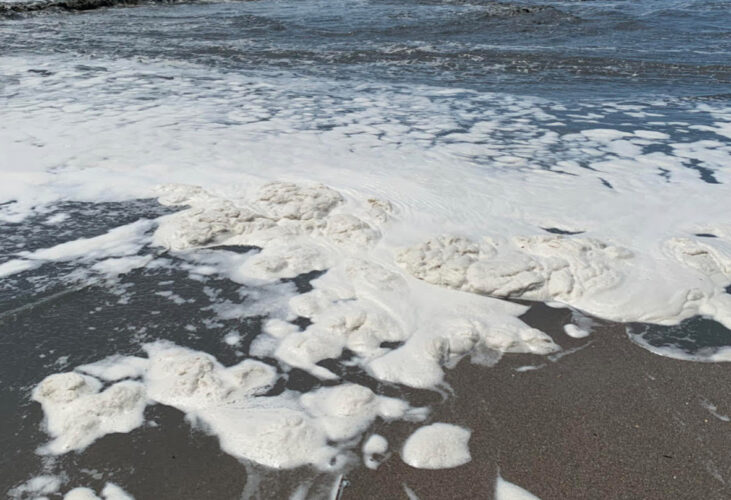
However, the chemicals’ presence is persistent and PFOS can still be found in sea foam in the Cape Fear region and, more broadly, in waste and other facilities.
The challengers also pointed to indirect consequences from the designation: litigation costs, liability insurance and ongoing and future waste management to name a few. The court, though, pointed out Superfund instructs the EPA to minimize litigation and defer to settlements.
Further, the chamber argued it went through each affected industry — paper and wood, for example — listing what the potential costs to each could be. For example, the American Forest and Paper Association predicted spending $573 million and $766 million per year to adopt a waste management method recommended by EPA.
The chamber had another problem with the EPA’s cost-benefit analysis: that the agency did not provide adequate notice for the hazardous substance designation based on initial analyses published and open for comment. The court decided the argument was not valid because ample time for comment was given and the final analysis was a “logical outgrowth” from the preliminary one. Further, the new information in the final analysis did not drastically change the conclusion nor prove critical.
“Reasoned decisionmaking does not require EPA to undertake a deep-dive, individualized cost-benefit analysis of indirect impacts for every single potentially affected industry,” the court wrote in response to this.
In addition to Millett, Judges Gregory Katsas and Neomi Rao ruled on the case and said the EPA did not break any of its own rules and had the statutory authority to enforce and decide the designation.
Port City Daily reached out to the U.S. Chamber of Commerce to ask if it planned to appeal the ruling again but did not receive a response by press.
“Now that they’re hazardous, we can enforce the Superfunds and we can get the polluter to pay for the cleanup,” Donovan said.
Have tips or suggestions for Emily Sawaked? Email [email protected]
At Port City Daily, we aim to keep locals informed on top-of-mind news facing the tri-county region. To support our work and help us reach more people in 2026, please, consider helping one of two ways: Subscribe here or make a one-time contribution here.
We appreciate your ongoing support.
