


NEW HANOVER COUNTY — The New Hanover County commissioners have asked staff to reexamine its ordinances pertaining to data centers after nationwide backlash against hyper-scale versions of the facilities and local moratoria on their construction.
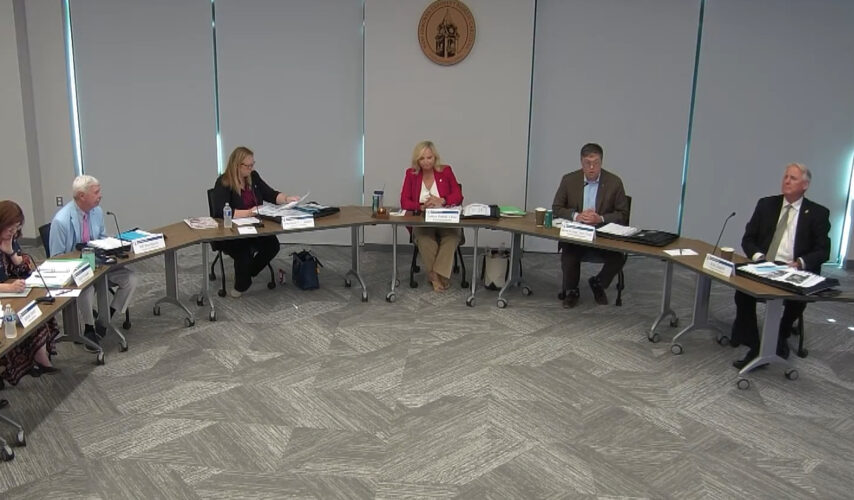
The commissioners took up the issue at their agenda review meeting Thursday after a Chair LeAnn Pierce requested planning staff discuss the county’s current approach to data centers.
“If there is an application that’s put on the table, we’re not prepared for it,” Pierce said. “That’s a problem.”
READ MORE: Temporary moratorium on data centers passes in Southport
ALSO: Leland braces for AI surge with strict proposed data center rules
Planning Director Rebekah Roth explained the county defined “data center” in its land code in 2020. They are currently allowed by-right in four zoning districts — commercial services, airport commerce, light industrial, and heavy industrial districts.
Though, the county has not seen large-scale, standalone data center projects come to town among the likes of Amazon’s $10-billion facility planned in Richmond County and Meta’s Forest City campus.
Additionally, data centers are seeing increased opposition across the country due to the growing processing needs of artificial intelligence; tech billionaires like SpaceX and Tesla founder Elon Musk and OpenAI CEO Sam Altman are behind projects to expand AI data centers across the country.
However, a recent Gallup poll showed 70% of Americans oppose local construction of data centers, citing concerns over energy and water use, as well as noise and water pollution. These concerns brought down a 900-megawatt data center proposed for Edgecombe County earlier this year, among other projects across the U.S.
Roth said the standards the county has in place don’t necessarily relate to concerns over noise, types of cooling systems, and the impact on the power grid often cited in data center conversations.
Additionally, other governing bodies in Cape Fear have passed year-plus moratoriums on data centers, including Southport and Boiling Spring Lakes, until they could examine impacts of large scale campuses; Leland and Shallotte have also recently updated regulations on the facilities.
Thus, the commissioners were in agreement Thursday about the desire to explore changes to its land code, particularly finding a way to require commissioner and public feedback in the approval process.
Commissioner Dane Scalise questioned the viability of a data center project in the county, which is coastal and, thus, prone to hurricanes and flooding. He also mentioned the county lacks large undeveloped parcels.
“I just, as a practical matter, find it hard to imagine that New Hanover is really the best place to put anything like this — there are so many other counties that are so much larger than us,” Scalise said.
Still, Scalise supported a proactive approach to regulation, considering the state legislature’s limits on downzoning properties, and wanted to bring commissioners in on the decision-making.
“It’s a political sticky wicket that I suspect would come before the commissioners if something like this were to advance, and I would hate for our hands to be bound and unable to take any sort of action that is appropriate for our community,” Scalise said.
Commissioners Rob Zapple and Stephanie Walker questioned if a current technology company in the area, such as General Electric, could expand its campus with a data center.
Roth said she was unaware of any plans to do so, but depending on the size of the expansion, it could be considered an accessory use. If permitting is changed for data centers beginning at a certain size, these companies would need to come back to the county in some way.
Zapple was also interested in requiring companies to put residential energy needs before those of data centers. The House of Representatives passed the Ratepayer Protection Act earlier this week aimed at making data center companies responsible for power upgrades rather than consumers.
Commissioner Bill Rivenbark questioned the parking requirements needed for a facility; Roth replied many of the needs are upfront and after construction ends, not much parking is required for employees running the facility.
“That’s a good fit for a piece of property like one that we’ve been dealing with up in Castle Hayne,” Rivenbark said, referring to the 1,800-home Hilton Bluffs planned on Sledge Forest land in Castle Hayne. “I’m not suggesting that they do that, but that would solve the traffic problem. It would solve every problem.”
The Hilton Bluffs project has given the county heartburn over its massive size and proximity to wetlands and the Cape Fear River; the homes are allowed by-right, meaning commissioners don’t have to approve the development to move forward.
However, County Manager Chris Coudriet chose to step in this week, rejecting the developer’s site plans due to public safety concerns over the site’s single access point.
On Thursday, the manager tried to level expectations on what commissioners could do when it comes to data centers.
“I don’t want to leave with the board with the idea that we can create an ordinance, even conditional rezoning, that says no data centers of X-size scale or otherwise; you don’t have, I don’t believe, the authority to say no,” Coudriet said.
Zapple was concerned with data centers being relegated to special use permits; though the permits give commissioners the most direct control over each center that could come to the county, the permits have strict approval requirements and limited public comment. This makes the process immune to subjective arguments for or against a project.
Zapple said he was in favor of conditional zoning, which allows more flexibility in approval decisions and public input from anyone who wishes to share.
Scalise cautioned against any overly burdensome requirements.
“GE is a major employer in this area, and they have an employee presence here, so I want us to be thoughtful about unintended consequences of what we’re formulating here,” Scalise said.
The county manager said staff would bring back a range of policy options for the board to consider.
At Port City Daily, we aim to keep locals informed on top-of-mind news facing the tri-county region. To support our work and help us reach more people in 2026, please, consider helping one of two ways: Subscribe here or make a one-time contribution here.
We appreciate your ongoing support.
