


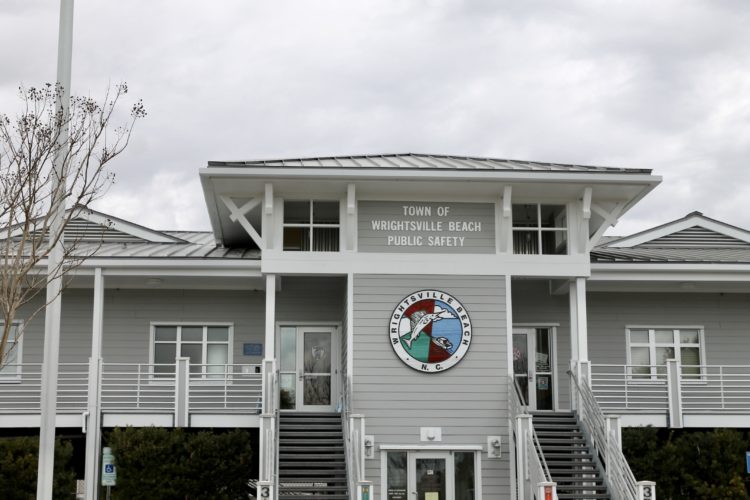
WRIGHTSVILLE BEACH — The former chief of the Wrightsville Beach Police Department is seeking compensatory damages from the Town of Wrightsville Beach for wrongful termination after, as he alleges in a lawsuit, he refused to give in to political pressure in three incidents, two related to parking.
David Squires served as the town’s police chief for four years until he was terminated on July 10, 2024. At the time, the town told Port City Daily he did not have a contract or a termination letter. Therefore, the reason for his firing — which also occurred amid turnover with the fire chief and town manager positions — was never revealed.
Squires’ lawsuit was filed June 5, 2026, though court records show the complaint was originally processed on November 12, 2025. It was dismissed at the Town of Wrightsville Beach’s request. The town argued the person who served the town — Tonya Maggio, acting on behalf of a South Carolina legal services limited liability company — did not have the authorization to do so.
Of his wrongful termination, Squires claims he received only one formal performance evaluation, in April 2023, during his time working for town. The lawsuit states Tim Owens, WB town manager at the time — who since took a job in Pender County for two months but announced last week he would be “returning to retirement” — gave Squires a 4.03 out of 5, which correlates with a “very good” rating.
Tony Wilson, who is currently the town’s planning and inspections director, succeeded Owens as an interim town manager in January 2024; six months later he would be the one to fire Squires. Squires alleges Wilson did not give a reason for the firing and Wrightsville Beach’s ordinances give the town manager the authority to fire the police chief outside of a board of aldermen vote.
According to the lawsuit, Squires has some ideas on what incidents caused the rift with Wilson.
The incident immediately preceding Squire’s firing revolves around police officers’ interaction with Brian Eckel, co-founder of Cape Fear Commercial; the company’s development arm is behind prominent developments such as downtown Wilmington’s Project Grace and the New Hanover County Government Center.
The lawsuit states officers were approached by an individual on the evening of May 4, 2024, alleging he had been assaulted as he passed the driveway of a nearby residence. The lawsuit doesn’t name the victim, though notes both the victim and another witness reported “several people in the driveway were consuming alcohol despite being underage.” The lawsuit doesn’t state whether these individuals were accused of the assault.
When officers responded to the driveway to investigate, two adults allegedly identified themselves as the homeowners. The lawsuit states one of whom was Eckel.
Squires notes the couple “expressed irritation at being questioned and briefly detained” but no arrests or charges resulted from the incident.
The following day, the lawsuit alleges Squires received a call from an alderman. Though the lawsuit doesn’t name the elected official, it references this person was employed by Eckel. Hank Miller, who was mayor pro tem at the time of the incident but no longer serves on the board of aldermen, confirmed to Port City Daily Tuesday that the reference was to him, as he is a commercially licensed real estate broker through Cape Fear Commercial.
The lawsuit alleges Miller told Squires the homeowners were very upset about the treatment they received from the officers and urged Squires to resolve the matter urgently, as Eckel was a very influential person — though it’s not clear what exactly was expected of Squires. The police chief allegedly told Miller a thorough review had been initiated.
Miller told Port City Daily Eckel did call him about the matter and clearly “wasn’t happy about what happened,” but Eckel didn’t ask Miller to fire the police chief. Miller noted he could not have initiated a firing if he wanted to because the police chief was under the town manager’s domain.
On Monday, May 6, Squires met with Wilson, who also conveyed to him the matter was of great concern. Wilson allegedly told Squires that the mayor — at the time Daryl Mills — wanted to review the police’s video of the incident. Squires says he again reviewed the matter with the district attorney, then Ben David, and determined a formal request would be needed. The lawsuit alleges the mayor withdrew his informal request after learning this and that the release of the video would be to the public, not just him.
The lawsuit says Squires received a phone call from another alderman — Miller identified this official as Zeke Partin — on May 7 where the alderman said she, Miller and the mayor were “under pressure to resolve Mr. Eckel’s concerns.”
The lawsuit did not name Partin, but stated “they” had an adult child employed at Eckel’s business. Port City Daily reached out to Partin, but she referred all comments to the Wrightsville Beach public information officer.
Squires, allegedly in consultation with the town attorney, DA’s office, and outside legal counsel, determined there was no evidence the officers violated any law, regulation, ordinance, policy, or rule in the interaction with Eckel. The lawsuit states Squires advocated for mediation to help address Eckel’s concerns, but Eckel refused.
Port City Daily reached out to Eckel for comment but did not receive a response by press.
Parking problems
The lawsuit details two other areas of conflict, both involving parking, occurring within a month of Squires’ firing.
Squires says he came across a citizen complaint posted to social media on June 10, 2024. The citizen claimed he received an unfair parking fine from the town. Squires forwarded the post to Wilson, along with advice from outside counsel about the town’s parking fees.
According to the lawsuit, the attorney advised Squires that the town “appeared to be violating” North Carolina General Statute 14-4(b) by charging parking fees in excess of $50.
It states: “If any person shall violate an ordinance of a county, city, or town regulating the operation or parking of vehicles, he shall be responsible for an infraction and shall be required to pay a penalty of not more than fifty dollars.”
The Town of Wrightsville Beach’s website lists multiple parking violations with fees more than $50. The only violation resulting in a $50 fine is overstaying the paid amount in a parking space; parking in the grass incurs a $150 fine, parking in lifeguard spots amounts to $250, and failing to pay for parking or depositing non-monetary items into the meters incurs a $300 fine.
On Tuesday, Port City Daily asked a town spokesperson how the town could charge fines upward of $50 when it appears incongruent with state statute.
Town spokesperson Bailey Hartsell replied Wednesday, saying it was her understanding that the authority comes from General Statute 160A-175, which gives municipalities the power to impose fines and penalties for violations of local ordinances and that the statute named in Squire’s lawsuit does not necessarily mean every parking-related fine must be capped at $50.
“It seems this is a very common practice for other municipalities as well,” Hartsell said.
By comparison, Carolina Beach’s fines are set at $60; all of the City of Wilmington’s parking fines are $50 or under, aside from parking in a handicap spot or in front of a fire hydrant, though fines for these infractions are dictated by state law.
Hartsell said her response was not a legal opinion, though she can have the town attorney provide a statement if needed. Port City Daily requested this statement but did not receive it by press.
READ MORE: Erroneous parking citations leave beachgoers frustrated, appeals tick up in 1 beach town
In his forwarding of the complaint and legal reasoning, Squires said he was open to discussing the parking fines with the town manager and anyone else. The lawsuit states an hour after sending the message, Squires got a call from Bill Blair, Wrightsville Beach’s mayor from 2013 to 2019 and consultant with Pivot Parking, the town’s parking enforcement company.
According to the lawsuit, Blair “admonished” Squires for hiring outside counsel and putting his concern in an email, which would be subject to release as a public record.
Port City Daily reached out to Blair for comment; he declined to give one.
The lawsuit states Squires and Wilson met to discuss the parking concern on June 11 and Wilson made clear he would not recommend changing the fines.
The second conflict detailed in the lawsuit, occurring on June 14, also concerned a parking matter.
Wrightsville Beach Police officers responded to what appears to have been a skirmish involving a Pivot Parking employee and two other individuals. All three were issued a citation for “affray” — defined as a fight between two more people in public that causes terror to other persons present.
Within an hour of the event, Wilson allegedly called Squires to inform him he was getting calls from elected officials concerned about the incident and he, along with the board of aldermen, were not happy with how the situation was handled. Wilson allegedly said the police should “give more weight to what the Pivot Parking employees had told the police, and less weight to what the other individuals told the police.”
Squires alleges he investigated the incident and discussed it with the district attorney’s office, both of which upheld the officers’ actions.
The lawsuit states both Squires “and the DA’s office agreed that it would be inappropriate to amend any of the charges.”
According to the lawsuit, Wilson was “unhappy” with this outcome and “emphasized the monetary value” of the town’s parking violation enforcement practices.
The town is projected to bring in $6.7 million in parking revenue and $950,000 in permits, fees and passes for this fiscal year ending June 30, compared to $3.5 million in property taxes and $1.53 million in sales tax.
The termination
The lawsuit states Squires was informed by the town clerk — Lance Heater, though the lawsuit doesn’t name him — that the May incident with Eckel was on the board of aldermen’s July 11 meeting agenda to be discussed in closed session. Squires says he was not permitted to participate.
When Squires told the clerk this was unprecedented in his experience, the lawsuit alleges the clerk responded by “expressing sympathy” and said something along the lines of “sometimes in cases of this nature, somebody’s head has to roll.” The clerk also allegedly told Squires he would let Squires know if his employment was in trouble after the closed session.
However, the closed session never happened, the lawsuit states. A day before the meeting, on July 10, Wilson terminated Squires.
The lawsuit states: “Upon information and belief, Plaintiff’s termination assuaged Mr. Eckel and no further action was taken in that matter.”
Squires claims he participated in a “name clearing hearing” and an informal grievance procedure; the town’s grievance policy the employee and supervisor try to resolve the problem informally before moving to official channels.
If no resolution is reached, the formal grievance must be presented to the supervisor within 15 calendar days of the event or learning of the event. The supervision had 10 dates to respond.
Squires alleges he filed a formal grievance and completed step one of the procedure, but claims the town did not respond to Squires’ request to initiate step two by the deadline set forth in its policy.
The second stage is an appeal; if the grievance is not resolved to the satisfaction of the employee, they can appeal to the appropriate department head within 10 days after the initial decision. The department head is then allotted 10 days to respond.
The department head’s decision can then be appealed to the town manager, who has the final decision. It is unclear who the police chief needed to appeal to, as he answers to the town manager at every stage.
Port City Daily reached out to the town requesting a statement from Wilson and the town as a whole; a spokesperson said the town does not comment on pending litigation.
The outlet also contacted other current board of aldermen and the mayor. Todd Schoen and Margaret Baggett responded. And said they were not on the board at the time and have no knowledge of the case’s details. Mayor Ken Dull said he cannot comment on current or pending litigation and Mayor Pro Tem Jeff DeGroote did not respond by press.
At Port City Daily, we aim to keep locals informed on top-of-mind news facing the tri-county region. To support our work and help us reach more people in 2026, please, consider helping one of two ways: Subscribehere or make a one-time contribution here.
We appreciate your ongoing support.
