


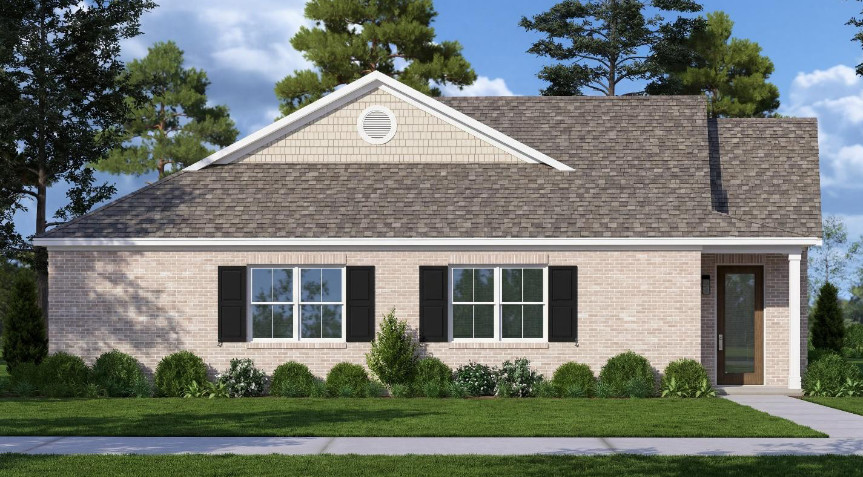
SOUTHPORT — More affordable housing could be on the way to Southport after a small development passed its first permit hurdle last week.
The Southport Board of Adjustment voted unanimously Tuesday, May 26, to approve Brunswick Partnership for Housing’s special use permit to bring seven residences between 250 and 254 E. 11th Street. Brunswick Partnership for Housing, a nonprofit focused on safe and stable housing for families in need, had to request a special use permit to develop residential buildings located in an Office and Institutional district. The adjustment board approves SUPs in Southport.
Brunswick Partnership for Housing was founded in 2019, with a mission to shelter unhoused families until they secure permanent housing. It also advocates for the development of affordable workforce residences, which the seven residences plan to reach.
READ MORE: Traffic, flooding concerns thwart Southport Crossing residential expansion
“There is very little affordable housing available in the county and what is available usually is not decent, safe, and sanitary,” Brunswick Partnership for Housing executive director Sally Learned told Port City Daily.
According to Brunswick County Homeless Coalition, a handful of affordable housing complexes exist in Southport, such as Abbington Oaks, Brunswick Village, Fiddler’s Creek, and Southport Green.
Brunswick Partnership for Housing’s board chair, Barry Fulton, told the board of adjustment the project would serve varied industries, such as healthcare providers, cafeteria or janitorial workers, educators, and hospitality or municipal employees.
“The problem is the housing markets get skewed to what is, generally, an older population moving in, a wealthier population moving in, and the folks that are working in the county and support that population can’t find housing, and when you have that gap, then you’re going to lose your workers,” Learned said.
The Brunswick Partnership for Housing project will consist of seven units across two buildings, made up of two one-bedrooms, three two-bedrooms and two three-bedrooms, as well as a storage building — altogether making up 10,516 square feet. Current renderings do not show amenities like a pool or clubhouse.
The development will be served by existing utilities and is adjacent to other O&I zoning districts. The property will also include a 20-foot landscape bufferyard and 2- to 3-feet deep stormwater pond.
Board members did raise concerns about stormwater management and flooding possibilities. City planner Wendell Biddle reassured the project was outside of the special flood hazard area and, therefore, no further requirements would be imposed.
The seven units are slated to be built next to Brunswick Partnership’s transitional housing project, established in 2023. The nonprofit converted a former Dosher Hospital building into four apartment units that have remained full since opening. Families can live free of charge for 12-to-18 months as they prepare to find safe permanent housing while receiving outreach care and case management.
The organization purchased the land for the workforce housing project from AT&T at a $30,000 price tag; the financing was covered by an anonymous private donor. Working with AT&T, the deal was a bargain, according to Fulton, as the tax value of the property is $126,000.
Both the affordable housing and transitional living complexes would be under the same ownership and enter a shared parking agreement with 29 collective parking spaces, but would remain separate entities.
Unlike transitional housing, there will be an income index used to determine rent.
The North Carolina Housing Coalition stats of 2026 indicate 52% of renters and 22% of homeowners in Brunswick County struggle to afford their homes. Roughly 26% of Brunswick County residents are cost-burdened, which means they spend about a third or more of their income on rent or a mortgage.
The rent will be determined pending final project costs, which Learned estimated around $2 million. But the target is between 60% to 80% of the area median income. As of 2025, the U.S. Department of Housing and Urban Development’s FY2025 income limits cite that for a family of four, a 60% AMI in Brunswick County is $57,000
The board of adjustment agreed the project met four criteria: not endangering public safety, meeting all required specifications, not adversely affecting adjoining properties, and in harmony with the surrounding area.
The project will go in front of the Southport Planning Board on June 18.
Have tips or comments for Sophia DePhillips? Email [email protected]
At Port City Daily, we aim to keep locals informed on top-of-mind news facing the tri-county region. To support our work and help us reach more people in 2026, please, consider helping one of two ways: Subscribe here or make a one-time contribution here.
