


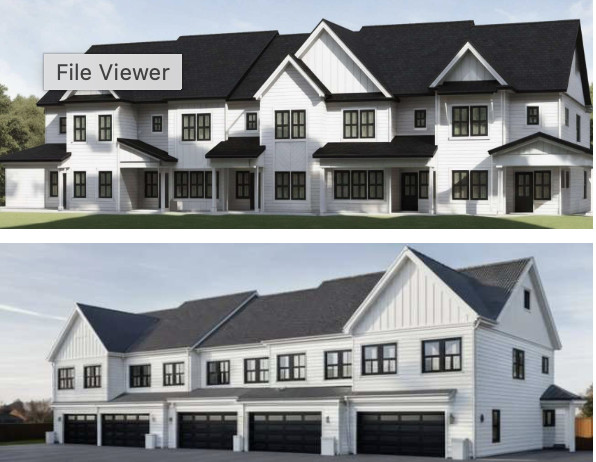
SOUTHPORT — After nearly two decades of revisions, traffic studies and shifting development plans, a proposal to double the residential units at Southport Crossing was denied by elected officials last week. Aldermen and residents cited concerns with traffic, flooding, evacuation capacity and infrastructure strain along the busy N.C. Highway 211 and N.C. Highway 133 corridors.
The vote came down to 5-1 denying the proposal, with Aldermen Marc Spencer dissenting. Applicant Paramount Engineering, on behalf of Edgehill REC, LLC’s planned unit development, wanted to amend the master plan currently allowing 60 multi-family and single-family units to be built at Southport Crossing.
Instead, they wanted to change the housing type to all multi-family townhomes and increase to 130 units. Also proposed: expanding open space and adding a community center with a clubhouse, swimming pool and fitness center.
READ MORE: Southport has a new planning board alternate but not without curt vote
The master plan had been before Southport officials multiple times since it was first proposed in 2008. According to Southport Planning Services Director Maureen “Mo” Meehan, the 48-acre parcel was at first supposed to include 300,000-square-feet of commercial space and 324 apartments. However, the development changed hands over the years and came back before elected officials between 2014 and 2016 to remove parcels and decrease density. Then the plan included 46 homes and 265,000 square feet of commercial properties.
The commercial portion was built out by 2017, now made up of Lowe’s Foods, Tractor Supply, a bagel shop and other retail spaces.
Two years later, another change came with increased residential density to 60 units, consisting of 32 multi-family and 28 single-family homes. Ground has yet been broken on the residential part, though the property itself has endured changes in the last few years.
Particularly in 2023, the Supreme Court determined, via Sackett v. EPA, some jurisdictional wetlands, which are protected by the Clean Water Act, would become nonjurisdictional. The ruling removed federal authority of wetlands without a “continuous surface connection” with other bodies of water — known as “isolated wetlands” and last year the Army Corps of Engineers changed the designation of one of a few wetlands on the site.
Thus, wherein previous plans indicated 36 acres of wetlands existed, it has decreased to 22.52 today.
“The nonjurisdictional wetlands are now eligible for development and that’s why we come before you with additional units,” Allison Engebretson of Paramount Engineering informed the aldermen at their May 14 meeting.
There are 9.82 acres of nonjurisdictional wetlands and Brad Schuler, also with Paramount, explained 130 townhomes are to be clustered on the property. The current proposal will increase development from 1.13 dwelling units per acre to 2.7; the maximum use allowed is six dwelling units per acre.
Townhomes will consist of two and three bedrooms, in a mix of single- and two-story buildings, each outfitted with garages for one or two cars. If approved, occupants could move in by 2028.
Meehan clarified the plan would still have to return before the aldermen, if approved, for the preliminary plat designations. Then they would address particulars like tree removal, parking lot standards, parking, and landscape specifications. However, Schuler said most of the land consists of underbrush, with no live oaks or specimen trees to be removed.
“Before you is just the big picture of what’s allowed in and of itself,” Meehan told the aldermen, adding Southport staff found it consistent with the 2050 comprehensive plan and the city’s unified development ordinance.
The technical review committee also signed off and the planning board approved the modification for recommendation to the aldermen.
But wetlands were a point of contention for many in attendance at the public hearing.
“Just because you rename an alligator a giraffe doesn’t mean it’s going to be a giraffe,” resident Lora Sharkey said. “Even if we reclassify a wetland, it doesn’t mean it’s not wet.”
Alderman Robert Carroll pointed out when the development was first approved, it was done under an old city code, wherein wetlands were allowed to be open space. That’s not the case in Southport today.
Engebretson countered, even though they’re grandfathered in, the developers also are up to par with new code standards. 30.8 acres of open space are included in the plans, which exceeds the 20% required in the city code, coming in at 60%.
Resident Clark Freise spoke during the public hearing about the wetlands.
“Are they going into conservation to remain open green space?” he asked, concerned about if a classification changes again.
Engebretson confirmed the plan is to build on nonjurisidictional, but the marked 404 protected wetlands will have to remain open space dictated by the master plan. A 404 wetland cannot be filled unless the USACE executes a permit allowing so.
Alderman Spencer’s questioning mainly focused on who the residential community would serve and whether it would be affordable. Developers confirmed all townhomes would be rental, not sold, and while not classified technically as affordable housing, rent likely would be in the high $1,000s to low $2,000s.
Schuler said it would be more affordable than what is currently available in Southport — apartment rentals are anywhere from $1,400 to $1,900 a month with the median home price coming at $476,450. Schuler saw the townhomes as a workforce option for police, fire or EMS personnel and teachers to affordably live in the community they serve.
“I’m struggling to see this as affordable housing,” Carroll said later in the meeting.
Spencer thought it would be a good alternative for elders in the community as well.
“Older people who want to stay in Southport but can’t maintain their home,” he explained. “It is a product that will provide that middle-grade price range or a retirement community.”
Furthermore, he suggested the townhomes be built above-grade rather than on a slab. The developers confirmed the location is not in a FEMA floodplain, despite wetlands on the property.
“I have seen what rain does here,” Alderman Rebecca Kelley said. “Buildings that are slab end up with significant flooding over and over again and they weren’t in a flood zone. So I have huge concerns for us to say a slab is appropriate when the recent classification of a wetland already causes concern.”
Kelley brought up former discussions about amending the unified development ordinance to require raising slabs in the city. She suggested the aldermen bring that discussion around again in the future.
The development team was open to making it a condition if needed.
They also added they were in for the long haul to upkeep the rental properties and ensure they continue to be marketable. Edgehill has 700 townhomes across North Carolina, from Asheville to Leland, with another 700 in the pipeline.
Mayor Pro Tem Karen Mosteller conceded bringing diversity of housing is needed, but asked the developer why they couldn’t stick to the original plan of 60 homes.
According to the applicant representatives, the price of the housing would be substantially more, as Lowe’s owns the land. Edgehill claims it would not be financially feasible to build only 60 units.
Spencer, a multi-generational Southport resident, divulged had he not bought his own home years ago he, too, couldn’t afford to live in city limits today. More so, he looked to past and recent leadership being more concerned with preserving the character and land in Southport almost to a detriment.
“The bills aren’t getting paid but the traffic keeps coming,” Spencer claimed, noting nearby municipalities and Brunswick County overall keep growing, which filters more people into the coastal community regardless. “We have to be proactive and grow and develop. We need as many billpayers as we can get — and that’s the truth. When we start talking about the budget and people don’t want us to raise taxes, it’s going to be tough.”
Everyone who spoke at the public hearing was against the residential density increase. Carroll asked if anyone in the audience wanted to step up to the mic to speak in favor — some laughter erupted.
Traffic was the primary concern, particularly as related to evacuation routes along highways 211 and 133. Maria Miller pointed to responsibly maintaining strong safety measures, saying getting to Southport from 211 already was overcrowded.
Amy Patterson urged aldermen to take into consideration all the additional developments that have been built in and around the community to gauge a “holistic” rendering of impacts.
“How is our infrastructure holding up?” resident Shirley Sullivan asked. “We are at capacity in many areas — fire department, EMS, wastewater, electric grid, medical providers, schools and more. Take a ride over to Southport Crossing and see how 800 additional trips might impact that shopping center.”
The development group had an approved traffic impact assessment from the North Carolina Department of Transportation for the first iteration of the master plan at 324 apartments. Roadway improvements were required or for the developers to contribute financially to a project NCDOT already had underway. Since NCDOT was widening Highway 211 — slated for completion by summer 2027 — the developers paid to help with it.
The intersection of N.C. 211 and N.C. 133 had a signal removed and was improved to become a flyover, with Old Long Beach Road also improved and extended to Highway 133.
According to Rynal Stephenson, a traffic engineer with DRMP, the project’s 130 units would bring 60% fewer trips than the 324 apartments first planned more than a decade ago and 20% less than what was planned in 2015. Alderman Lowe Davis thought those comparisons were “apples to oranges.”
“What’s the current traffic count for 130 units today?” she asked.
Aldermen Kelley chimed in: 852.
Stephenson added it was 2,000 for the 324 apartments.
“Every modification that came back,” he said, referring as far back to 2008, “traffic decreased each subsequent time we looked at it.”
“2008 Southport and 2026 Southport: It’s like different planets. You’re not asking us to approve or deny a comparison,” Davis said. “Even though it’s less, we are dealing with what it would be if it were built today. We have to make a determination on this reality.”
She read a motion to deny the amendment to expand housing, seconded by Kelley: “It’s not reasonable due to the physical conditions and impacts to surrounding areas.”
Spencer asked if it was possible to table their decision to try and come to a better agreement with the developer. Kelley noted they could bring back an amended proposal.
The denial stood 5-1.
At Port City Daily, we aim to keep locals informed on top-of-mind news facing the tri-county region. To support our work and help us reach more people in 2026, please, consider helping one of two ways: Subscribe here or make a one-time contribution here.
We appreciate your ongoing support.
