


BELVILLE — A Brunswick County municipality joined its neighbor in banning open-burning within its incorporated borders. Both towns hope to see more follow.
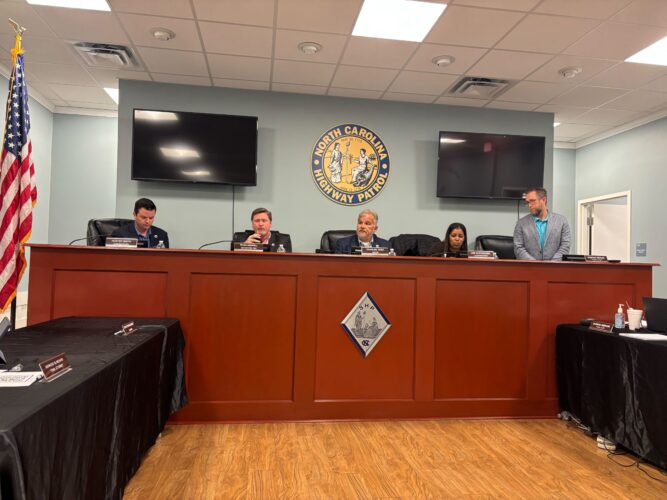
On March 24, the Belville Board of Commissioners voted unanimously to ban open-burning as a method to clear land. As opposed to burning, Section 22.12 of Belville’s zoning ordinance requires any land-clearing operations include disposal of debris at an off-site location, such as a solid waste or composting facility, or suggests chipping and mulching instead. The ordinance was proposed to help with air quality concerns related to smoke pollution, protect public health and safety and prevent fire hazards.
READ MORE: ‘Uncharted territory’: Leland needs state to validate burn ban, a first among municipalities
ALSO: Smoke clears over Southport: Developers cease burns after community pushback
Violation of the ordinance will result in a $500 daily fine for every day a contractor is in breach of code, and will constitute a Class 3 misdemeanor under G.S. 160A-175 and G.S. 14-4, which stipulate enforcement rights for municipalities.
Tuesday’s motion was five months in the making, according to Mayor Charles Bost. He told Port City Daily Leland council member Veronica Carter introduced the idea to the mayors and boards of varied northern Brunswick County municipalities, including Navassa and Northwest. Southport and Carolina Shores already had burn bans in place by the time Leland established its ordinance last fall.
“Developments are happening so much, especially in Leland, they had a concern about getting burning under control. They saw the whole region needs to have a unified approach to it,” Bost said, noting he wanted Belville’s ordinance to be consistent.
Carter explained getting all the northern municipalities involved against open-burning was the best way to address the issue of smoke impacting residents living in close proximity. Belville and Navassa border Leland, with the three towns taking up about 21.5 square miles cumulatively.
“It did no good for us to adopt a burn ban when, literally, across the street is a different municipality or unincorporated Brunswick County,” Carter said. “We change. We ban it. The wind changes and then, suddenly, we have a problem. What do we really accomplish?”
Navassa’s town council has not had any official discussions on the matter, but Mayor Rose Terry said the town supports Leland’s ban.
Leland council members voted unanimously Oct. 20 to enact a burn ban in direct response to a land-clearing operation for a new Publix built off Highway 17. It drew resident pushback, many reporting respiratory problems because of the burning. Inhaling a toxic particulate known as PM 2.5, found in land-clearing smoke, can lead to heart attacks, irregular heart beats, issues with asthma, lung disease irritation and premature death in people who already suffer from heart or lung disease.
About a month after Leland passed the ban, the ordinance returned before council as a discussion point. More specifically, council had to appeal to the Environmental Management Commission in order to enforce air quality specific ordinances, which have fines higher than $500. The town had to apply to the EMC to establish an air quality program, per state statute; the EMC has not yet approved the town’s application. Leland wants to increase the fine limit, which Carter said would give the burn ban more “teeth.”
No developer has broken the ordinance since the burn ban’s passage, according to Carter, who also said Leland has not received a response from the state.
If Belville wishes to increase its fine from $500, it would need to also apply for an air quality program.
Bost told Port City Daily open-burning from developments has not been an issue in Belville yet. No past developments caused smoke or fire-related concerns, but he wanted to address open-burning before it became a problem for residents.
There are four developments incoming in 2026: the second phase of Evolve at Waterford Village Apartments, a 408-unit community on 25 acres, 600 East, a waterfront luxury community and marina development, a Mitchell Homes Showroom location, and a dental office.
“Fire doesn’t care about what jurisdiction it’s burning in,” Bost said Tuesday.
A case of cross-border burning occurred in Southport late last year. The city, which already had a burn ban in effect, received complaints from residents when Waterway Project developers burned debris in the unincorporated county areas, adjacent to Southport city lines. Smoke coated cars and left pets wheezing inside residents’ houses, according to accounts documented by Port City Daily and aldermen.
The issue was later resolved in a conversation among then-Mayor Rich Alt, Roger Perry of East/West Partners, and other local officials, who concluded the smoke from the burning was harmful to residents and the land-clearing method needed to cease altogether.
Bost described the boundaries between Belville and Leland as “all over the place.” The two municipalities’ lines have become jagged after a series of annexations from Leland; it wanted to address its growing population, expand the town’s tax base and services, and preserve land. The blurry lines between the two towns led to conversations of a merger between Belville and Leland, broached in 2000, 2006 and 2012, to address infrastructure and service needs. However, Belville maintained its sovereignty.
Bost didn’t share concerns about the new ordinance deterring developers from the small town of about 2,600 people. He pointed to Brunswick County’s growing population.
According to North Carolina’s Office of State Budget and Management, Brunswick County grew by 24% between 2020 and 2024; in 2024, the county’s population was around 170,000. It’s expected to grow to more than 240,000 in the next 10 years, making it the fastest growing county in the state.
“The appeal for Brunswick County and what we offer is not going to deter development,” Bost said.
In 2025, according to former Port City Daily reporting, the Brunswick County Planning Board approved 31 residential developments, which equaled 13,552 units, and 21 commercial developments.
Wilmington-Cape Fear Home Builders Association Executive Officer Cameron Moore told the outlet during Leland’s ordinance passage that the cost developers incur to clear the land would go up without debris-burning allowed. Burning debris is typically seen as a cheaper alternative. Land-clearing without burning, like shipping debris to a facility or mulching, can cost anywhere between $3,000 and $5,000 per acre, though vegetation-exclusive debris is usually more inexpensive. Moore said increases would likely be added to the price of the house or commercial space when it goes up on the market.
Bost added: “I think it’s wrong to make an argument not to have a policy to protect the environment just because it might cost a little bit more to haul the garbage away.”
Leland and Belville leaders emphasized the need for the county joining in solidarity with municipalities. The county broached the topic in November last year, but concluded under state law, it cannot ban open-burning for land-clearing operations outside of 100 feet from an occupied dwelling. County burn bans are under the discretion and jurisdiction of North Carolina Forest Service.
“This is a move to try to make the whole north-end compliant and similar so they can all be equally enforced,” Bost said adding, “inspiring the county to also adopt this, because they seem to be reluctant to do that.”
Belville’s ordinance goes into effect immediately, but Bost told Port City Daily no development will be impacted by it, as land-clearing operations have already concluded for a development off Highway 133. The vote on Tuesday was primarily a preventative measure.
[Ed. note: The article was updated to include response about ongoing and expected developments in Belville.]
Have tips or suggestions for Emily Sawaked? Email [email protected]
At Port City Daily, we aim to keep locals informed on top-of-mind news facing the tri-county region. To support our work and help us reach more people in 2026, please, consider helping one of two ways: Subscribehere or make a one-time contribution here.
We appreciate your ongoing support.
