


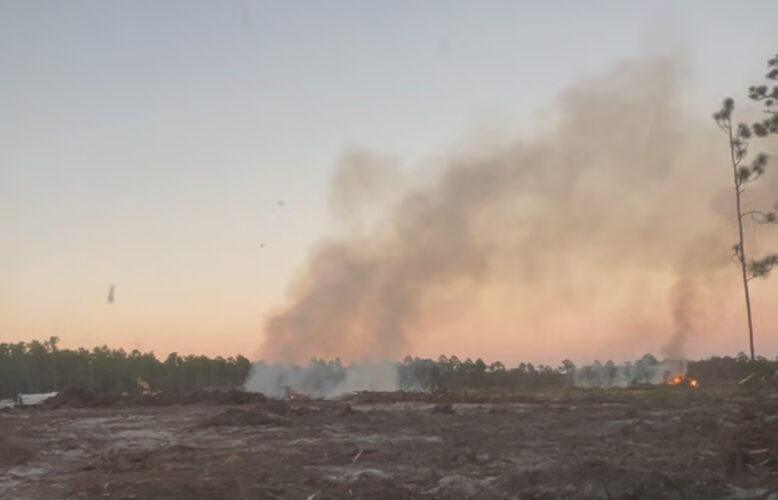
SOUTHPORT — After weeks of complaining, residents near Southport Elementary and its students will breathe without concern of smoke inhalation. A 1,390-unit development by Indigo Plantation and off of 9th Street no longer will be conducting land-clearing burns.
READ MORE: Brunswick County constrained on development moratoria, open burning regulations
ALSO: By 10-vote margin, incumbent wins Southport alderman seat in recount
Mayor Rich Alt, with help from Rep. Charles Miller [R-19] and Brunswick County Commissioner Pat Sykes, spoke with local developers at East/West Partners to cease open burning of logging debris on the Waterway Project. The burning brought in “substantial” complaints from residents for weeks, according to Southport spokesperson ChyAnn Ketchum.
The Waterway Project, greenlit by the Board of Aldermen in June 2025, has 326 acres on Brunswick County property, with the remaining 47.6 acres located in Southport. Only 199 housing units are set to be built in Southport, compared to the 1,190 on Brunswick County land. The property in county territory is set to hold 100,000 square feet of commercial space as well.
It is common practice for developers to burn lumber and vegetative debris after land-clearing when constructing new developments. East/Coast Partners began clearing the Southport part of the development this fall. Shortly thereafter, complaints were fielded by the developers and Southport Board of Aldermen.
Alderman Robert Carroll said he heard objections from neighbors in the Indigo Plantation community, as well as teachers working at Southport Elementary. A few messages sent to Carroll personally included complaints of smoke inhalation causing household pets to cough, the open-burning leaving ash all over cars, and school hallways smelling of smoke.
One message from a school teacher residing in town indicated: “I haven’t had an asthma attack in over a year, and I’ve had four in three days … Where they were burning before the smoke makes a direct path through [the] trail behind the school straight to my house, and it just sits there.”
“The smoke got so bad that it filled the entire playground when the kids were out playing,” Alt said.
Roger Perry, executive chairman of East/West Partners, said that when Alt reached out to the company to let them know that the burning was causing issues with school children, the developers immediately changed their schedule to only burn on weekends. Alt, however, thought the developers were going to cease burning altogether.
They didn’t.
“We were not aware they had made that decision,” Alt said.
When the burning began again the weekend of Nov. 22 and 23, Alt described the wind moving in from the west: “So it blew the smoke back into the residential neighborhoods and all the way over to the other side of town.”
Alt cited the aging population of Southport as one of the biggest concerns, due to increased health risks and sensitivities that could be impacted by open burning. The median age of Southport residents is 63 years-old.
Smoke from open burning can lead to a series of health problems from inhaling a toxic particulate known as PM 2.5, including heart attacks, irregular heart beats, problems with asthma, lung disease irritation and premature death in people who already suffer from heart or lung disease.
Perry of East/West Partners said he believed the issue was blown “out of proportion.”
“They said it was a problem with the school kids, so we stopped that,” he said. “They say it’s a problem on Sunday for the town, so we stopped that. It’s not like it’s a federal crime.”
Despite this assertion, Perry said the burning is officially over.
“We didn’t think we were creating a nuisance. Evidently, a lot of folks think it is a nuisance, and that’s good enough for us,” Perry confirmed.
Normally, debris burning is a cost-effective way for developers to clear a site. While East/West Partners don’t have the exact figure on costs for alternative clearing, Perry provided an estimate of around $100,000. Other than hauling the debris off-site and shipping it off, the developers also have the ability to turn the debris into woodchips, which can be used for mulch, Perry explained.
Alt waved off the cost increase to PCD. The current cost for the project is set at $515 million but is projected to be upward of $700 million when all is said and done. He said an additional $100,000, like Perry estimated, was “truly nothing” comparatively.
“The amount of money that’s the delta between burning and carting away is just going to be attached to the price of the house,” Alt said. “It’s just like when you put new streets in; all those infrastructure things are part of whatever your house costs.”
Compared to the potential lawsuits he said developers could face from locals complaining if they had to go to the hospital due to smoke inhalation, Alt said the cost of not burning the debris was minimal.
The Waterway Project is split between the county and Southport due to House Bill 911 that went into effect July 2024, which relinquished Southport’s extraterritorial jurisdiction to the county, including a majority of the territory the project is being developed on.
In the works since March 2022 — then known as Project Indigo — the development was entirely on Southport property before, but the application was withdrawn September 2022 due to changes in Southport’s development strategy, with the intent for Southport leaders and the developers to finalize new plans. By the time the project returned, the law passed putting the majority in the county’s jurisdiction and the county approved the development plan in November 2024.
In its greenlighting of the project proposal and conditional rezoning, East/West Partners and Southport entered an agreement for the town to annex the land after development completion, a goal the developers ultimately desired.
Because Southport does not permit open burnings, developers were dragging the logging debris onto Brunswick County’s land to burn. The aftereffects have added to the chorus of people advocating for towns and even Brunswick County to institute a burn ban.
According to General Statute Chapter 106-942, municipalities are allowed to regulate burn bans, especially within 100 feet from occupied dwellings and residential areas. The statute also states open burning cannot take place within 500 feet from residential neighborhoods, occupied homes, major highways and roads.
Leland passed an ordinance recently that fines developers $500 and they could potentially face a class III misdemeanor if they attempt to burn debris instead of disposing of it alternatively. However, Leland’s also must get EMC approval for an air-quality program to enforce the ordinance fully.
The county, however, is not allowed to issue burn bans outside of 100 feet from an occupied dwelling and is not permitted to deny burn permits for specific burnings. County burn bans are under the discretion and jurisdiction of North Carolina Forest Service.
Commissioner Sykes stated in order for the county to make any changes regarding open burning, the state law would have to change first. She added the Brunswick commissioners didn’t have plans to lobby for it in Raleigh, despite open-burning consistently being a topic of discussion at commissioner meetings.
At its most recent meeting, the Brunswick County Board of Commissioners discussed prohibiting on-site burning of vegetative debris. Staff referred to other counties — like Buncombe, Forsyth, and Mecklenburg counties — that have air pollution programs, meant to mitigate issues that come from burning. In order for Brunswick County to implement such a program, the county would have “an uphill battle” to get it approved, according to County Manager Steve Stone.
“We would either have to have specific authorization, special legislation, from the General Assembly, or we would have to prove to the state that we had unique pollution conditions here that merited Brunswick County having its own air quality regulation and monitoring program,” Stone said to the commissioners.
Not only would it require studies to be conducted, the program would be costly. The county would have to hire staff and experts to run and implement the program; and the cost for developers would also be higher. The higher cost for developers would then lend to higher market prices.
Alt commended the professional discussions he and elected leaders had with the developers. He said it only took 36 hours to agree to stop burning debris.
“There was no screaming and yelling,” Alt said. “No tempter tantrums. It all worked out for the best.”
Have tips or suggestions for Emily Sawaked? Email [email protected]
At Port City Daily, we aim to keep locals informed on top-of-mind news facing the tri-county region. To support our work and help us reach more people in 2026, please, consider helping one of two ways: Subscribe here or make a one-time contribution here.
We appreciate your ongoing support.
