


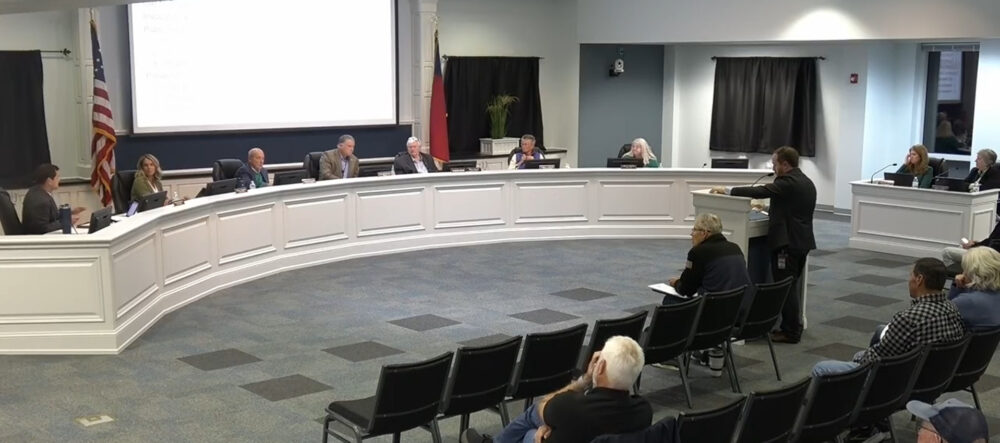
OAK ISLAND — A staff push toward getting rid of parking space minimums for commercial developments passed in town council despite concerns about making the wrong decision.
On March 17, the Oak Island town council voted 3-2 to pass a text amendment removing parking space minimum requirements from commercial developments, including retail, restaurants, recreation, and adult or sexually-oriented businesses. Councilmen Bob Ciullo and Terri Cartner dissented.
READ MORE: OKI to ditch parking space minimums to spur commercial development
“We keep making decisions without a lot of information, and I’m tired of doing that,” Cartner said.
She advocated for bringing the subject to a workshop to discuss further, noting she was “sensitive” to developers’ needs but still hesitant.
“My concern is that we’re doing the same thing we’ve done on other issues in the past, and that is going from 100 to zero with one chop of the hatchet,” Cartner added.
Parking space minimums typically are put in place to accommodate clientele numbers. The formula to calculate the minimum spots needed is based on the size of the business space, which, in theory, determines the building’s foot traffic and customer capacity. Staff, however, called the calculation “arbitrary.”
The original ordinance obligated developers to follow a formula of one parking space per every 200 square feet of floor area inside the business. Town staff was concerned small businesses and developers would be driven away by the requirement.
As an example, a 5,000-square-foot commercial lot would necessitate 25 parking spots. Staff noted the minimum requirement was oftentimes too costly for small businesses. Asphalt construction totals between $900 to $2,500 per parking spot; in the example provided by staff, the cost to accommodate the ordinance would be, at most, $225,000.
The move comes as part of the commercial code repair initiative started by Oak Island in July 2025. One of staff’s biggest concerns was the lack of commercial development. When the initiative was presented by Town Manager Kathryn Adams, she noted only 11% of the town’s land use was commercial, while the rest was overwhelmingly residential. Oak Island needed to diversify its tax base and revenue stream, she concluded. Adams pointed out, for the 2024-2025 fiscal year, only 3% of the town’s $8.6-million tax revenue was commercial.
Other cities have already made the decision to get rid of the minimum requirement. Most notably, the City of Wilmington scrapped the mandate in 2022, and the removal is also part of a nationwide trend. For example, municipalities in states like Colorado or California are making the same decision.
The amendment was first brought to the Oak Island planning board in January. It passed 3-2 with Vice Chairman Durral Gilbert and board member David Purser dissenting. Both expressed concerns about emergency vehicle access on overcrowded streets, overflow into residential neighborhoods, and sudden building expansion.
Resident Glenn Baker echoed planning board members during the public hearing on Tuesday.
“The total repeal, absent a public infrastructure plan, threatens to destabilize our residential neighborhoods next to [the commercial district],” he said. “When we remove the requirement for a business to provide on-site parking, the demand does not vanish. It simply is displaced… It is a critical safety failure. If a resident cannot exit their own property, or if emergency vehicles are hindered by haphazard street parking, the town has prioritized developer flexibility over the basic safety and property rights of its citizens.”
Baker added he wasn’t opposed to lowering the standard, but urged council to take a more “surgical” approach, rather than approve “total deregulation.”
Ciullo agreed, starting though the two often don’t line up in their thinking, this was one instance he believed “wholeheartedly.”
“I think a surgical approach with a scalpel, rather than a chainsaw, is what we need to be doing, as opposed to what this request is.”
Councilman Tommy Brown was particularly in favor, though. Brown amended the motion to include the removal of parking space minimums for adult-use businesses, such as strip clubs. Brown said he was concerned if they opened and closed later, a new business moving in could be forced to keep or accommodate an oversized lot.
He also noted town council and staff would just address the amendment’s fallout as needed.
“My step one is removing this and then addressing the impacts accordingly,” he commented, “either the ones that we and the planning board have identified as likely to sprout up, and then reactively for those that maybe we haven’t considered.”
Brown added getting rid of the mandate would also prevent stormwater runoff because it would generate less parking lots, or impervious surfaces.
Councilman Chasey Bynum was also in favor of the removal, and advocated for supporting businesses trying to settle down on the island.
“If we keep saying we are going to support our commercial businesses to succeed, then let’s give them every reason to come here,” she said. Bynum also reminded council members there was a current development, which would be impacted by whatever decision was made.
Port City Daily reached out to the town and Bynum to inquire into what development she referred to, and Bynum noted the business was not yet approved and could not provide a name. However, she commented it is a singular building and is part of town council’s push to improve Oak Island’s streetscape; however, the owner was unable to meet the parking minimum. The town did not respond by press.
She added the minimum parking space mandate was the reason she couldn’t open a business in Oak Island herself. It was meant to be a restaurant but never came to fruition.
“I don’t have the desire to open that business anymore, but the business I wanted to open, I couldn’t because I couldn’t accommodate the parking,” Bynum added.
She agreed with Brown about addressing complaints as they come.
Cartner, however, pointed out her two years of experience on the board; both Bynum and Brown are serving their first terms on council after being elected in November. She noted council has made the wrong decision more than once in the past.
“We’ve done it more than one time in the last two years.”
As noted by Ciullo at the beginning of discussion, the most recent case of council making a decision then dealing with fallout came in the recent rights-of-way amendment.
In summer 2025, Oak Island began enforcing its rights-of-way after more than a decade of not doing so. Council at the time placed stricter regulations on hardscaping and parking and directed staff to begin enforcement. By December, the town issued 502 violation notices.
The sudden shift resulted in backlash from residents, who felt either the amendment was not properly communicated or it impacted their daily lives negatively, as they used it to park or plant vegetation. A months-long abatement period ensued in order for town staff to re-evaluate properties found in violation and to come up with a solution to the public’s criticism.
Following a unanimous decision by council in January, the ordinance was amended to split the 20-foot rights-of-ways into two halves to alleviate the effects on residents’ day-to-day lives. Both halves have different regulations, some more restrictive. Any resident found to be within the bounds of the new code had their violation notice voided while anyone still out of regulation received a new notice.
“We have just gotten out from underneath this right-of-way code enforcement debacle,” Ciullo said, “and a big concern I have is it’s just gonna put us right back in the middle of it with homeowners extremely concerned about, ‘Here we go again with the right-of-way issue.’”
He agreed with Cartner’s earlier suggestion about bringing the amendment to a workshop.
“I don’t think we’re equipped to make this decision,” Ciullo said.
The motion passed anyway, despite consideration of a workshop. Port City Daily reached out to the town to inquire whether the new ordinance will go into effect immediately but did not hear back by press.
Have tips or suggestions for Emily Sawaked? Email [email protected]
At Port City Daily, we aim to keep locals informed on top-of-mind news facing the tri-county region. To support our work and help us reach more people in 2026, please, consider helping one of two ways: Subscribehere or make a one-time contribution here.
We appreciate your ongoing support.
