


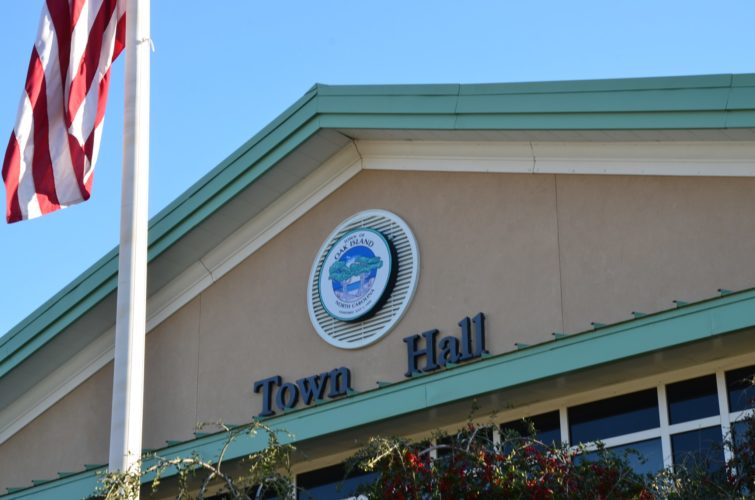
OAK ISLAND — A small town’s efforts to make commercial development a less complicated — and less expensive — venture has succeeded in its next step.
On Jan. 27, the Oak Island Planning Board voted 3-2 to pass a proposed text amendment that would eliminate parking space minimums for commercial developments. Vice Chairman Durral Gilbert and board member David Purser dissented. The proposal came from town staff, who expressed concern the minimums were based on unrealistic standards and too costly, driving small businesses and developers away from Oak Island.
READ MORE: OKI officials reach compromise on rights-of-way, re-evaluate violations
ALSO: ‘From zero to 100’: Oak Island to enforce right-of-way obstructions
The amendment was presented by Planning Manager Taylor Davis, who noted current regulations require one parking spot for every 200 square feet of floor space for retail businesses and one for every 150 square feet for restaurants. This is problematic to businesses because the space requirement is costly for small developers.
For example, a 5,000-square-foot retail space would require a minimum of 25 spaces in order to develop the property. Typically, asphalt construction costs $900 to $2,500 per parking spot, bring in a minimum of $22,500 for 25 spaces — compared to the new way which would only require disability parking be put in place.
The proposal was put forth as part of OKI’s commercial code repair initiative by town staff, introduced in July 2025. Its strategy is to update, simplify, and improve local ordinances to attract more businesses.
According to the town manager, Kathryn Adams, at the July meeting, Oak Island’s land use is only 11% commercial, and the town is at 88% buildout. Commercial tax makes up less than 3% of the town’s base.
The town, she said, needs to diversify its tax base and revenue stream.
Other municipalities, including the City of Wilmington in 2022, have passed similar ordinances and amendments to do away with parking minimums. The minimum removal has become a trend nationwide in places like Colorado and near metropolitan cities in California, both to entice more businesses, and reduce the amount of impervious spaces and stormwater runoff created by larger parking lots.
Davis added the space used for parking could instead be put toward other purposes, like building expansion or outdoor seating for restaurants. The town would encourage whatever parking the developers could afford into their budget, side-street parking, and sharing lots with neighboring businesses.
“The goal here is to give back some of the autonomy to our business owners or property owners to determine what is best for their business,” Davis said. “The elimination of the minimum parking ordinance does not preclude someone from installing parking if it’s needed or desired.”
However, the proposal brought a few issues. First, several planning board members wondered, including members Gene Brooks, Purser, and Gilbert, if the cars parked along the street, and into more residential neighborhoods and streets, would inundate residents.
“So, where’s all those people going to park? Up and down the side streets and everywhere else,” Brooks said.
“So, their parking problems are going to become everybody’s problem,” Purser added.
Davis later assured there wouldn’t suddenly be a deficit of parking spaces around town.
“It’s not as if we’ve got 50 people in line to build new buildings. We’ve got a handful. And so, even if there is one person right now who doesn’t want to do any parking — which, of the ones I know about, they’re all doing parking — we’re not going to feel a wave of an effect of having zero parking because many of our businesses already have parking established,” she said.
Purser also queried about access and parking for emergency response vehicles. He pointed out the potential of parking along the street making the area too overcrowded, forcing vehicles to park haphazardly.
Gilbert suggested the rights-of-way as a solution.
Purser also noted that businesses — he listed grocery stores as an example — could suddenly double in size, without the parking to match and thus adding to more vehicles inundating nearby neighborhoods.
Gilbert doubled down about his concern over a “free-for-all”: “Now homeowners have to call to potentially get a car towed if they’ve got friends and they want to use the front of their own [house].”
Purser warned of resident feedback — or rather complaints.
“When residents start seeing parking in front of their yards in the wooded section of Oak Island Drive, I have a feeling that they’re going to quickly say, ‘We do not want this,’” he said.
Port City Daily reached out to the town to ask if it had received any comments in favor or against the proposal yet but did not receive a response by press.
No residents were present for public comment at the Tuesday meeting, however, they will be able to provide feedback when the topic is brought up to council. PCD asked the town what dates that may be but did not hear back by press.
Gilbert said the recommended solution to share a parking lot or spaces was something the town had no control over. If businesses decided to overcharge one another for using parking spaces on their property or butt heads over customers use of parking spaces, there would be nothing the town could reasonably do to stop it, as it would be a private matter on established property.
Specifically, he was concerned about moving forward with the amendment without a fallback plan or a phased strategy, nor a clear understanding of how the new commercial development market would play out after the changes.
“I feel like this is one piece to this parking puzzle and we’re willing to just let the other pieces settle themselves out in the open market,” Gilbert said, “business to business and business to residents. That’s why I’m struggling.”
In the end, the motion passed exactly as written, eliminating parking space minimums entirely.
Have tips or suggestions for Emily Sawaked? Email [email protected]
At Port City Daily, we aim to keep locals informed on top-of-mind news facing the tri-county region. To support our work and help us reach more people in 2026, please, consider helping one of two ways: Subscribe here or make a one-time contribution here.
We appreciate your ongoing support.
