


OAK ISLAND — After a months-long debate about rights-of-way and how they can be used by residents, a small Brunswick County beach town has reached a compromise.
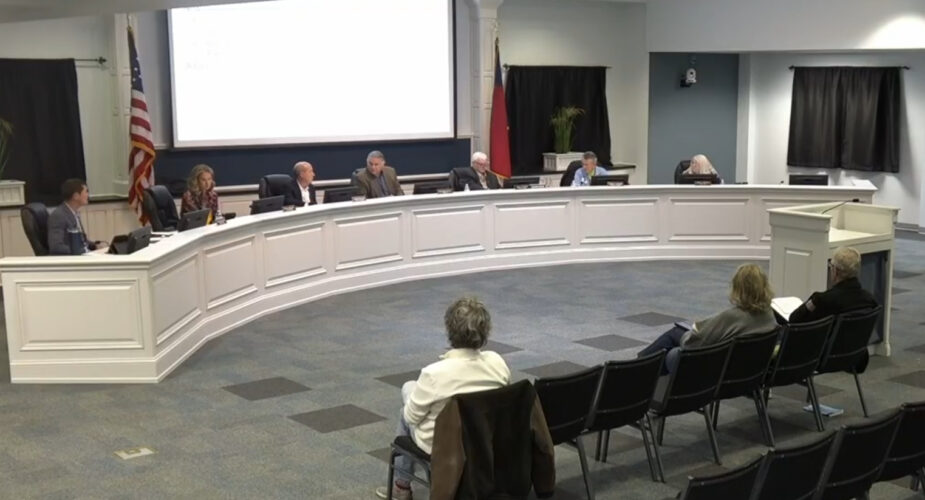
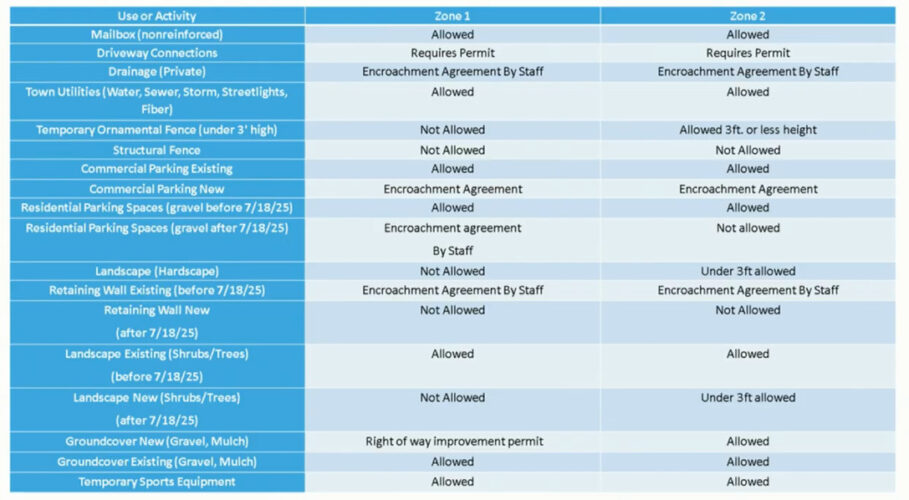
On Jan. 20, the six-member Oak Island Town Council voted unanimously to approve an amendment to town regulations on construction or other improvements in the rights-of-way. The new ordinance splits the 20-foot rights-of-way into two zones, with the first encapsulating 10 feet from the edge of the pavement and the second existing 10 feet measured from the boundary of the first zone to a property owner’s home.
The two zones are supposed to give residents more allowances within their rights-of-way, meaning they will no longer be in violation of the town UDO. Before, the ordinance only really allowed mailboxes, newspaper boxes, driveway connections, or drainage piping in the rights-of-way. Residents, however, were using the rights-of-way to park (some even installing gravel to do so), or planting vegetation in violation. Now, the amended ordinance gives leeway by creating a list of allowed improvements or structures and allows gravel-based residential parking spaces.
READ MORE: ‘From zero to 100’: Oak Island to enforce right-of-way obstructions
While both zones have different regulations, zone one’s rules are more restrictive than zone two. For example, in zone one new shrubs or trees are not permitted, but in zone two, closer to the homeowner, they must be under 3 feet in height. Obstructions in the rights-of-way, like ornamental trees, are not allowed to exceed 3 feet either.
“Common sense, I think, rules the day, and I am personally extremely happy to be at a point where we are right now,” council member Bob Ciullo said at last Tuesday’s meeting.
The change in ordinance was requested by town staff after the town began enforcing the rights-of-way regulations in the summer 2025. Though always a part of the town’s UDO, enforcement became more stringent after council amended the ordinance that month to place stricter regulations on hardscaping and parking in particular and directed staff to see it through.
Before that, the town went more than a decade of not enforcing the rights-of-way. But by December it had issued 502 notices of violation.
The change sparked a lot of backlash from residents, who felt either the decision was not communicated effectively or the rules negatively impacted their day-to-day lives.
An abatement period for addressing the violations was put into place for months and came up again in December, but the new council decided to save the agenda item for its January meeting.
The abatement period for the initial violation notices ended Jan. 18, though no fines or further warnings were issued to recipients.
Recipients of violation notices based on the newly amended zones will have a standard 10-day grace period, as opposed to the six-month abatement period from before. After 10 days, fines typically escalate further to $50 a day. Anything exceeding the 3-feet mandate is subject to removal by the town.
Encroachment agreements for structures in the rights-of-way, like retaining walls, can be submitted to the town for consideration. It will take about two to three weeks to be addressed, according to Development Services Director Matthew Kirkland, for staff to properly review the information and conduct another site visit if necessary.
The changes and new regulations are immediate and will be communicated to the town via correspondence through email, on social media, and the town’s weekly newsletter, The Current.
Have tips or suggestions for Emily Sawaked? Email [email protected]
At Port City Daily, we aim to keep locals informed on top-of-mind news facing the tri-county region. To support our work and help us reach more people in 2026, please, consider helping one of two ways: Subscribe here or make a one-time contribution here.
We appreciate your ongoing support.
