


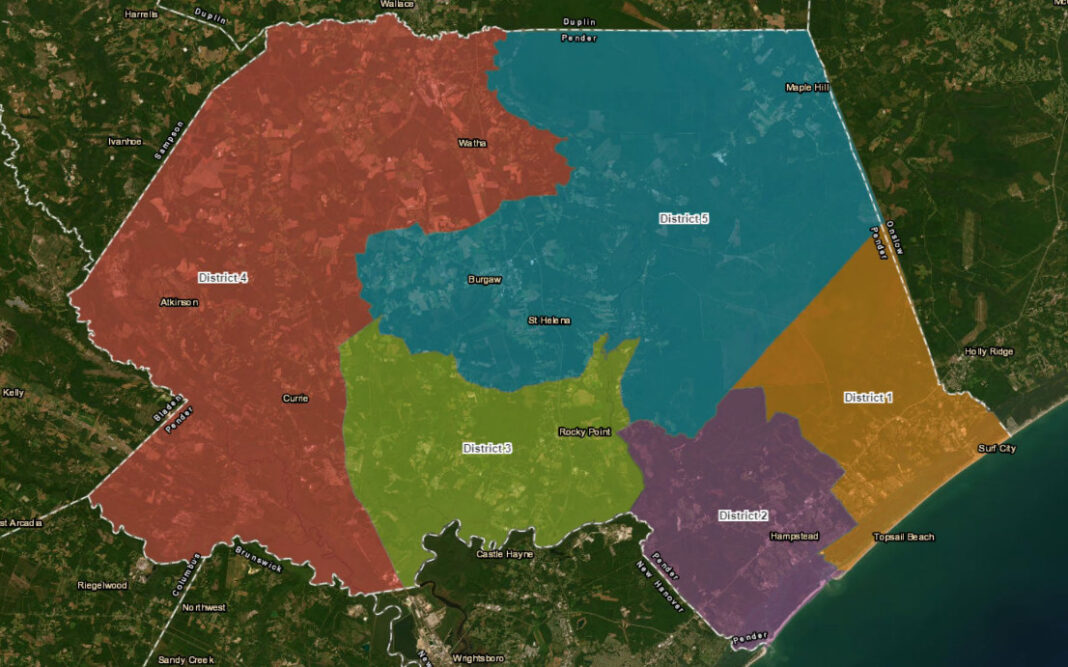
PENDER COUNTY — For the second time in about three months, the push to rebalance Pender County’s voting districts has reached a definitive stalemate — this time, the outcome appears final.
Commissioner Brent Springer’s motion to redraw district lines died for lack of a second during this week’s meeting. A follow-up motion from Commissioner Jimmy Tate to study electoral districts and a potential voter referendum for electoral districts later failed in a 3-2 vote — Chair Randy Burton and commissioners Jerry Groves and Springer against. For now, the lack of a decision leaves the current 2012 boundaries in place.
READ MORE: Stalking report against Pender Post owner dismissed by authorities — for second time
ALSO: 2026 Primary Election Results: Pender County
The votes came after County Manager Colby Sawyer provided an update Monday on the same redistricting resolution originally introduced by Springer in January. The resolution was a formal order to start the process of drawing new maps to ensure the county’s districts had equal population and followed the “one person, one vote” doctrine, requiring districts to have similar populations so votes carry equal weight. If passed, it would have directed staff to work with state experts to create new district maps by July 2026, though Sawyer said maps would likely not be ready in time for the November general election.
Springer initially moved to approve the resolution as written, which carried a July 2026 deadline for newly drafted maps. However, Sawyer expressed concern over staff’s capability to meet the quick timeline, considering the current budget season and other high-priority projects like the EMS and Fire merger.
“I don’t know that we’ll be able to do it by then, if I’m directed to, we’ll make a full-faith effort,” Sawyer told the board. “But I’m not sure that I can bring you a quality product.”
There were other matters to consider as well. Sawyer consulted with professionals at the UNC School of Government on redistricting options. He said the board is legally limited to using official decennial Census data to redistrict. This leaves the county with two choices: use the 2020 data to update the maps now or wait until the 2030 Census results are released.
The experts concluded that because the 2030 Census is only four years away, any maps drawn using 2020 data now would be considered obsolete by the time they were fully implemented. Sawyer said even if the board started the work on new maps immediately, they likely wouldn’t take effect until the 2028 election cycles due to the time required for mandatory public hearings and state approval.
While the experts’ recommendation was to wait until the 2030 Census, Sawyer was clear he was looking for direction from the board on how to proceed.
Springer amended his motion to push the deadline for new maps from July to September of 2026, intending to give staff more time to work through the current budget cycle before diving into the redistricting process. Uncertain of a timeline for completing maps, Sawyer requested the board grant him a 60-day window to do more research and return with a detailed plan of steps required for redistricting. He stated this research period would inform the final date for the board’s consideration.
Conversely, Tate proposed the county not only redistrict but change from an at-large residency voting system to an electoral district system. Under the current method, commissioners must live in a specific district, but all county voters cast a ballot for every seat. With electoral districts, only residents of a specific district could vote for their representative.
Statewide, 61 of North Carolina’s 100 counties use a form of electoral districts, including Brunswick County, while 39 still elect commissioners at-large.
As explained by Sawyer, switching to electoral districts would require a referendum for voters to decide if they want to move away from the at-large system and instead allow each district to elect its own specific commissioner.
Tate appealed directly to Springer to modify his active motion to include electoral districts.
“Mr. Springer, would you please consider — and I’m asking you on the plea of other people, of course, it’s your motion, and I’ll respect it,” Tate said. “But would you consider allowing this to be electoral, where the voters can decide on their wishes for us?”
Tate pushed for the board to “try something new” with electoral districts, but Springer declined to alter his motion.
“I don’t think [the public] likes too much ‘new’ anyway,” Springer said. “The Pender EMS and Fire merger wasn’t something new, and they’re still at the wits end of that. I’m at the point where I think we need to move forward with it. My motion still stands.”
During a Jan. 20 meeting, Springer said the county’s eastern side is more politically influential in Pender County, stating “the west side is predominantly blue, and the east side is what puts most of us in office.”
Port City Daily reached out to Springer for clarification on his position, though an answer was not received by press.
With Springer refusing to budge on the voting method, the board moved to a vote on his amended motion to redistrict by September 2026. Burton called for a second; when none came, the motion died on the floor.
Tate immediately followed with a substitute motion, requesting the county research the possibility of a transition to electoral districts and a public referendum.
“This motion may die, but can you bring back a draft that follows the electoral process that gives the voters the opportunity to vote and decide?” Tate asked Sawyer, receiving applause from the gallery. “If November of this year is too late to be on the ballot, at the most the available next date that works for the voters?”
Vice Chair Brad George seconded Tate’s motion, but it was ultimately defeated.
The board’s deadlock followed a public comment session where residents from the western side of the county argued the current at-large system silences their voices.
“We want to be equally treated. We want to be equally represented,” resident Debbie Walker told the board. “We on the west side feel as though we have not been represented … what do we have? Who is representing us?”
The push to redraw Pender’s maps is driven by a decade of explosive growth, concentrated in the coastal municipalities on Pender County’s east side, that has left the county’s 2012 boundaries obsolete.
For the districts to be considered equal, each of the five areas should have about 12,040 residents. Currently, District 1 in the Hampstead area is overcrowded, holding 15,532 residents. At the same time, District 5 in the rural west is under-populated, with only 6,885 residents. Comparing the two, there is a 70% population spread, meaning District 1 has more than double the people of District 5, yet both have the same one-seat representation on the board.
Because every voter casts a ballot for every seat under the at-large residency system, the county’s larger coastal population can play a greater role in deciding who represents the rural west. Redrawing district lines could change that balance, but the outcome would depend on how the maps are drawn.
Depending on how boundaries are configured, western communities could either be grouped into a single district, which could strengthen their representation, or spread across multiple districts, which could weaken it.
Resident Kenneth Ramsey echoed Walker’s frustration, telling the board he has learned through frequent meeting attendance public input “does no good.” Despite his skepticism, Ramsey was clear his preferred solution was electoral district representation.
“You’re going to do what you want to do,” Ramsey said. “If there’s 100 people that come here and talk against something, you’ll still do it the other way.”
With both motions defeated, the 2012 maps will likely remain the standard for Pender County elections until the results of the 2030 Census are certified.
Have tips or suggestions for Charlie Fossen? Email [email protected]
At Port City Daily, we aim to keep locals informed on top-of-mind news facing the tri-county region. To support our work and help us reach more people in 2026, please, consider helping one of two ways: Subscribe here or make a one-time contribution here.
We appreciate your ongoing support.
