


PENDER COUNTY — A proposal to begin the process of redrawing Pender County’s voting districts was tabled this week and moved to next month for consideration.
Pender County commissioners voted 3-2 — Brad George and Jimmy Tate dissenting — on Jan. 20 to take up the redistricting resolution on Feb. 17 instead. The resolution, introduced by Commissioner Brent Springer, states current boundaries are no longer representative of the county’s population and allows staff to begin redrawing the county’s residency voting districts, intending to better reflect population spread.
READ MORE: ‘Safety-wise, it’s a big issue’: Residents concerned with approved 355-home Hampstead development
ALSO: Pender County officials admit failure to follow protocol led to $667K fraud loss
But commissioners cited concerns over timing, staff capability, and whether undertaking the process ahead of the 2030 U.S. Census would meaningfully change how residents are represented.
The county uses residency districts, meaning candidates must reside in a specific footprint of the county but are elected “at-large” by all voters countywide. Residency districts ensure commissioners are from different parts of the state’s fifth largest county — the second-fastest growing — even though they are expected to represent countywide interests.
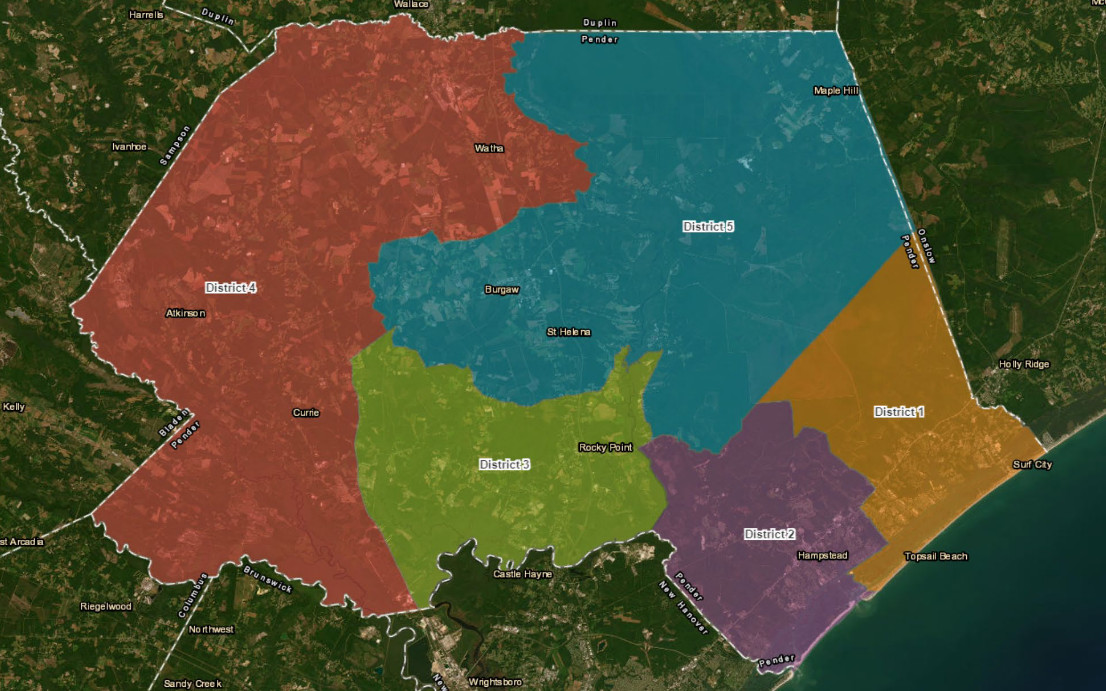
There are five districts in the county, sectioned off in geographic areas. The lines were last redrawn in 2012 using 2010 Census data to reflect population growth in the Hampstead and Scotts Hill areas. Under state law, counties using residency districts with at-large voting are not required to redraw districts after each Census, leaving the county with discretion over when boundaries are updated.
Since the last redraw, the county population has climbed from 52,217 residents in 2010 to 60,203 by 2020, with more 2024 estimates putting the total over 70,000. Therefore, commissioners are concerned current boundaries may no longer reflect population distribution.
While county staff explained the districts are not out of statutory compliance, the growing population could eventually raise questions about fairness. Currently, the county’s five residency districts are lopsided due to uneven growth along the coast.
According to 2020 Census data provided by staff, District 1, which anchors the Hampstead area, has grown to 15,532 residents. District 2, which covers Surf City and Scotts Hill, is nearly identical with 15,485 residents. Combined, these two eastern districts now hold nearly 45% of the county’s total population.
In contrast, the more rural District 5 has just 6,885 residents, less than half the population of either coastal district.
In voting districts, state law generally requires the largest and smallest districts to stay within 10% of one another to ensure every person’s vote carries equal weight. Because Pender County uses residency districts where everyone votes at-large, those limits don’t apply.
The county’s most populated District 1 is 48% larger than the ideal target of 10,446 residents. Its least populated District 5 sits 34% below the target, creating an imbalance.
The resolution would have authorized the manager, attorney, and staff to coordinate with the Office of the State Demographer to begin preparing statistically valid maps to ensure districts are “credible and equitable.” County Manager Colby Sawyer explained the State Demographer will provide map options at no direct cost, an issue brought up by a concerned resident during public comment.
Jim Harris spoke to incurring costs of the process, considering the county may want to redraw maps again once 2030 Census data is made available. Though the demographer’s services are free to the county, Sawyer said indirect costs could involve significant staff hours.
State demographers are prohibited by law from considering factors like race or political affiliation in the process, focusing primarily on population equality.
Once maps are drafted, the county would hold workshops, public hearings, and an online comment period to get community feedback before a final vote is taken by commissioners.
Commissioner Tate — on the board during the county’s last redistricting in 2012 — was concerned with county staff’s ability to balance multiple large projects simultaneously. The proposed approval timeline for the new maps was July 2026, which coincides with voting on the county’s first budget under the new county manager and the formal integration of Pender EMS and Fire under county supervision.
“I’m in favor of it, but what I’m not in favor of is if it’s not a full, transparent process, and if we rush in a process without you all having a chance to do the work,” Tate said. “Sometimes I think staff agrees, when it’s OK to tell us if you need more time.”
About two months into the role, Sawyer said the manager’s office is “incredibly taxed.” He noted the process of engaging with state officials and holding town halls would require significant time and effort, though staff would operate to the best of their ability to meet deadlines.
Tate also questioned redistricting now instead of waiting for the 2030 Census. While the county receives annual population growth estimates, officials are legally required to use the formal decennial census — conducted once every 10 years — to redraw political boundaries. This leaves Pender reliant on 2020 data until the results of the 2030 Census are formally processed and released in 2031.
Commissioner Springer asked County Attorney Trey Thurman about the risk of being sued if the county does nothing. Thurman explained Pender’s at-large system acts as a legal shield. In higher-level elections — like for U.S. Congress — a population gap between the largest and smallest districts of more than 10% would be illegal because it violates the “one person, one vote” rule. However, since every Pender voter still gets to vote for every seat on the board, the courts generally say no one’s vote is being weakened.
While the county is safe for now, Thurman noted updating the lines proactively prevents a scenario where the General Assembly might step in to mandate a change if the districts become too extreme.
For some residents, only adjusting the map doesn’t go far enough to address how commissioners are elected.
Resident Walter Davis came before the board during public comment advocating for district voting — where citizens only vote for the representative in their specific geographic area. Speaking at the Jan. 20 meeting, Davis contended redrawing lines is meaningless if everyone still votes for every seat.
“Each commissioner will be able to better represent their community in that district that they live in,” Davis said, “instead of a system that encourages every commissioner to serve the needs of the population centers. District voting gives the population centers to stay equal to the amount of the population that they contain.”
Davis added the Pender County School Board should be included in the redistricting conversation. He argued redrawing lines for one board but not the other is a half-measure, especially when both bodies are elected at-large.
Chair Burton voiced opposition to district voting, asserting the current at-large system ensures each commissioner is accountable to every citizen in the county, rather than a single area.
“I try hard to go all across this county to get the support of the citizens that I serve and I could foresee someone just staying in their district and not worrying about getting votes from all over the county — people pay taxes from one side of the county to the other,” Burton stated.
Also against district voting, Springer warned district-based elections could alter the board’s partisan makeup, pointing to political differences between eastern and western Pender County.
“The west side is predominantly blue, and the east side is what puts most of us in office,” Springer said. “If you go to district vote, you’re gonna have potentially a Democrat sitting up here versus a Republican, right? And right now we allegedly have an all Republican board.”
Changing Pender County’s election method from at-large to district voting would require approval from the North Carolina General Assembly. Because the county’s current residency district structure was established through state law, commissioners cannot switch to electoral districts without legislative authorization.
With the resolution tabled until Feb. 17, Sawyer and county staff were directed to return with a refined project timeline to better account for staff workload, a cost analysis, and additional information on the process from the State Demographer.
Under the proposed plan, any approved changes would not take effect until the 2028 election cycle. The upcoming 2026 primary and general elections will proceed under the existing boundaries. Currently, the terms for commissioners Randy Burton, Brad George, and Jerry Groves are set to expire in 2026 (Burton the only rerunning), while commissioners Jimmy Tate and Brent Springer will hold their seats until 2028.
Have tips or suggestions for Charlie Fossen? Email [email protected]
At Port City Daily, we aim to keep locals informed on top-of-mind news facing the tri-county region. To support our work and help us reach more people in 2026, please, consider helping one of two ways: Subscribe here or make a one-time contribution here.
We appreciate your ongoing support.
