


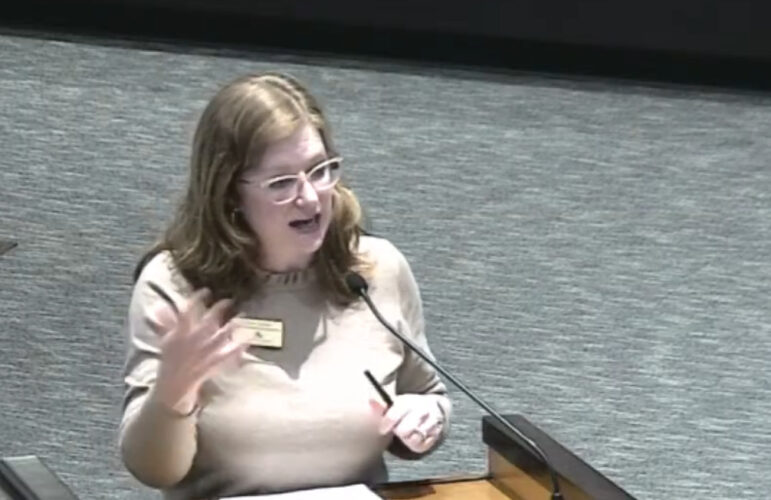
NEW HANOVER COUNTY — The New Hanover County Board of Education passed a resolution last week urging the state to change its funding formula for students with disabilities and provide more money to cover the entire population in New Hanover County Schools.
While supportive of the state changing its policy, the New Hanover County Special Education PTA claims the discussion portrayed students with disabilities as a financial burden to the district.
READ MORE: NHC school board resolution requests state raise EC funding cap
Yannone said she has received at least 10 emails from concerned community members about how students with disabilities were portrayed last week.
The group is requesting the board adopt more inclusive terminology for the future, and, more specifically, NHC-SEPTA President Denise Yannone told Port City Daily she wanted to see them avoid using the term “EC” as short for exceptional children.
“Students should not be relegated to two letters and placed in groups that separate them in negative connotation,” she wrote to PCD, pointing to NCDPI’s use of “students with disabilities” and promoting the use of “students without disabilities” also.
“Words matter and they can injure — which is what we teach our students, especially when intervening with incidents of school bullying,” Yannone wrote in a statement.
The board’s discussion at its Jan. 6 meeting surrounded a resolution calling on the state to revise the “arbitrary” cap on its funding for students with disabilities, which is set at 13% of the overall student population. The students that fall within the percentage then receive a flat rate of $5,300 per student, regardless of how expensive their needs are.
As reported by Port City Daily last month, NHCS’ exceptional children population is 13.9%, resulting in 101 students not covered by the state funding formula.
Because school districts have to fund the needs of all students with disabilities, NHCS had to find $564,927.34 in the last budget cycle to cover those students. That number could change based on the December student count and evaluation of needs, which Assistant Superintendent of Support Services Julie Varnam said her team is still finalizing.
“This is the real crux of the issue, and if we could lick this problem, we would solve so many different things,” Superintendent Chris Barnes said at the Jan. 6 meeting.
Varnam added not all students with disabilities have equal financial needs.
“The cost to serve our 30 most fragile students, all of their related services — I’m not mentioning their special education. I’m not mentioning the classroom teacher that also serves a few others, I’m talking about just the related services for our 30 most intensive students — exceeds $1.4 million this year,” Varnam said.
For example, she said, the cost of 13 students to have their needs covered under one nursing contract is $964,000; certified nursing assistants cost another $255,000, she reported.
“The list goes on with language facilitators, cued speech transliterators, educational interpreters, behavior technicians and Braille services,” Varnam said. “I’m so grateful that the board has asked for this information to be discussed, that it be provided to legislators.”
Varnam said her team is “very much in favor” of a weighted funding formula, where students would be placed in categories based on the intensity of their needs with funding adjusted accordingly. After the Department of Public Instruction conducted a study on doing so in 2021, a proposal to switch to a weighted model was proposed to lawmakers last year, though it didn’t gain traction.
The proposal has three levels, the first and lowest-cost including some therapy or other services, but the student can be placed in a general education classroom most of the time. The second tier includes more assistance, including a separate classroom sometimes. The most expensive tier represents a complete separation from general education, including “homebound” education.
Board member Josie Barnhart, who put together the resolution, said if the model was implemented New Hanover County would receive an additional $2 million.
“If we have allocated funding specifically for EC, then that would free up and allow us to reevaluate how we could staff in different environments,” Barnhart said.
Yannone said the PTA’s qualm wasn’t with the substance of the resolution necessarily; NHC-SEPTA doesn’t have an official stance on the weighted funding model, but she said she would be supportive of the state raising the cap.
Rather, Yannone said Tuesday’s comments painted students with disabilities in a negative light.
“The unfortunate impression was that students with disabilities are taking away resources from students without disabilities,” she wrote. “The facts do not support this.”
She said there are many budgetary concerns for the school district that would still exist should the state’s special education funding model change — declining enrollment, sequestered funds due to a federal sanction, capital needs in and outside the proposed 2026 bond.
NHC-SEPTA’s letter, sent to each board member and Superintendent Barnes on Jan. 9, requests the school publicly adopt the United Nations Guidelines for Disability-Inclusive Language or a similar set of guidelines.
Some of the U.N.’s key principles include describing people as having a disability rather than disabled, avoid using “special needs” or “special person” as it implies exceptionalism rather than inclusion and framing student needs in terms of skills rather than impairment (Braille-user versus blind person).
The resolution also requests the board announce a reminder of the use of disability-inclusive language at the start of each school board meeting, ensure district staff undergo professional development and make a concerted effort to follow the guidelines, and students receive instruction in the use of disability-inclusive language.
On the latter recommendation, the resolution states NHC-SEPTA believes student instruction will assist with “reducing the amount of bullying and harassment many students with disabilities experience and have reported, and will improve positive school atmosphere for all.”
Port City Daily reached out to each board member for a response to the letter; Barnhart said she did not recall receiving the letter and Bradford said she was out of the office. No others responded by press.
Tips or comments? Reach out to journalist Brenna Flanagan here.
At Port City Daily, we aim to keep locals informed on top-of-mind news facing the tri-county region. To support our work and help us reach more people in 2026, please, consider helping one of two ways: Subscribe here or make a one-time contribution here.
We appreciate your ongoing support.
