


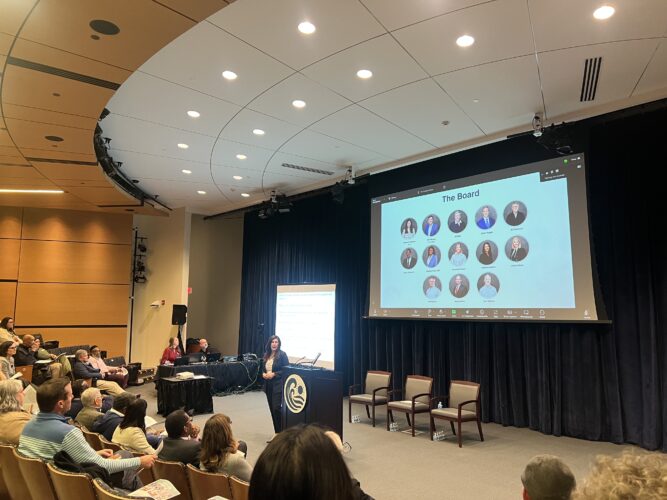
NEW HANOVER COUNTY — The New Hanover Community Endowment hosted a listening session with the public Wednesday night. Questions on how the $1.6-billion entity will address recent government funding retreats and publicize data on its grants’ requests remain unclear, however.
“The Endowment and our bylaws prohibit us from being a backstop for what the government would pay for,” board chair Shannon Winslow said during Wednesday’s question-and-answer.
Port City Daily asked the leaders, including interim CEO and President Sophie Dagenais — who presented budgetary outlooks for 2025 and 2026 expectations, along with taking audience questions — to describe the dynamic between The Endowment and government entities. Particularly, where is the line between what the government should fund and The Endowment should include in its grantmaking, for some of the region’s top-of-mind issues — affordability, homelessness, housing, traffic and infrastructure.
“We’re looking to be more of an enrichment,” Winslow said. “But we are looking to solve some of these issues. And the good news is, in New Hanover County, we have an endowment that can enrich and solve some of these issues where other counties are not fortunate enough to have the assets that we have at The Endowment.”
Though, the stance comes as government funding at all levels is becoming less reliable. Area nonprofits, such as the domestic violence shelter, and government departments, like housing and urban development and public schools, saw their funding cut, reduced or delayed for review by the Trump administration this year.
Additionally, several local politicians, including New Hanover County Commissioner Dane Scalise and former Wilmington City Council member Luke Waddell, have suggested local governments shift their nonprofit funding to The Endowment. In the county’s budget passage, the commissioners actually pulled back $1.6 million in non-county agency funding.
The Endowment did step in to cover the $1.6 million in nonprofit cuts from the county budget this year, which included funding to the Carousel Center ($50,000), Domestic Violence Shelter ($100,000), Good Shepherd (467,200) and more.
Other cuts didn’t get picked up by The Endowment, including the county’s $3-million annual commitment to workforce housing and its $200,000 annual contribution to the Continuum of Care. The county also pulled out of a joint homelessness strategy with the City of Wilmington.
Instead, The Endowment has its own housing strategy which consists of $19 million in grants spanning from the production of affordable units and shelter space to core operating expenses for housing nonprofits.
Dagenais told Port City Daily The Endowment’s resources could never fill the gaps left by local, state and federal governments, and thus, it has to be picky about what it funds.
Still, some in the community believe The Endowment could do more. In August, council member Salette Andrews asked city staff to figure out how the city could fund the homelessness strategy without the county, hopefully, with the help of The Endowment.
Port City Daily asked Dagenais and Winslow if they planned to assist in funding the joint plan; the detailed plan includes growing the capacity of the CoC and nonprofits, along with examining zoning regulations.
“Well, we see it’s important to be very familiar with that plan,” Dagenais said, noting the plan is sitting on her desk. “It could well inform some of the strategies that we want to recommend to our board going forward, whether they relate to housing and shelter or mental health.”
Ultimately, Dagenais said, it was too early to say, as implementing the plan would require an “extraordinary” amount of work and resources. The joint homelessness committee did not determine a price point before disbandment.
“What we can predict is that we do not have all the resources to address it,” she said.
Accountability
Port City Daily also asked about The Endowment’s accountability metrics for its grants. In March, the former CEO and President Dan Winslow — who abruptly departed in the summer less than a year on the job — said the team is exploring how to create a data dashboard where members of the public can track progress on grant-funded projects and community impact. Dagenais told Wednesday’s crowd it was still in the works, with progress indicators — unspecified to Port City Daily — still being studied.
“We have named them internally,” Dagenais said. “We are consulting with our community advisory council and with our board.”
One of the main complications of presenting the data is that impact can be hard to trace; feedback on if a grant is making the community better is multifaceted and often not immediate. The Endowment will also need to outline data-sharing agreements with grantees.
“It requires quite a lot of work and what I can promise you is we are doing the work, and it will be very apparent when we can begin to share publicly what that looks like,” Dagenais said.
The Endowment does maintain it tracks the progress of its grants. As reported in Port City Daily’s story on the Endowment-funded Community Justice Center, The Endowment has implemented scheduled reporting requirements and ongoing grant monitoring processes that review “progress, financial documentation, and outcomes” of the CJC.
“While we don’t share specifics out of respect for our partners, we track funding and outcomes to ensure accountability and impact,” The Endowment wrote in a statement for the story in October.
Though The Endowment has shown it will revoke a grant when the “vision behind it or underlying it” is no longer being pursued. Such was the case with the Northside Food Co-op’s grocery store planned for 10th and Post streets.
The Endowment pulled its $6.7 million-grant, the lion’s share of the store’s funding, in June. This occurred several months after the city announced its plans to bring a big-box grocery store to Chestnut Street, only 1 mile away from the co-op. As a result, the Northside Food Co-op announced it would reevaluate its business model.
In late November, Cape Fear Holdings — an entity of Cape Fear Development, which had a year to close on the purchase — informed the city it would be pulling out of the Chestnut Street project. It’s unclear if the restrictive covenant will remain to keep the property a grocery story.
However, Winslow and Dagenais refused to acknowledge The Endowment’s decision to revoke the co-op’s grant was in response to the Chestnut Street project, rumored to be a Publix.
“We’re not privy to conversations with Publix, if it was a Publix by the way, or any grocery store … what I know is that the vision went away,” Dagenais said, pointing out The Endowment did make a smaller, $320,000 grant for operations to Growing Resilience, the nonprofit overseeing the food co-op.
Moving forward
Much of Wednesday’s meeting was dedicated to audience questions. They ranged from whether The Endowment could help pay for the school district’s planned $320.5 million capital bond — the answer essentially being no — to if the environment can become a funding priority for The Endowment. Dagenais said she anticipates some interesting opportunities and a whole economy around the environment.
Aside from questions, Dagenais did offer a year-end recap of The Endowment’s actions and a preview for 2026.
The Endowment awarded $35 million in new grants this year and paid out $18.5 million in prior commitments, coming in just under its budget of $54.8 million for 2025. The grants were made almost evenly across all four of The Endowment’s pillars — community safety ($14 million), education ($13.4 million), social and health equity ($16.6 million) and community development ($15 million).
Looking to next year, The Endowment has a slightly larger budget of $57.8 million. With $23.7 million in prior commitments, the remaining balance for new grants in 2026 is $34.2 million.
The budget is determined based on The Endowment’s corpus amount, with annual distributions capped at 4%. In 2028, a majority of the Endowment’s income will be made up of investment income — and not just taxpayer dollars from $1.25 billion of the 2021 hospital sale to Novant; The Endowment then will become a private foundation, required to spend at least 5% of its corpus annually.
Though The Endowment did not provide an update on its permanent CEO search — Dagenais serving in the interim after Winslow’s exit — several members of Wednesday’s audience pushed for Dagenais to stay on in the role. Ruth Finch, executive director of Elderhaus, was one. Elderhaus received nearly $1 million this year to strengthen its programs and operations for older adults.
“I want to specifically call out Sophie tonight and acknowledge her engagement, her articulation, her intellect, her accessibility and approachability, engagement, her curiosity, when she goes out and actually has conversations and listens and learns what’s going on in this community …” Finch said. “I want to acknowledge the board that, I don’t know if you found her or she found you — that’s no matter at this point — but you see the value and the excellent asset that she is to this organization, and she is a true treasure.”
Also piling on the praise was Pastor Robert Campbell of New Hope C.D.C, an affordable housing organization that has received $5.26 million from The Endowment over the last two years.
“You’re a very intelligent woman, but your heart is even bigger than your brain,” he said, gesturing to Dagenais. “Thank you for caring about our community, and I would like to say to the board, I hope we keep Sophie.”
Reach journalist Brenna Flanagan at [email protected].
At Port City Daily, we aim to keep locals informed on top-of-mind news facing the tri-county region. To support our work and help us reach more people in 2026, please, consider helping one of two ways: Subscribe here or make a one-time contribution here.
We appreciate your ongoing support.
