


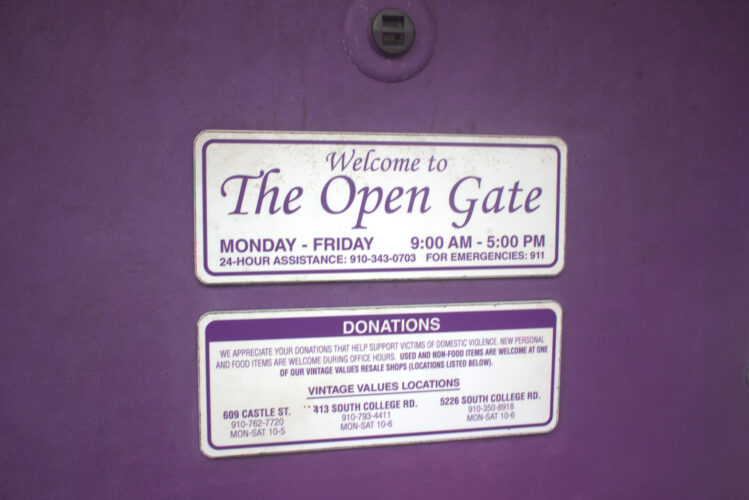
WILMINGTON — The ongoing trend of government funding loss has left nonprofits in the region grappling to do more with less, many pivoting to find more private dollars. Wilmington’s Domestic Shelter and Services learned just last week more than a million dollars is coming its way, giving it a boost to hire staff and extend outreach.
READ MORE: Domestic Violence Shelter and Services announces awareness month events
DVSS has been a lifeline for many seeking help in the agency’s four-decade existence. The shelter and services primarily serve New Hanover, Brunswick, Pender, and Columbus counties and offers people escaping domestic abuse a place to live, food to eat, a bus ticket, and more. Despite this important work, funding from the government has depleted, leaving some nonprofits reeling and scraping the bottom of the barrel.
DVSS has lost nearly $170,000 in grant funding this year from the federal government, along with $30,000 from the City of Wilmington, $100,000 from New Hanover County and $470 from state funding.
Executive Director Lauren Bryant and Direct Services and Outreach Coordinator Mandy Houvouras said their funds are now predominantly local. Whereas a year ago, 44% came from government grants, it is only 30% today. The other 70% comes from private donors, other grants, fundraisers, and their Vintage Value shops around Wilmington.
While DVSS has been able to maintain staff, sacrifices have been in the direct financial and material aid they provide clients; current staff are also stretched thin with an increasing workload and no additional help. But on Sept. 30, DVSS received a $1.4-million grant from the New Hanover Community Endowment.
“We’re not just trying to stabilize and stay where we are, we’re able to even meet the increased capacity and expand,” Bryant said of The Endowment grant. “We’re not just in survival mode. Now we can survive and thrive … This Endowment funding has helped us plug some holes and given us a little bit more cushion.”
The Endowment money could not have come at a better time; the same day as it announced $1.4 million for DVSS, the organization found out it lost money from the Crime Victims Fund, as a part of the federal Victims of Crime Act. Over the last six years, funds have gradually decreased in disbursement. In 2018, VOCA funds were at $103 million, to be given to domestic violence shelters and organizations across North Carolina. For fiscal year 2025, the projected state budget is only $16.5 million.
DVSS normally received money from two different pots of VOCA funds: one covered basic services and one was specifically used to aid underserved communities. The team at DVSS was informed their $125,000 grant for underserved communities was not renewed because of shifting priorities under the new federal administration.
Funding for federal domestic violence programs was also under review, as per the new DEI executive order under President Trump. That money paid for two full-time staff positions, one based in office and the other at the shelter, who worked to identify and assist LGBTQ+ individuals, elderly clients, and those with disabilities.
Yet, needs continue to grow, despite loss of dollars. The capacity for the DVSS shelter is 26, but the organization regularly goes over. According to the DVSS 2024 annual report, the shelter had more days at or over capacity than it did under, with 48 adults staying for more than 42 days — the usual time limit is 45 days.
“We’ve got little Pack N’ Plays,” Bryant said, “kiddos in trundle beds. I think last year, we sheltered 130 adults and about 100 kiddos.”
Not only does the nonprofit provide temporary shelter for those in need, it also offers multiple educational and preventative services. Most recently, DVSS began hosting training for Novant Health nurses to teach them how to recognize signs of domestic violence and abuse.
The DVSS team has also taught seminars in schools. For children, they employ the philosophy that hands and words are not meant to harm, as part of the program Hands are Not For Hitting. As for teenagers, the seminars look quite different, according to Houvouras.
She noted technology has played a large part in the conversation because of location sharing. Teenagers find it commonplace to drop a pin on a map and share it with friends and partners from their cellphones — which could cross boundaries when peer and partner expectation is to know where they are at all times. Houvouras said the program gets to the root of much of domestic violence, showing teenagers it’s about control. DVSS teaches how to set boundaries and reframe perspectives on relationships.
Safe Dates is one program; it covers what dating abuse can look like and what makes a healthy relationship. Students sign up for 10 sessions through a DVSS partnership with GLOW Academy, an all-girls’ charter school.
“I won’t forget, a few years ago a teen said: ‘I really want to end this relationship. I’m not happy anymore with this person, but I have to wait until I have a good enough reason, like I don’t have a reason to break up with them right now,’” Houvouras detailed. “And that never occurred to me — that they’re walking around waiting for something big to happen so that they can justify ending a relationship.”
Shequana Pulliam, prevention specialist and head of the Teen Advisory Council, meets with students a few times a month as well, to talk about what they find of value and importance. DVSS also holds listening sessions with the teens.
Pulliam explained that teens in middle and high school often don’t feel heard, so if they have a problem, they are less likely to talk about it. That can become dangerous in situations of domestic violence. Pulliam and the Teen Advisory Council hope to facilitate open and judgment-free conversations.
“By creating these spaces now, and engaging in healthy dialogue, we provide an opportunity for them to listen, share concerns, show compassion, and think of unique ways to create change amongst themselves,” Pulliam said.
At the heart of these discussions, she explained, was empowerment, which DVSS teaches adults, too. According to Kim Cook, a professor of sociology and criminology with a specialization in domestic violence at UNCW — and a survivor herself — said empowerment is vital to healing.
“The opposite of trauma is empowerment because being traumatized by domestic violence is a situation of incredible powerlessness, where your whole body has become a crime scene and your whole life has become a place that you don’t even recognize anymore,” Cook said.
The nonprofit hosts empowerment groups weekly for clients and other survivors. It used to offer an empowerment group in Spanish, too. Rocio Hernandez, who has chosen to use an alias for her and her son’s safety, attended one in the mid-2000s.
With a 2 year-old son in tow, Hernandez had to build up the courage to step into Open Gate for the first time in 2007. She was alone in the United States, without other family. Her partner was arrested and she was urged to seek domestic violence services.
Scared, it took passing by the DVSS office a few times for Hernandez to finally knock on the door, but when she did, she said her life began to change for the better.
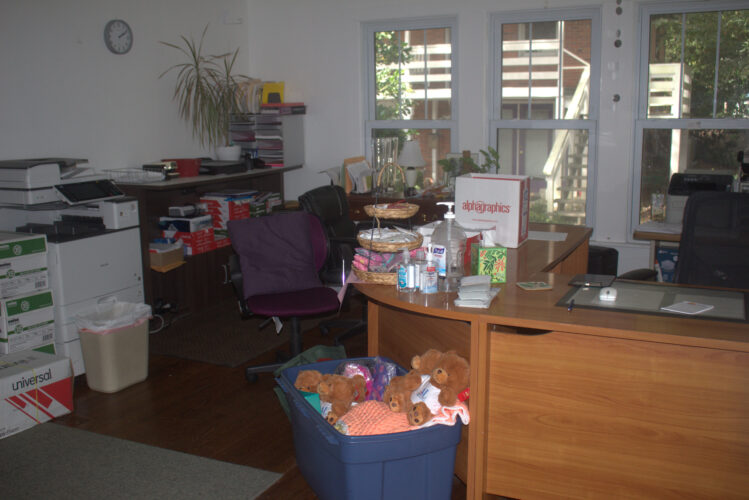
“I am here. I am one of the survivors,” she told Port City Daily. “The shelter, for me, was a blessing.”
Hernandez did not speak much, if any, English at the time. She said she was too scared, as her abuser used Hernandez’s lack of proficiency as another way to control her everyday life. The Domestic Violence Shelter and Services had classes in Spanish for her to attend.
Looking back, Hernandez said her self-worth was shot, not to mention recovering from physical abuse. At the time, she couldn’t stand to have photos of herself taken. Her partner had convinced her she was ugly — so she never took any pictures, not even with her son.
“They helped me to learn my value and love myself,” she said. “In the class, they told me I was beautiful. Now I look at myself in the mirror and I practice telling myself I have value.”
The Spanish empowerment group continued until the Covid-19 pandemic hit in 2020. Because of funding cuts, DVSS hasn’t been able to pick up the program again and DVSS’s part-time Spanish-speaking employee stopped working with them earlier this year. The organization plans to use some of The Endowment money to also hire a bilingual advocate.
Currently, the organization utilizes its Language Line or temporary interpreters to translate as need be, but there is a need for permanent help, especially according to Hernandez, who has spoken to Spanish-speaking victims e in the same situation she was 18 years ago. Having someone full-time who can comfortably speak with clients and who understands the culture is more of a benefit.
“There’s a lot of Spanish speakers walking alone,” Hernandez said. “They don’t see the information now. They have nowhere to go.”
According to a 2021 study from Esperanza United, 1 in 3 Latina women will experience intimate partner violence in their lifetime, making them an incredibly vulnerable population. Now, in 2025, a study from the Alliance for Immigrant Survivors has shown that advocates have seen a rise in immigration policing concerns from immigrant clients, even if they are legal residents.
In addition to outreach programs, DVSS provides help for survivor’s daily needs, such as transportation, food, and even rent. With the trend of funding decreasing each year, the first item DVSS cuts back on is direct aid. They’ve had to minimize how much help they provide with transportation fees, rent, utilities, and similar expenditures. It’s why community efforts and collaboration remain so important. Help from the church, local law enforcement, the hospitals, and even individual donations plays a large part in propelling DVSS forward.
Some partners who provide funding for their organization include United Way, North Carolina Community Foundation, International Paper, GE Foundation, Charitable Auto Resources, the Cynthia and George Mitchell Foundation, the Dan Cameron Family Foundation, and the Lagomarsino Foundation.
“It is not just the survivors’ issue. It’s a community issue. It impacts every one of us,” Bryant said. “That survivor’s got friends or family or workplace or church. They’re going to be affected. Maybe they can’t go to work. So then there’s an economic impact.”
The Endowment money — including $600,000 DVSS received last year, as well as the $1.4 million announced last week to be disbursed through 2027 — will help boost advocacy. As Bryant and Houvouras explained, they were filling in the gaps left behind by the cuts to their funding, especially when it came to hiring more people and ensuring those they already had on staff were being compensated and their burden lightened.
“Our services do not happen if we do not have a team full of advocates,” Bryant said. “We cannot serve the over 1,400, almost 1,500, people we do every year if I don’t have somebody to sit with them and walk them through their journey and their process.”
DVSS’s team is made up of nine people – four based in the Open Gate office and five based in the shelter.
“From the board standpoint, the biggest thing is trying to stabilize and keep what we have staff-wise,” Bryant said. “Because if I don’t have that staff person to meet and to advocate with clients, to tell them those resources, then we’ve got a packet of information that you have to wade through.”
Bryant also wants to hire an advocate to assist in protective orders and who could cover the Community Justice Center, which opened just more than a year ago. DVSS is there every Monday from 9 a.m. to 12 p.m. and are on call otherwise, according to Houvouras. While at the CJC, advocates can file protective orders for those in need. However, DVSS has been pulling staff members from the office and shelter in order to have representation at the Harrelson Center location, so hiring someone to act as that liaison would reduce how far current staff needs to stretch.
In New Hanover County, 1 in 3 homicides with female victims are a result of domestic violence. Globally, 1 in 3 women experience domestic violence in general, with 1 in 7 men facing it.
“If you’re in a city council, county commissioner room, there’s a good chance that it’s impacting somebody in there in a big way,” Bryant said. “And you’re sitting at a church pew. There’s somebody sitting in that church pew with you. You’re eating at a restaurant, there’s somebody in the booth, at that table.”
Houvouras explained the abuse isn’t always physical either — sometimes, it’s about the dynamics in a relationship. Isolation, too, impacts behaviors, as domestic violence is also based on power. Financial control and the loss of autonomy in decision-making are common red flags.
According to Cook, another key factor can come with personality changes.
“If people see themselves as shrinking and making themselves smaller in order to avoid causing a problem in a relationship, that might be a red flag that something worse could develop in this situation,” Cook said.
When asked about messaging DVSS wants to impart on survivors, Houvouras stated a proverb that resonated and originated from a Greek LGBTQ+ poet Dinos Christianopoulos: “They tried to bury us, but they didn’t know we were seeds.”
“The path may not always be easy, but there is a way, and you don’t have to walk it alone,” she said.
October is DVSS Awareness Month and on Oct. 16, the local organization will be hosting its “Take Back the Night” rally at 6:30 p.m. at Water Street Park. The organization’s Vintage Value stores at University Landing, Castle Street, and Monkey Junction will also be having “Catch a Discount” days until the last weekend of October. The proceeds and earnings from the Vintage Value stores go back to fund the organization, while clients also are able to shop at the stores for free in order to get clothes, household goods and more while transitioning back to independence.
The DVSS 24/7 crisis hotline is (910) 343-0703.
Have tips or suggestions for Emily Sawaked? Email [email protected]
Want to read more from PCD? Subscribe now and then sign up for our morning newsletter, Wilmington Wire, and get the headlines delivered to your inbox every morning.
