


NEW HANOVER COUNTY — The Community Justice Center, a grant-funded operation bringing nonprofits and the justice system under the same roof to promote efficient collaboration and access, has now been open for more than a year. The vision of a one-stop shop has yet to be fully realized, and when it does, its partners say it could be years — and the ability to provide permanent staff — before the public sees the transformational change promised by the founding documents.
READ MORE: DA to lead endowment-backed Community Justice Center, Gabby Petito’s family at ribbon cutting
ALSO: CJC to increase security, protective orders, Ben David talks updated needs
The problem is the Community Justice Center has a little more than a year to provide its indispensability before its grant runs out.
Statistics on how many people are utilizing the CJC and their case outcomes have yet to be tracked; each of CJC’s partners that spoke to Port City Daily indicated the CJC is still in an adjustment period as it tests what processes work and where more resources are needed. Though, anecdotally, they said they’re seeing success.
“I can’t show you an exact number of how it is, but my day-to-day is more efficient, it’s more collaborative,” District Attorney Jason Smith said.
Founded by former DA Ben David, based on the Family Justice Center model, the center runs on two grants totalling nearly $5 million it received from the New Hanover Community Endowment in 2023. One covers the CJC’s capital needs and the other provides for two administrative and eight district attorney’s office positions.
The partner agencies operating within its walls — the Wilmington Police Department, New Hanover County Sheriff’s Office, Novant Health, Rape Crisis Center, the Carousel Center and Domestic Violence Shelter and Services — are responsible for funding their own staff.
The grants are set to be exhausted in December 2026. As CEO and chief legal counsel, David’s goal is to have government agencies — both local and the state — pick up the operational costs of the CJC.
To accomplish that, David is tasked with not just demonstrating CJC’s success, but being able to prove it is an invaluable service to those experiencing domestic violence and youth violence, the CJC’s dual target areas.
“If we’re doing our job well, the numbers should be going down, in some respects, not up, but some of this just gets down to: How do you measure the plane that didn’t crash?” David said in an interview with Port City Daily in September.
The quantifying question
A year into the CJC’s operation, only the family and partner violence component of the CJC has come online.
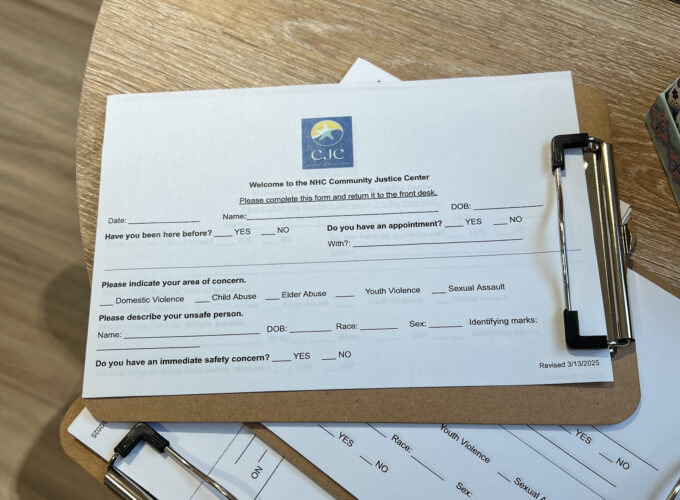
Services include helping clients file protective orders, filing police reports, talking with nonprofit victim advocates about a case or additional resources, meeting with medical staff to document injuries and evidence and more.
Specific data on how many clients the CJC is fielding isn’t available. David did share, the two domestic violence prosecutors have investigated 224 cases in the first six months of the CJC.
“This is not the complete picture,” David said. “To some respect, it’s inadequate or incomplete, because we’ve been inventing the plane and flying it at the same time.”
David said the cases that have come in have been included in each individual partner’s count, which doesn’t capture the other agencies that have assisted. He added they are now looking at a tracking system that will measure the holistic services provided by the CJC.
The Endowment does have scheduled reporting requirements and ongoing grant monitoring processes that review “progress, financial documentation, and outcomes” of the CJC, though both The Endowment and David declined to provide statistics.
“As we continue to evolve, we look forward to deepening our engagement and understanding of how the work of grantees is unfolding and creating positive change in New Hanover County,” Endowment spokesperson Amber Rogerson wrote in a statement. “While we don’t share specifics out of respect for our partners, we track funding and outcomes to ensure accountability and impact.”
In February, David said he was looking for the CJC to absorb the 50 or so protective order filings the clerk of court was seeing each week by having them filed from the CJC, made possible through eCourt’s new online filing options. David said he’s seeing around 15 to 20 being filed per week through the CJC and OpenGate, the domestic violence center on Market Street.
David did explain the CJC’s success isn’t necessarily reflected in an increased number of cases nor reduction in case age; the caseload remains the same, though the CJC does allow for more specialized attention to domestic violence cases.
The Endowment grant has allowed for three prosecutors and two legal assistants to focus on domestic violence and led to the dedication of Wednesdays for domestic violence district court cases. This gives victims the ability to obtain protective orders and relief in a bubble away from the melee of other district court cases.
David said prosecutors are seeing around 30 to 40 cases a week. In New Hanover County Superior Court, he said there’s 148 defendants under indictment.
The benefit from these additions is hard to quantify; the thought is that dedicating a prosecutor’s attention and a physical safe place, both at the CJC and in court, will improve outcomes in domestic violence cases.
“We’re going to demystify the process, we’re going to help you in a safe setting while your kids are playing in the playroom and there’s no one looking over your shoulder,” David said.
Co-located nonprofit providers in the CJC serve as a wraparound to the justice system — advocating for victims and providing resources to keep them from further harm after a violent incident. Ideally, nonprofits could also prevent a violent scenario from occurring in the first place through early detection and resource intervention.
David said, ultimately, his goal is to bring down crime in the community. In line with national and state trends, New Hanover County has seen a 34% increase in domestic violence crimes since 2019, including double the amount of homicides (19 in 2024). The CJC’s impact on these statistics takes time and parsing of other factors.
The number of youth violence, particularly gun offenses, is also on the rise, with the DA’s office administering 162 cases this year.
“I joke with people that I should have asked for $10 million instead of $5 [million] because we need $10 million … As I’m getting into this job, there’s a lot of things that I now realize we need, and we’re specifically now bulking up the youth violence side of this house because we see that as a growing need,” David said.
The Endowment grant has allowed the district attorney’s office to dedicate three positions to youth violence, but the physical space, on the fifth floor of the Harrelson Center, to commingle with community partners has yet to launch.
The goal is to bring in youth offenders, often involved in gangs, and their families to connect them to conflict mediation, take guns out of their hands and, instead, arm them with resources to target the root cause of violence — poverty, mental health struggles, lack of opportunities.
The fifth floor lease begins Nov. 1 but move-in likely won’t occur until next year, giving the CJC’s youth violence sector has even less of a runway before the end of the grant.
David said in the past he doesn’t want to go back to The Endowment again for funding after the grant expires. The ideal would be for the state to pick up the eight district attorney positions and the nonprofit’s three positions and the CJC’s rent through a mix of sources, possibly other grants.
David already tried his hand during the New Hanover County commissioners’ last budget cycle; $200,000 was on the table, David saying it would have gone to part of the CJC’s $280,000 rent, set to increase when the youth violence component comes online. David said he hoped to start gathering funding early, establishing a “nest egg,” but withdrew the request after learning the county commissioners were looking to cut $30.6 million in spending.
David was confident the CJC could make its case to government agencies and the public. With the hard data to come, this narrative relies on testimonies from the agencies within the CJC.
“Part of this is about keeping the public trust and trusting what the sheriff is saying to the community that elects him or the DA when the community elects him or her; the same thing with the chief who has to work for an elected city council,” David said.
Tallying testimonials
Port City Daily spoke with several of the agencies involved with the CJC — the district attorney’s office, the Wilmington Police Department, Coastal Horizons/Rape Crisis Center and Domestic Violence Shelter and Services.
District Attorney Jason Smith said he was thankful for the ability to grow the overall capacity of the DA’s office by moving experienced prosecutors onto the grant and hiring new prosecutors in their turn. A study the office conducted a few years ago noted the need for six to eight additional prosecutors, but in his opinion, the office needs 10, with The Endowment currently covering eight.
“Let’s say I didn’t have The Endowment grant — that’s eight positions that are on The Endowment — right now we would be in a world of hurt,” District Attorney Smith said, noting the office’s caseload has risen with the growing population of New Hanover County. “I don’t believe that we could service the amount of domestic violence crimes we’re seeing.”
He admitted measuring the increased efficiency he’s noticing isn’t easy to quantify, noting case age and convictions are tricky metrics.
“How do you measure case participation?” Smith asked.
Smith took over as district attorney in January, after winning the 2024 election against Rebecca Zimmer Donaldson. Former Gov. Roy Cooper appointed her to the post in September to serve out David’s term, as he retired after 20 years as New Hanover and Pender counties DA.
Smith said, when he came on, two prosecutors on the grant had a caseload of 100 to 200 misdemeanor intimate partner violence cases and were “swamped.”
“I said: ‘Well, what are you doing?’ [They said:] ‘Well, they’re talking to me for an hour and crying on my shoulder for an hour.’ And I’m like: ‘That’s a good time to call DVSS,’” Smith said.
Outreach coordinator at the Domestic Violence Shelter and Services, Mandy Houvouras told Port City Daily she’s seen several survivors seek services through DVSS as a result of a law enforcement interview. She attributes it to the CJC’s ability to strengthen relationships between DVSS and detectives.
“We’ve always partnered with those individuals, but usually that’s like one or two people that we have a relationship with, and so working in such close proximity at the CJC and having these, like weekly conversations, has opened the door to us collaborating in much deeper and richer ways,” Houvouras said.
Ryan Estes, speaking on behalf of the Rape Crisis Center, agreed.
“There’s several community partners that are housed there that are saying, ‘hey let me reach out and get Coastal Horizons here,” Estes said. “Obviously, with things as sensitive as sexual victimization, that’s oftentimes not an individual’s entry point into the system. They start with the hospital. They start with domestic violence and become more comfortable sharing their story. That’s how rape crisis becomes involved. And I think we’re seeing that pattern at the Community Justice Center as well.”
WPD detective Brianna Weeter said she’s seen many more victims she speaks with being connected with the nonprofits within the CJC, noting the ability to connect with someone across the hall avoids a victim leaving WPD’s care with somewhere else to drive to. This is also helpful when someone needs to take their case to the NHCSO because it has jurisdiction.
Weeter said almost everyone she talks to at the CJC is taking advantage of the nonprofit services offered there. Officers are seeing more walk-ins than they do at WPD headquarters, she added.
“That big WPD building, people are afraid to show up because they don’t really understand where it’s at, how it works … moving down here, where they can come up, they see us — it’s a lot less tense,” Weeter said.
Part of WPD’s onboarding process now includes tours of the CJC; officers have also been given stickers with QR codes for survivors to scan when officers are out in the field. The code takes them to information and contact info for the CJC.
“As a police officer, you’re called to a situation at two o’clock in the morning to untangle a mess in 30 minutes that it took 20 years to create,” Lt. Greg Willett, WPD spokesperson, said.
Now, Willett said, an officer can feel confident in referring a victim to the CJC’s one-stop shop.
“Worst-case scenario, you can take the most uninformed, slick sleeve police officer right out-of-field training, and all they need to know is about this facility and this function here,” Willett said. “As long as they know that they can advocate for the person to come here, then that victim is getting a lot more than they would have, like when I first started.”
Working through kinks
While the partners agreed the CJC was moving in the right direction, almost each one indicated the year since opening has been trial-and-error.
The Endowment grant’s two administrative positions were intended for chief legal counsel, the position occupied by David, and a program director. The CJC Board of Directors hired Joanne Cain, who stepped into the role on Nov. 4 and left in March. David wouldn’t disclose the reasoning behind her departure.
The position was then reworked into a court coordinator position. With the transition to eCourts in February — a virtual system for court documents, accessible by the public — CJC participants realized a need for someone to help navigate virtual filings. Suann Bechtel, who ran the family court division in New Hanover County for 40 years, filled that role as both a civil and criminal court liaison.
For example, Bechtel can help a woman navigate a child-abuse case against a former partner, a criminal proceeding, while also helping her through a civil custody case, all while connecting her to nonprofits in the CJC and Harrelson Center at large.
David’s vision for the CJC also utilizes the eCourts environment for victims to attend hearings virtually, allowing them to remain in the safety of the CJC and not have to physically face an abuser. The virtual court has yet to launch, with David saying the court system has not yet needed it.
“We’ve just built it with the expectation that once they get leveled out with eCourts, that they might need to start doing some of that,” David said. “But in the first six months, we haven’t had to utilize it yet, but it’s all up and ready to go.”
Additionally, the CJC has had to recalibrate its inclusion of a nurse from Novant to conduct Sexual Assault Nurse Examiner, or SANE, exams. In February, a nurse had not started working at the CJC, though now victims are able to receive forensic exams through a dedicated private space.
“That has been really revolutionary in our work with survivors historically,” Houvouras said.
Both David and Houvouras pointed out strangulation protocol has been a focus, noting how often it’s a precursor to major assault or homicide. David said the nurse’s work can serve as corroborative physical evidence that could raise a perpetrator’s charges from misdemeanor to felony.
“If we convict that guy of that felony, he’s not allowed to bear arms anymore — that’s your shooter five years from now,” David said.
Port City Daily asked Weeter if the forensic exams have helped their cases involving sexual assault. Though “not yet” was the answer, she added the nurse has been a great knowledge base for officers to tap into.
Estes said the team was still working on getting the physical infrastructure necessary for SANE exams, which require specialized care. This includes STI prevention, emergency contraception and even DNA collection, all of which differs from the more broad forensic exams.
Chelsea Croom, Rape Crisis Center program director, is seeing at least one person weekly out of the CJC, according to Estes. Those numbers have picked up over the last few months, he said.
CJC collaborators have identified a need for a permanent navigator, too — or someone that can help field the intake of new clients, particularly walk-ins, though they remain low. The navigator would then facilitate the client’s move through various resources within the CJC. UNCW interns currently assist with this process, but David said a new hire, Lauren Beatty, started Oct. 1 to help with front-of-house and data collection.
This position was not part of the original Endowment grant request, but is covered by $50,000 in lapsed salaries. David explained the grant covered salaries starting July 1, 2024, though he didn’t start until September and Cain didn’t come on until November. When Bechtel replaced Cain, the salary was lowered as well. Any money that lapses due to change-ups in the DA’s office also reverts back to the CJC.
The navigator is particularly important, while the CJC remains impermanently staffed. Though the building is available 24/7 for on-call needs, the WPD staffs one officer, though not always a detective, most of the time on a rotating basis; the sheriff’s office has permanent staff onsite. DVSS maintains office hours Monday, Wednesday and Friday mornings. They, nor Rape Crisis Center, can afford to be in the CJC all-day, everyday.
“Coastal [Horizons] is obviously really large, our rape crisis team is large, but, still, to have someone there at all times is a strain on the program,” Estes said. “It’s not a strain from the justice system asking us that, but it’s that need to be able to truly secure funding if we’re going to have people — because that’s just not how our model has historically worked.”
Houvouras agreed the next step to ensure the CJC becomes a hub for victims was to permanently staff someone from DVSS there, noting she was looking at expanding the grant funding DVSS receives in order to do so. In the days following the interview with PCD, DVSS received a $1.4 million grant from The Endowment; some of it will replace lost government funding, but some of it will go toward a CJC staff member.
For the WPD, Weeter said they were hoping to get a violent crimes detective more permanently stationed, to closely assist cases of domestic violence and sexual assault.
As far as measuring success, the CJC partners attested the initiative is moving in the right direction.
“I get a sense that people wanted this to execute on the large vision on day one and I don’t think that’s an expectation of system transformation,” Estes said. “We are shifting mindsets and ourselves, and that takes time — and when that gets developed, then the data follows.”
Houvouras added: “In order for the Community Justice Center to thrive, it has to be built on the lived experience of survivors and the input of those who’ve been doing work alongside them for a long time.”
Reach journalist Brenna Flanagan at [email protected].
Want to read more from PCD? Subscribe now and then sign up for our newsletter, Wilmington Wire, and get the headlines delivered to your inbox every morning.
