


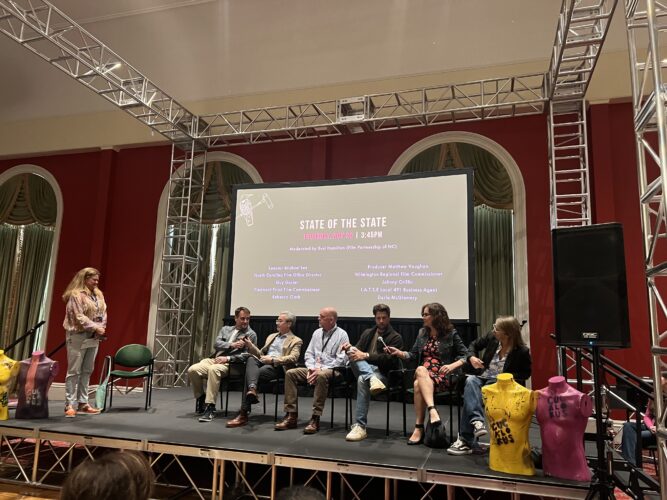
WILMINGTON — This year may have been lackluster for film in Wilmington and across the state, but leaders are hoping 2026 will come with changes to North Carolina’s film incentive, including more benefits to smaller, independent productions.
The hurdle? Getting the North Carolina General Assembly to, one, include the updates in both chambers’ version of the budget, and, two, actually pass a budget.
READ MORE: Gov. Stein announces $20M investment in NC film industry, bestows Order of Long Leaf Pine
“This is not a question of trying to get someone here on board,” Wilmington Regional Film Commission, Inc. Director Johnny Griffin said at the Cucalorus Film Festival’s State of the State Conference last Thursday, adding that Cape Fear leaders on both sides of the aisle understand the importance of film on the regional economy.
“But we’ve got 100 counties in North Carolina and all sorts of opinions across the state,” Griffin continued. “But I think, we do have to look at [the incentive] continually, have to make sure that we’re current, I think there are some things that need to be updated.”
Griffin was among other panelists at the conference, including North Carolina Film Office Director Guy Gaster, Piedmont Triad Film Commission Executive Director Rebecca Clark, Producer Mathew Vaughan, I.A.T.S.E Local 491 Business Agent Darla McGlamery and Sen. Michael Lee (R-New Hanover). Rep. Deb Butler (D-New Hanover) was also in attendance but not on the panel.
Each panelist agreed it was time to increase the state’s film incentive caps.
The state has offered a film incentive in some form since 2006, but for the last few years qualifying productions have received a 25% rebate, meaning the state returns 25% of qualifying expenses after the project wraps.
The overall cap — how much the state allocates every year in its budget — technically is $31 million; however, unspent funds accumulate and can be used in subsequent years.
The state also has a talent cap of $1 million that a production can be paid, to cover talent pay for one person up to $1 million. Any income over does not count for the rebate. The talent cap typically only applies to celebrities starring in a project, but the cap can limit a production’s ability to afford expensive talent.
“One production company talked to me and said: ‘We have three that would love to come to North Carolina. We can’t deal with that cap,’” Lee said at the conference.
Lee has proposed raising the talent cap from $1 million to $4 million, along with the amount of money a production can be refunded, in the state budget.
Features or TV movies are currently capped at $7 million; this would move up to $20 million. For a single season of a TV series, the current amount is $15 million; it would increase to $25 million. The commercial rebate would remain at $250,000.
Lee started working on his budget proposal during the state legislature’s 2024 short session, but he wasn’t successful in getting the budget adjustment (the state follows a two-year budget cycle). In 2025’s General Assembly talks, the updates made it into the Senate’s version of the budget but not the House’s.
Then, despite both chambers having a Republican majority, the legislature didn’t pass a budget this year, keeping expenses at current funding levels.
“When we, finally — hopefully — get around to getting a budget done, hopefully we can get what we worked on in the previous budget cycle, then this year to kind of get that over the goal line,” Lee said.
The goal is to keep North Carolina’s incentive competitive with other states in what increasingly appears like an arms race to attract film. More states have incentives than not nowadays, with changes implemented just this year from Texas, New York, California, Louisiana and others. The competition even has Los Angeles on the ropes, as the city faces soaring production costs as the major studios — Disney, Warner Brothers, Paramount, Universal, Sony — and executives remain based there.
On top of the state-versus-state competition, film offices are increasingly having to worry about productions going overseas.
“Primarily, it’s a combination of just business decisions that are making that [happen] — whether it’s incentives, whether it’s cheaper costs with labor, location-wise,” Gaster said. “It is one that across the U.S., there has been a downturn in production and North Carolina is no different.”
This “race to the bottom” — as referred to by several industry leaders — coupled with questionable returns on investments have some people calling for states to turn their attention away from big studio productions.
Susi Hamilton, director of the Film Partnership for NC and moderator of the panel, advocated for Sen. Lee to increase funding to the Filmed in NC Fund. Controlled by the Cucalorus Film Foundation and the NC Film Office, the grants are intended for productions under $1.5 million, thus projects unqualified for the current film incentive. The Filmed in NC Fund supports independent film and video projects by artists who are permanent residents of the state, as well as full-time students at colleges or universities living in the state year round.
“If we want to grow the industry in the state, we have to start with growing our producers and our writers and directors,” Hamilton said.
Grants for the Filmed in NC Fund range from $500 to $3,000, with this year’s awards going to 15 recipients, totaling $12,000.
Lee said trying to tinker with the grant amount would put a spotlight on the program and could draw negative attention or scrutiny.
“Sometimes it makes sense to put money in a lot of different pots, until we have the ability, one day — hopefully in the not-too-distant future — to create an add on top of what’s already there,” he said.
His approach is to include in the Senate’s budget proposal this year a “micro-budget” incentive that could be applied to productions that don’t meet the minimum $1.5-million spend for a feature film. The micro incentive would apply to productions spending between $50,000 and $1.5 million; in return, they could recoup 20% of costs or $100,000, whichever is less, on qualifying expenses.
Additionally, a micro-production could add 5% to its rebate — bringing it up to the current 25% amount — if it pays 75% of its compensation and wages to North Carolina residents. Another 3% or 5% could be gained through filming in economically distressed areas in the state.
However, the micro-budget provision has less consensus with state legislators than raising the existing incentive caps, Lee said.
Clark, speaking for the Piedmont Triad Film Commission, also advocated for the incentives to include additional, built-in funding for productions outside North Carolina’s crew bases, Charlotte and Wilmington. These productions have to attract crews from those bases, which requires them to move for a short time or commute.
Lee responded he had an idea for how to accommodate the need and requested Clark speak with him after the panel.
Though the panel agreed on the importance of smaller budget productions, also noting many have seen a rise in smaller, indie productions over the last few years, Griffin reminded the audience that a strong independent film community needed the “bigger Hollywood-type projects” to bring in top wages that could sustain filmmakers.
“A vendor will loan you equipment, or give you equipment at a good rate — they can only do that if somebody else is paying for the equipment,” Griffin said. “If you’re not paying for it, then we’ve got to have those bigger projects.”
The panelists agreed the updates to the film incentives were needed and would make the state more competitive; however, measuring how North Carolina’s incentive stacks up against other states is complicated and multi-faceted.
“It is hard to do an ‘equal comparison’ of incentive programs because of the nuances,” Griffin wrote in an email to Port City Daily following the panel discussion.
Most programs either opt for a cash rebate or a tax incentive; the latter can be particularly attractive when programs allow for unused credits to be transferred to other production entities.
Griffin told PCD there are several states that have “meaningful incentives.” This could include a good percentage, 25% or more, high project caps, and ample funding in the program, as seen in California, New York, New Jersey, Massachusetts, Georgia, Louisiana, Ohio, Pennsylvania, Texas, and New Mexico.
Almost 40 states have some form of incentive now, though what makes North Carolina stand out among other locations is its crew bases. Vaughan, who produced last year’s Cucalorus standout “Operation Taco Gary’s” said so himself.
“We’ve looked at shooting in places like Kentucky that also offer a great incentive, but you know, the worry [is] how many people are you bringing in to make something work in Kentucky versus what we were able to accomplish here?” he said.
Griffin concurred.
“We don’t have the best incentive that’s out there, but we have an incentive that works very well for a certain range of projects, and for those projects, we can be very competitive against other states that have greater incentives,” he said.
Griffin later clarified to PCD North Carolina is highly competitive for films in the range of $35 million and series up to $65 million.
“When project budgets exceed these amounts, NC becomes less attractive,” he said.
Though if the film incentive is updated, it would bring North Carolina in line with other historic hubs for the industry — California, New York, Georgia. All three have transferable tax incentive programs rather than rebates. California and Georgia have tax incentive rates set at 20%, while New York just upped its rate to 35%. California has a per-project cap of $20 million (though it’s considering raising it to $35 million) and California, along with New York, set aside funding for indie productions.
However, each has a higher overall cap — New York just increased one to $800 million, while California is considering a raise to $750 million. Georgia has no cap, meaning no limits to what it could spend on productions.
What all these states have in common, though, is losing productions to other countries. Georgia became the home for Marvel movies after 2008 but the company is now moving to the United Kingdom due to higher incentives. Though it’s building facilities in New Mexico and New Jersey, Netflix co-chief executive Ted Sarandos said the company would invest $1 billion over the next four years to produce series and films in Mexico, too.
Some countries have film incentives just as competitive as California or New York; for example, the United Kingdom has a 25.5% rebate, the Czech Republic offers a 25% rebate but a large per-project cap of nearly $20 million, and the Basque Country straddling Spain and France offers a 60% rebate for 50% of production expenses occurring locally.
Also, the costs of production in other countries are much lower, from set construction to locations to labor. The New York Times found seven technicians for one month of filming in Budapest cost around $60,000, while in Los Angeles, $53,000 covers just one senior-level grip for the same time frame. The costs are harder for stateside companies to reckon with, especially as labor costs have grown after two industry strikes.
“In addition to the actual incentive, exchange rates and universal health care have to be taken into consideration also,” Griffin said. “As a general rule, Australia, Canada, and Europe are favorite locations currently based on all of the above mentioned factors.”
Still, North Carolina has some unique features. Vaughan pointed out it was perfect for his road trip story behind “Operation Taco Gary’s” because of its range of terrain. And stateside is still preferable among independent projects large and small that can’t afford an overseas move.
But Vaughan didn’t see the shifting changes of the industry to be all doom and gloom.
“I think it’s a great time to make whatever it is you want to make,” he said. “Like there’s not a better time to be out there making things and figuring out. I think we’re gonna see more indie productions than we’ve ever seen in a long time.”
Gaster said he anticipates 2026 to be a better year for in-state spending. 2025 is currently at $175 million but Gaster doesn’t expect it to eclipse $200 million, compared to last year’s “goal” amount of $300 million.
“Phones are ringing, there are discussions that are taking place, locations are being suggested, shared… there was a time not so long ago where I was going into the office and the phone would not ring all day, and it would happen for multiple days in a row — that’s not the case,” Gaster said.
Tips or comments? Reach out to journalist Brenna Flanagan here.
At Port City Daily, we aim to keep locals informed on top-of-mind news facing the tri-county region. To support our work and help us reach more people in 2026, please, consider helping one of two ways: Subscribe here or make a one-time contribution here.
We appreciate your ongoing support.
