


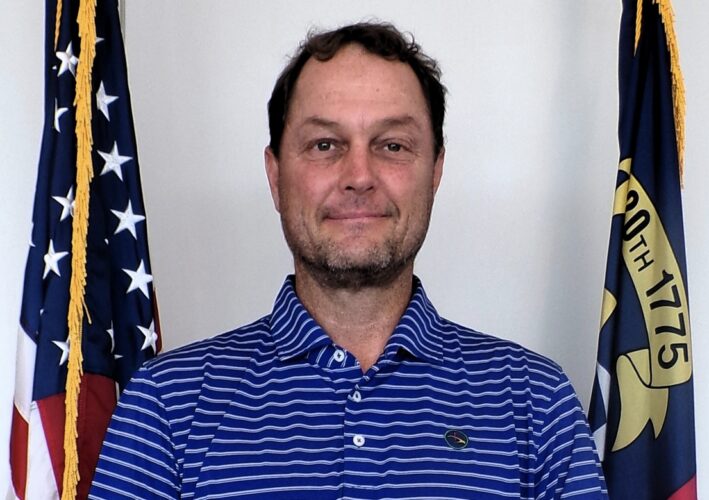
WRIGHTSVILLE BEACH — David Wortman, an attorney, is vying for a seat on the Wrightsville Beach Board of Aldermen.
Wortman has been a resident of Wrightsville Beach from youth, with his family first purchasing a home in the area in 1981.
“I was fortunate to grow up riding my bikes to the park and fishing on Crystal Pier,” Wortman said. “Now, my wife, Ellen, and I are raising our two boys here and it is more important than ever to ensure that the Wrightsville Beach I have known for almost 45 years is here for the next generation. This is why I am running for alderman.”
Though the alderman race is nonpartisan, Wortman is affiliated with the Republican party. He will face off against Todd Schoen (U), Hank Miller (R), Lee Williams (R), and Margaret Baggett (R) for two open seats.
A few things to consider this election season:
- A valid ID is required to cast ballot in North Carolina
- Election Day is Nov. 4, 2025, with voters required to go to their assigned precinct locations
- Early voting opens Oct. 16 and closes Nov. 1, and voters can cast a ballot at any of these four sites: Northeast Library (1241 Military Cutoff Road), Carolina Beach Town Hall’s Police Training Room (1121 N. Lake Park Blvd.), Cape Fear Community College’s McLeod Building, (411 N. Front St.), and New Hanover County Senior Resource Center’s Multipurpose Room, (2222 S. College Road). See all hours of operation here where you can also track the wait times at each early voting location.
Anyone who wants to register to vote can do so here through Oct. 10 or register and vote in one stop during early voting,
Port City Daily asked all candidates a slate of questions about topics that are tracking high with voters and residents currently. Wortman’s answers have been edited below for clarity.
The paywall has been dropped on candidate profiles to help voters make informed decisions ahead of the election. Candidate opinions and statements are not a reflection of Port City Daily.
Port City Daily: Why run for the board of aldermen now? Have you ever served in a public office?
David Wortman: In 2016, I ran for and was fortunate enough to win a seat on the New Hanover County Board of Education, serving the last two years as vice chair. Representing our county of 250,000 people — and more specifically 26,000 students — was not without challenges. My time on the school board included a change in superintendents, as well as navigating through COVID. I worked through budgets, making sure our schools were fiscally responsible when allocating funds. During my term, we completed a much-needed renovation of Wrightsville Beach School.
In short, my time on the school board gave me much needed experience and important local and state contacts to ensure that upon election as a Wrightsville Beach alderman, I can immediately and effectively advocate for my Town.
Additionally, in 2022, I was appointed to the Wrightsville Beach Planning Board where I have served as chair for the past two years. During my time there, I have had the pleasure of serving with other WB volunteers discussing the future of our island. My record clearly indicates my desire to limit high density development, keeping the Wrightsville Beach charm for our future generations. We regularly hear from residents about issues pertaining to text amendments, updating and enforcing current ordinances, and what they expect our community to look like in the future. These conversations, both during and outside meetings, have encouraged me to seek the position of WB Alderman.
PCD: Parking and congestion continue to plague tourists and residents during peak season, and with population growth continuing locally, what do you think Wrightsville Beach should do to help lessen the burden of tourist traffic on the town?
DW: Traffic and parking are the two most discussed issues I have heard on the campaign trail. Most candidates agree that residents deserve the opportunity to purchase two parking passes that would allow them to park in any public parking spot on the beach.
Further, removing parking spaces around crosswalks to allow additional visibility for pedestrians and drivers is a safety issue that should be immediately considered.
On average, between 22,000 and 24,000 cars cross our drawbridge per day according to WMPO/DOT traffic studies. These are “two way” traffic studies meaning they measure vehicles going to and coming from WB. Using industry standards estimating each single home residence (including all occupants) travels a particular route 10 times per day (apartment/condo seven times per day), we can assume that approximately 6,000 to 8,000 unique vehicles travel onto our island on an average busy day.
Traffic studies are unable to differentiate between those vehicles traveling for work, for pleasure or to their residence. WB has approximately 1,840 publicly managed parking spaces, 1,000 parking spaces within its hotels including Shell Island, Lumina and others, 500 spaces in private parking lots including the Surf Club, Carolina Yacht Club, Hanover Seaside Club and Bluewater parking areas) and at least 5,800 spaces in residential areas (2,926 residential units with an average of two spaces per unit). In total, conservatively, we have approximately 9,000 parking spaces on WB. While we can certainly look at ways to improve parking, I believe in order to improve our residents’ quality of life, our focus should be on how to address our consistent and extreme traffic congestion.
First, I would explore how incorporating traffic circles at our most used intersections would reduce the amount of time vehicles wait to make turns to both the north and south ends of the island. The intersections of Waynick and Causeway and at Lumina and Salisbury would be the most logical place to add these modern roundabouts.
Modern roundabouts reduce delays up to 40% when compared to vehicles sitting at signal lights. Roundabouts also reduce emissions leading to environmental advantages. There will be logistical issues in creating these roundabouts including acquiring the space necessary to construct them in the most efficient way. With construction on our bridges scheduled to start in almost two years, now is the time to explore these permanent solutions to our traffic congestion.
Additionally, setback crosswalks, or crosswalks moved away from intersections, will improve both safety and visibility for drivers and pedestrians. Increasing the distance of these crosswalks away from the edge of an intersection allows drivers more time to see and react to pedestrians.
During high volume days, I would increase the presence of law enforcement in the downtown area to ensure a smooth flow of traffic. Vehicles stopping and dropping off beachgoers in the downtown area significantly contribute to the backup of cars on the Causeway bridge.
Improving congestion, increasing pedestrian safety and reducing emissions will directly improve Wrightsville Beach residents’ quality of life.
PCD: These issues will be compounded further when NCDOT begins to build the new bridges at Wrightsville Beach in 2028. What should the town be doing to prepare residents’ for this project’s impact?
DW: As addressed previously, we should use the impending bridge replacement to adequately address traffic congestion. However, in the short term, we need to continue discussions preparing for the traffic congestion resulting from these potential closing of bridges.
While the N.C. Department of Transportation is the ultimate decision-maker in these decisions, WB residents need a voice in determining how we adapt to the construction. Questions like: 1) Will it really take two years to replace each bridge; 2) Can we close only half of the Causeway bridge during construction allowing limited traffic to and from the island; and 3) How will traffic flow during construction of the Salisbury bridges are discussions that we need to start now.
Having town halls and public forums help increase the transparency of what is to come. As an alderman, it is my responsibility to advocate fiercely for our residents to protect their quality of life.
PCD: Wrightsville Beach is perennially confronted with questions and concerns over beach access, particularly with escalating parking costs and no public transportation offered. What options would you recommend to improve beachgoers’ access to the shore?
DW: It is important that we balance beachgoers’ access to the shores with Wrightsville Beach residents’ quality of life. One must understand that parking fees pay our public utilities, including restroom and showers. There are currently plans to construct additional utilities to improve access and quality of experience for visitors.
I have previously discussed having ride-share spaces located on the north end, the south end and in downtown Wrightsville Beach to give beachgoers the option of using UBER, Lyft or other ride-sharing options. These spaces must be located outside of traffic areas so that vehicles are not stopping and disturbing the flow of traffic.
There is no additional space to construct more permanent parking on the island. In fact, I believe we need to remove some parking spaces to make crosswalks safer for pedestrians. The quality of life of Wrightsville Beach residents and safety of visitors should be our focus making these decisions.
PCD: Last year’s parking revenue was nearly $6.7 million; it’s almost double what the town brings in from property taxes and yet parking expenses total less than $2 million. Do you think this financial setup is justified? Why or why not? Do you think the town should raise, lower or keep parking rates the same?
DW: The current parking rates are consistent with rates in other area beach towns including Kure and Carolina beach. Parking revenue pays for public utilities (restrooms and showers), lifeguards and other emergency personnel.
PCD: If you had to rate the status of the town’s infrastructure — streets, stormwater and water systems, sidewalks and bike paths — how would you do so? What projects do you think the town should prioritize?
DW: As with many towns, WB’s infrastructure is showing age. We were fortunate to transition for town water to Cape Fear Public Utility Authority on Sept. 30 and, so far, that transition has gone without major issues.
WB recently inserted its first stage of bike lanes on Causeway Drive. I would like to look at putting more bike lanes accessing the north end of our island including the Shell Island corridor. Many residents and visitors alike ride bikes to restaurants and shops. Adding more biking options along with more accessible bike racks would improve these outdoor travel options.
One question I do consistently hear from residents is: Can we bury our utility lines? While I know that the current expense for burying lines is high, I would like to look at grants and matching funds from Duke Energy, to make this a reality. While this may not occur within the short term, I would like to develop a plan, discuss this option with residents and listen to their feedback to determine if this is something that would benefit our community.
PCD: Beach renourishment is already on the plate for sustainability of Wrightsville Beach, but how else should the town address environmental mitigation against erosion, susceptibility to storms, rising sea levels, etc.?
DW: Sand renourishment is always an issue for any beach, especially along the east coast. Beaches naturally move from the progression of waves and storms with East Coast beaches typically moving from north to south and east to west, meaning sand renourishment should occur every three to five years. Wrightsville Beach’s next scheduled renourishment is in 2027 but this question is increasingly important with the recent storm that battered our coastline.
First and foremost, using contacts with our state and federal officials is of utmost importance. Having access to these officials to either gain approval for interim sand renourishment or access to state and federal funds is an absolute benefit to not only WB residents but our entire local community. Prior experience and relationships will allow me to effectively advocate for Wrightsville Beach.
Second, the planting of sea oats and conservation of dunes acts as an erosion control for area beaches. Recently, local Boy Scouts participated with volunteers in the annual Sea Oat Harvest on Wrightsville Beach. These scouts are learning the importance of conversation of our beaches and resources and are taking an active part in the preservation of our future.
Finally, enforcement of ordinances prohibiting access to dunes and protected areas will allow these areas to thrive. Thriving dunes and protected areas will help maximum erosion control for Wrightsville Beach.
PCD: Wrightsville Beach has endured a lot of turnover in the last year with the resignation/exit of its fire chief, police chief and town manager. What do you want to see these leaders in their new positions achieve for the Town of Wrightsville Beach and what priorities do you want them to put first?
DW: WB has undergone many changes within the last year and a half. From a new police chief, fire chief and town manager, Wrightsville Beach is seeing improvement in many areas. One consistent issue that residents have voiced is their desire for increased communication from the town.
In March of 2025, the town hired Bailey Hartsell as communications manager. Her role is to “lead the town’s communication efforts, ensuring transparent, timely and effective engagement with residents, businesses and visitors” per the March 14, 2025 news release. I am glad that the town recognized this need.
The addition of “The Loop Newsletter” has helped to residents understand what is going on in our community.
I am excited about the recent hires and promotions for the town and look forward to what they do moving forward.
PCD: What is one other issue not discussed above that you have a plan to address if elected and how would you do so?
DW: One of the most rewarding parts of campaigning has been listening to WB residents’ ideas about improving our quality of life. Ideas from planting live oaks in our green space, enforcement of our current ordinances, allowing limited hours of dog walking on beaches and having more frequent town halls are some of the most consistent messages I have heard.
The biggest impression I have taken from these discussions is, overwhelmingly, Wrightsville Beach residents love their island and where they live!
Want to read more from PCD? Subscribe now and then sign up for our morning newsletter, Wilmington Wire, and get the headlines delivered to your inbox every morning.
