


WILMINGTON – After two weeks of waiting to finalize the vote and a night full of public disagreement, the Wilmington City Council moved forward with an anti-camping ordinance though council members’ changes from the last meeting prompted the ordinance’s implementation to again be delayed another week. However, the council did agree to start up a new program to embed social workers within the city’s police department.
READ MORE: City to explore using its property for homeless shelter after approving camping ban
Council voted unanimously to approve a “social worker co-responder model” at its Tuesday night meeting. The ordinance calls for four social worker positions who would be city employees stationed within the Wilmington Police Department.
The positions are intended to work alongside officers in 12-hour patrol shifts, allowing the social workers to provide services to homeless individuals when the co-responders encounter them on the street or receive calls for response.
City Manager Becky Hawke indicated the social workers would alleviate stress put on WPD officers who interact with unsheltered individuals regularly and are often strapped with enforcing anti-camping measures while trying to connect them with help. Per the latest data, service providers have been able to count 506 homeless individuals in the tri-county, the majority in Wilmington, with not enough shelter space to go around.
“It’s a way to pair trained providers who would be able to respond to these calls and step in with the support of law enforcement, so it remains a safe environment for everybody, but they are able to engage with our members of the community, hopefully establish a rapport, and then be able to connect them with the appropriate service providers and meet their needs,” Hawke said.
Establishing a co-responder model was brought up at the Sept. 9 council meeting by Mayor Bill Saffo. The mayor initially wanted to make the model a corequisite of passing council member Luke Waddell’s anti-camping ordinance, also discussed Tuesday. Hawke urged against pairing the two due to unknown budget implications; Saffo replied in September he didn’t care about the costs — “we can find the money” — but eventually complied with Hawke’s suggestion.
The anticipated annual cost is $500,000, including salary, benefits, and related equipment and uniform needs. Hawke said Tuesday the price tag this fiscal year would be covered through lapsed salaries, but would become an addition to next year’s budget should council choose to continue the program.
There was no discussion from council on the new program Tuesday. There was also no explanation, by the city manager nor city documents, on how the social workers would interact or interfere with the Getting Home Program. Port City Daily asked the city if the WPD would continue participating in Getting Home and how the two sets of social workers would interact.
After publication, city spokesperson Amy Willis provided the following response to Port City Daily: “City staff is working with the Wilmington Police Department to finalize the job description for these new positions. WPD Chief Ryan Zuidema only began in his role Monday, so the details are still being worked out. Please feel free to check back in a couple of weeks for additional information.”
Since 2023, Getting Home, a joint city-county initiative, has paired four social workers at New Hanover County’s Department of Health and Human Services with WPD officers. The county allocated $218,000 in annual salaries to its four social workers and supervisor.
Getting Home recently underwent a shift in how it responds to homeless individuals, moving from a street outreach focus, as originally intended, to a caseload approach. Essentially, the county’s four social workers have a client list they are working on to help steer people into the right housing or programs; this leaves less time for street patrolling for those in need, though the program’s leaders have acknowledged the social workers will respond to calls for assistance outside the office.
Most recently, the Getting Home team was provided office space at 320 Chestnut Street to offer quicker access to downtown, typically a concentrated area for the unsheltered. The county manager, Chris Coudriet, also recently indicated the program could expand to hours outside the 8 a.m. to 5 p.m. model, which was chosen because that’s when most homeless service providers are available for intake.
Saffo’s call for the city to hire social workers was made in conjunction with a homeless initiative that will take more time to put together — a low-barrier emergency shelter on city property. In recent conversations with the city, homeless service providers have pointed to the lack of shelter space and housing as the main bottleneck in getting people out of homelessness.
“We used an analogy like a waiting room: You could have the most pleasant waiting room in the world, but if you don’t have a provider to treat the person in the waiting room, it’s still just a waiting room,” Andrea Stough told Port City Daily in August. Stough is the director of the Cape Fear Continuum of Care, the tri-county lead homelessness agency in charge of federal fund distribution.
Thus, councilmember Salette Andrews has also directed the city manager to explore how to fund and implement a homelessness strategy created last year. The strategy was a joint venture with the city and county, though the county has since decided to pull out.
The strategy, unveiled in September 2024, was informed with the input of homeless individuals and service providers, who have also spoken out about the anti-camping ordinance, which was first brought forth by Waddell in 2024 but tabled. Waddell brought it up again in July this year, which has been discussed at four meetings now.
“Where could a homeless person living on the streets legally occupy if there’s no shelter bed and how could they not be in violation of the city code?” Allen Serkin, executive director of the Cape Fear Council of Governments, asked at council’s August meeting.
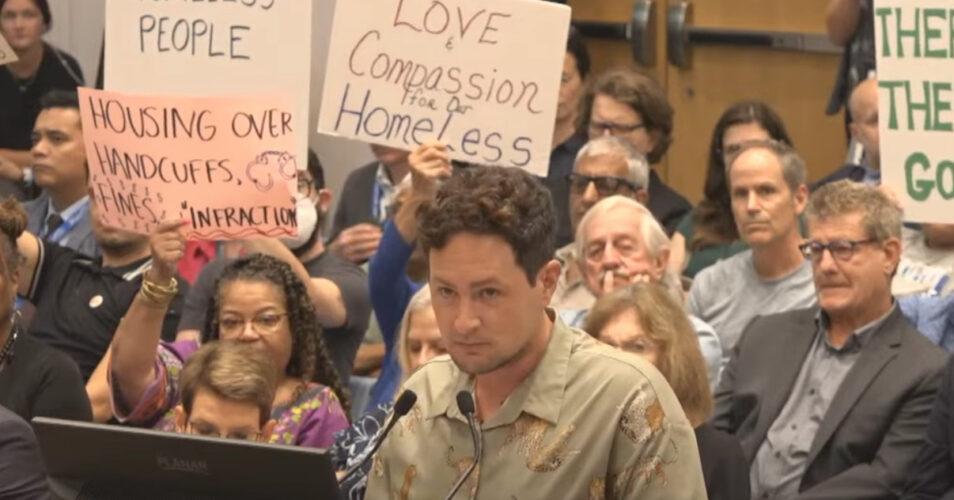
An amended version of Waddell’s ordinance advanced Tuesday night alongside the co-responder model. Several residents also showed up with signs and ready to speak, almost all opposed it. Resident Trey Barefoot claimed constituents sent more than 600 emails to council in recent months; he noted Andrews has been the only one to respond.
“We have urged you to vote no on this ordinance and instead to invest in the steps we have already provided with you again and again and again,” Barefoot said. “Those steps come from our local service providers, not hopes or wishes or dreams of utopia. The action steps that work are what we provided to you.”
Resident Robert Carpenter referenced comments made by former interim police chief Ralph Evangelous, noting the ordinance “won’t change what the police do”: “ But what it does do is send a message that the poor and needy are not needed in Wilmington.”
The anti-camping amendment, intended to prevent homeless individuals from sleeping and otherwise occupying city property, would coalesce several of the city’s current rules in one spot and slightly expand enforcement authority.
It was approved 5-2 at the Sept. 9 meeting, council members Andrews and Kevin Spears dissenting, though amended from Waddell’s original version. Criminal penalties were removed in favor of infractions, while prohibitions against people sleeping in cars were also removed.
The ordinance returned on Tuesday for a second — and what was supposed to be a final — reading before enactment. However, more amendments were proposed, meaning it has to go through another reading.
Council member David Joyner, who voted for the ordinance but pushed for limitations on sleeping in cars to be removed, went back slightly on his stance. He asked for the language to reflect those sleeping in their car in city surface lots not to be held in violation, but sleeping in a car parked in a parking garage not be permitted. Joyner said there was at least one scenario where a parking deck was located under residences and thus some citizens reached out with concerns about designating the deck as a safe space.
“I think it is important and accomplishes the goal of still allowing people who are living out of their vehicles to sleep in their vehicles,” Joyner said.
At the last council meeting, he noted individuals with cars are closer to escaping homelessness than others without a vehicle and didn’t want to punish them.
Despite voting against it previously, Andrews also had an amendment. She wanted to strike the word “occupy” from the language, over concerns prohibiting someone from occupying a space could violate the Constitution due to its vagueness. Joyner, an assistant district attorney, supported the move.
“In addition to what you’ve cited relevant to civil liberties, my experience from the courthouse tells me that I don’t know that a jury of 12 people would be able to unanimously determine that they agreed on what the word ‘occupy’ would mean in this context,” Joyner said.
Joyner and Andrews’ suggestions were combined into one amendment to the presented ordinance. Council accepted the amendment in a 6-1 vote. Spears was the dissenting vote.
“I still believe that needs to be rejected,” Spears said. “We don’t need this new ordinance to do the work. We can just do the work.”
Despite her amendment passing, Andrews voted against approval for the overall ordinance. Joyner voted in favor. Spears also dissented, along with Mayor Pro Tem Clifford Barnett, bringing the passage to 4-3.
The mayor pro tem didn’t explain his vote despite having voted for the ordinance the first go-around. PCD reached out to Barnett about his decision but didn’t get a response by press.
Because of the changes made to the ordinance Tuesday, it restarted the process of first and second readings, which are required to pass each ordinance. The council often moves to waive second reading on uncontroversial measures, the anti-camping ordinance not falling into that category. When Mayor Saffo called for a vote on waiving the second reading of the ordinance’s new version, Spears was the sole dissenting vote.
Thus, the ordinance will return once again at the next meeting on Oct. 9.
Reach journalist Brenna Flanagan at [email protected].
Want to read more from PCD? Subscribe now and then sign up for our morning newsletter, Wilmington Wire, and get the headlines delivered to your inbox every morning.
