


LELAND — After tabling a vote on changes to a flooding ordinance last month, council members in Leland broached it again this week, but this time set forth the goal involve all stakeholders.
READ MORE: Leland tables flooding ordinance, for now, after pushback
ALSO: Leland planning board backs new flood development rules, now primed for final vote
A proposed flood damage prevention ordinance has been discussed since last fall among officials. It passed the planning board recommendation and came before council for a vote last month, but it was tabled due to pushback. The ordinance proposes stricter rules on new development:
- Increase the required elevation (freeboard) for new buildings from two to four feet.
- Ban the use of structural fill to elevate homes
- Limit residential development in flood zones to no more than two units per acre.
- Expand the town’s regulations to include properties in 500-year flood zones from just the 100-year flood zones.
Strong opposition came from developers, realtors and organizations, including the Business Alliance for a Sound Economy (BASE) and the Wilmington-Cape Fear Homebuilders Association. Both worried the changes would be ineffective at preventing flooding, lacked scientific basis, created hundreds of nonconforming homes and would negatively impact property values.
However, no residents showed up to last month’s council meeting to speak in favor of the ordinance changes. Bill McHugh, who initially proposed the changes in 2024 after Potential Tropical Cyclone 8, told Port City Daily the industry folks that came against it were from mostly out of town and not local to Leland.
He said the council had received numerous calls and emails about the ordinance since they began discussing its possibility last November. PCD sent a public records request to the town of Leland asking for all emails the city council and the mayor have received regarding the ordinance this year, both for or against. The town returned roughly five emails and one digital public comment, sent in June and July.
Only Larry Widman was supportive of council’s measures.
“The question is: Should development be allowed in flood zones at all?” Widman wrote. “When the ordinances were drafted, was climate change factored in? Flooding and storms will only escalate at an increasing rate which I don’t think anybody can accurately predict.”
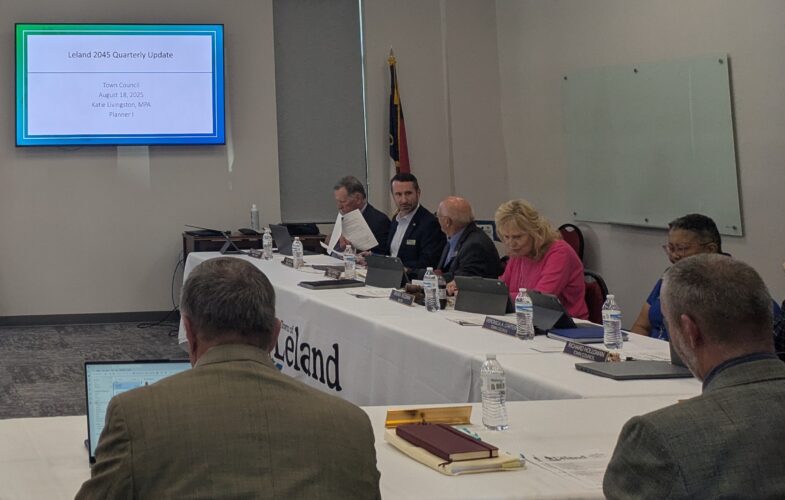
Speaking during their recent agenda review meeting on Aug. 18, council wants to hear more from the public on the matter. They plan to hold community workshops and include residents affected by flooding, developers and experts in flood management, environmental scientists and engineers. The workshops will focus on hearing concerns and exploring legal and environmental research.
“What additional solutions can we come up with?” McHugh questioned Monday. “Let’s have a conversation about how we can solve this problem before it gets any worse.”
Town manager David Hollis also wants more information on the “practical” impacts of the changes, such as the amount of structures currently in the floodplain, what has happened to those structures during flooding events, and where the current rules are falling short.
Council member Veronica Carter said she expected to have received this information already, since staff began drafting the ordinance in February.
“Maybe we failed you in that regard, that we didn’t give you all of the practicality and the options and what that would look like,” Hollis responded. “We need to make sure that we know as much as we can about it and we’re conveying that too. If we didn’t do that, we need to do that.”
While no residents spoke during public comment in favor of the changes at the July meeting, Carter said at the recent agenda review she knew how it appeared to the public: “A group of developers come in the room and basically chastise us.”
Brunswick resident Drew Hatcher, a project engineer with McKim & Creed, had written to council July 15, according to PCD’s public records request and cautioned the ordinance could cause more issues than it solves. He called the changes a “barrier to entry” for new developments that would “do nothing” to alleviate current and future flooding concerns.
Hatcher suggested an alternative option: mitigation banking.
It’s a system that treats land and water like a bank account for flood control. A county or company has a large area of wetlands and developers are able to buy into the area to offset their impact on the floodplain. When a developer builds in a flood-prone area, taking away natural flood storage like trees and wetlands, they have to pay back or deposit an equal amount of flood storage back into the system somewhere else. This can potentially be far away from a development site and not necessarily have an immediate positive impact on nearby homes.
The Cape Fear region uses mitigation banking through the private entity Lower Cape Fear Umbrella Mitigation Bank, owned and operated by LCFUMB, LLC of Wilmington. This bank currently consists of two wetland and stream sites in Brunswick County, located near an urban center, to restore and preserve natural heritage areas. It services the greater Wilmington area, including New Hanover, Brunswick, Columbus, Bladen, and Cumberland counties, providing a local option for developers to fulfill environmental obligations.
Since the bank’s establishment in 2013, it has restored and preserved over 500 acres of significant wetland and headwater stream habitat in the Cape Fear Region.
Drawbacks of this plan include the difficulty and cost of creating a new wetland ecosystem that can accurately replicate the attributes like soil chemistry of a natural one.
The legality of Leland’s proposed ordinance also was at the center of council’s Monday debate. Some developers decried it would decrease property density and create nonconforming properties without the owners’ consent, therefore proposing a violation of state law. However, the town’s legal team maintained the ordinance is a flood damage prevention measure, not a zoning regulation — therefore it wouldn’t fall in with downzoning laws.
“This is such an intense thing and I think we gotta make sure we don’t do anything illegal,” Mayor Brenda Bozeman said. “Let staff do their homework on it and bring it to us so we can make the right decision.”
“With all due respect, I think we did that,” Carter responded. “I think we’ve had time if we’re about to hit the one-year mark here in November.”
Carter added Raleigh passed a flood ordinance in 2022, which has not been challenged in court. Raleigh’s ordinance prohibits new development on vacant land in a floodplain. The ordinance is similar to what Leland proposed, as both would have banned new construction in certain flood zones.
To date, no legal challenges have been made against Raleigh’s ordinance; however, the key difference is Raleigh’s rules do not affect existing homes. In Leland, it wouldn’t either, unless the homes had damage or were to undergo changes, then they would have to abide by the new code.
“If we need to adjust ours so that we’re sure it’s legal, that’s one thing,” Carter stated. “Things can be taken out, things can be added. I think we’re past worrying about if the whole thing is legal.”
McHugh agreed.
“We’re not going to pass anything that is illegal,” he said. “Somebody needs to fire the first shot and a coastal community who had an unnamed thousand-year storm come through might be the right person to do that.”
At the direction of council, Leland town staff will now be organizing and planning community workshops on the ordinance. Hollis presented the council with a plan for a meeting within the next 30 to 60 days, eyeing a date in October.
Have tips or suggestions for Charlie Fossen? Email [email protected]
Want to read more from PCD? Subscribe now and then sign up for our morning newsletter, Wilmington Wire, and get the headlines delivered to your inbox every morning.
