


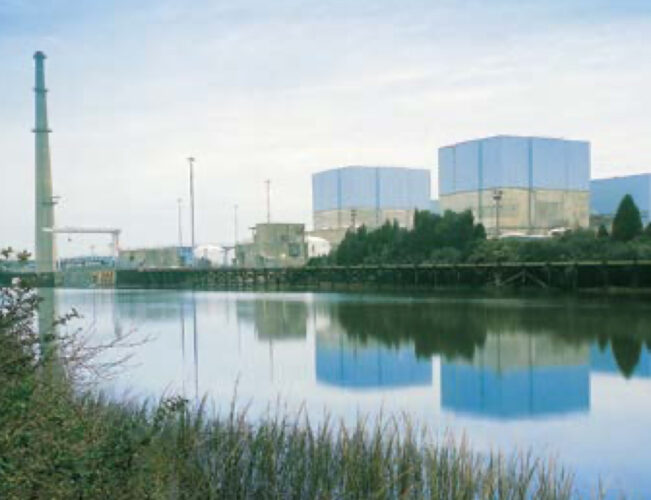
BRUNSWICK COUNTY — A nuclear safety official is alleging Duke Energy retaliated against her for raising safety concerns at North Carolina nuclear energy facilities, including Brunswick Nuclear Plant. This comes as a Duke-funded lobby group pushes to rollback federal nuclear safety oversight.
READ MORE: New analysis finds Duke spent $8.9B on failed nuclear projects
Kathy Adams worked for Duke Energy for 42 years without disciplinary or performance issues. She was promoted to supervisor of quality assurance for Duke’s North Carolina nuclear facilities in 2017.
Adams filed a 2020 complaint to the U.S. Department of Labor’s Occupational Safety and Health Administration alleging Duke retaliated against her for raising safety concerns related to Brunswick Nuclear Plant quality control official Mike Gore. Adams claims numerous quality control inspectors made complaints against Gore for discouraging them from writing quality condition reports during plants’ scheduled shutdowns.
Inspectors write quality condition reports to identify nuclear facility deficiencies, initial actions to address issues, and assess potential impacts on plant operations. During scheduled refueling outages, staff and contractors often evaluate needed repairs and perform maintenance work that cannot be done when the plant is operational.
“These reports are crucial tools of nuclear safety,” Employment Law Group spokesperson Laurence Hooper told Port City Daily Thursday. “[Quality condition reports] provide a forum and a process for inspectors to flag important problems without fear of retaliation. They also create a paper trail by which Duke can be held accountable, and they can reveal broader patterns within and across facilities. Discouraging inspectors from filing these reports is tantamount to telling them not to do their job.”
Employment Law Group is representing Adams in the ongoing case, which is scheduled for an Office of Administrative Law Judges hearing at the end of the year. The OALJ is the forum for labor-related administrative disputes; Adams is requesting a judge award punitive damages, reinstatement, and attorney’s fees.
OSHA determined it was unable to conclude if a violation had occurred and dismissed Adams’ complaint in 2021. Adams’ legal counsel challenged the ruling, arguing the agency failed to provide any details to support its conclusion, leading to a hearing before District Chief Administrative Law Judge Paul Johnson. He found Adams failed to prove her employer demoted her for improper reasons and ruled in Duke’s favor in 2022.
Last year, the Department of Labor’s Administrative Review Board found Johnson failed to properly consider evidence and vacated his decision. Adams’ case is proceeding to an evidentiary hearing before a different judge in December.
Adams alleges Duke contractors and quality control inspectors first told her Gore discouraged them from writing quality condition reports in 2018. Subsequently, Duke’s Employee Concerns Program investigated Gore’s actions at Brunswick Nuclear Plant in Southport and found “some instances” where inspectors were “hesitant” to write quality control reports but determined it could not substantiate allegations that the supervisor undermined inspectors’ independence.
According to legal documents, a representative of Duke contractor Day and Zimmerman told Adams in March 2019 he had “a stack of complaints” about Gore related to the official’s refusal to properly document conditions identified by quality control inspectors during inspections. The contractor said his firm’s quality control inspectors would not return to the Brunswick Nuclear Plant because of Gore’s leadership.
That month, Adams informed Scott Saunders — Duke’s nuclear oversight general manager at the time — that quality control inspectors had made numerous complaints regarding Gore’s reluctance to appropriately document unacceptable conditions. Adams testified Saunders was reluctant to pursue corrective action, but eventually authorized the company’s human resources department to issue coaching, counseling, and an action plan.
Around the same time, quality control managers Pete Tingen and Mike Hart filed complaints against Adams to the Employee Concern Program alleging she took adverse actions against them for challenging her. This came after she gave the two managers low-performance evaluation scores because they required “direct oversight for even mundane and everyday tasks.”
Duke’s investigation into Adams’ conduct could not substantiate retaliation claims, but the company’s Employee Review Board recommended reassigning her to a non-supervisory position due to Tinger and Hart’s criticism of her leadership.
Saunders left his position in 2019 to work with the Institute of Nuclear Power Operations, a nuclear industry-funded organization set up after the Three Mile Island nuclear accident that sets industry-wide performance objectives; Duke CEO Harry Sideris is on the INPO’s Board of Directors.
Saunders’ replacement, Brian McCabe, cited the Employee Review Board’s recommendation in his decision to strip her of supervisory duties in November 2019. Alternatively, Adams alleges Duke demoted her for acting to ensure the company’s alignment with federal safety rules and claimed McCabe undermined her efforts to counsel Gore.
Brunswick Nuclear Plant communications manager Karen Williams said Duke could not comment on the pending litigation because it is a personnel matter.
“Brunswick Nuclear Plant is committed to maintaining the highest standard for operational safety with comprehensive industry safety procedures as well as meeting stringent federal regulations,” she wrote in an email to PCD. “These processes and procedures keep our plants operating reliably, and our employees and neighboring communities safe. In addition, oversight of the nuclear industry is provided by the U.S. Nuclear Regulatory Commission (NRC) and Brunswick is recognized as meeting the highest safety standards. The safety of our employees and the communities in which we live and work is our top priority.”
Although the Brunswick Nuclear Plant implements a broad range of emergency safety measures, Union of Concerned Scientists Director of Nuclear Power Safety Edwin Lyman told Port City Daily he views the facility among his top concerns for risk of a potential accident, making quality control reports all the more crucial. The Union of Concerned Scientists is a nonprofit science advocacy group and prominent nuclear safety watchdog group that has tracked Brunswick’s safety issues for over a decade.
The physicist pointed to the facility’s proximity to the Atlantic Ocean and vulnerability to flooding, as well as its boiling water reactor design, which he likened to the Fukushima Daichi Nuclear Power Plant. Lyman served as an expert analyst to understand the Japanese facility’s meltdown in 2011 and co-authored a 2014 book on the disaster. The Fukushima Daichi plant experienced a severe meltdown after an earthquake damaged the electrical grid and a tsunami impaired emergency diesel generators used to cool down reactors.
Lyman argues inadequate safety regulation left the plant unprepared for the natural disaster, causing a large release of radioactive material into the surrounding area, and U.S. reactors likely would have had similar incidents if exposed to similar extreme conditions. An April 2024 Government Accountability Office report found Brunswick Nuclear Plant to be at high risk of flooding and wildfires.
“The U.S. nuclear industry implemented numerous modifications following the Fukushima event,” Williams said. “Using principles of continuous improvement, we collaborate with industry peers and experts to identify opportunities to advance the resiliency of our operations. During Hurricane Florence and Potential Tropical Cyclone #8, we safely maintained the plant with all plant systems functioning as designed and staffed our operational and emergency response organizations fully despite challenges to local roads.”
After Fukushima, the Nuclear Regulatory Commission created new plant-specific safety enhancements to incorporate lessons learned from the incident. NRC staff determined the Brunswick Nuclear Plant failed to meet post-Fukushima reevaluated flood risks in 2017.
“There’s a list of things they committed to do after the Nuclear Regulatory Commission found they were underestimating the probable maximum flood height,” Lyman said. “[Duke] committed to temporary measures, but nothing that involves any real infrastructure improvements at the plant.”
Lyman surmised Duke may have sought to discourage inspectors from writing quality condition reports to save money on maintenance costs. Hooper described Gore’s alleged discouragement for proper reporting as enabled by a culture at Duke that obscured the persistent complaints against him.
“We can’t characterize evidence beyond the public record, but we’re confident that Duke’s unjust treatment of Kathy was a broad-based systemic failure that happened in plain view of people who could have stopped it,” Hooper wrote in an email to PCD. “As with all such failures — and their solutions — it starts with tone at the top.”
Lynn Good — who was Duke’s CEO and president from 2013 to April 2025 — has a track record of allegations she neglects safety oversight duties. Good remains on Boeing’s board of directors since first being elected in 2015 and during her tenure, Boeing’s board has faced multiple lawsuits for neglecting safety issues concerning fatal crashes of two 737 MAX aircraft that killed 346 people in 2018 and 2019 and a near-fatal accident last January. At least 32 whistleblowers filed retaliation complaints against Boeing between December 2020 and January 2024.
Good was appointed to Boeing’s aerospace safety committee in 2019. An October 2024 filing in the Ohio Attorney General Office’s class-action suit against the board alleges Good did not attempt to address whistleblower safety concerns:
“Good did not ensure that Boeing implemented a policy requiring mandatory reporting regarding manufacturing issues that threatened safety. As an audit committee member during the relevant period, Good failed to respond in good faith to red flags showing that falsification of records was a serious issue at Boeing that was not improving.”
Last year, a second Duke Energy whistleblower filed a lawsuit alleging the company retaliated against him for reporting Duke’s violations of safety maintenance policies in a report to the Nuclear Regulatory Commission.
“Quals should not be falsely given and entered into record without the proper training and basic knowledge of the task and equipment or tool,” Edwin Shelton, who worked as a nuclear maintenance technician for 14 years at Duke’s McGuire Nuclear Plant in Mecklenburg County, wrote in a 2022 compliance report.
Shelton’s 2024 complaint claims senior management intimidated him to soften or delete identifications of specific safety violations at the Catawba Nuclear Station near Charlotte. His original report claimed the company’s lack of accountability, integrity, and funding for training contributed to a shortage of qualified maintenance technicians.
“Given what is happening at the federal level, it is more important than ever to protect whistleblowers willing to sound the alarm about unsafe practices,” Natural Resources Defense Council southeastern campaigns director Drew Ball said.
Nuclear safety rollbacks
President Donald Trump signed four executive orders Friday containing sweeping directives to cut nuclear energy regulations and safety review timelines to rapidly expand domestic production.
They include ordering the Nuclear Regulatory Commission to carry out a comprehensive revision of its rules to reform the agency’s “overly risk-averse culture.” The orders argue NRC’s oversight and lengthy review timelines have hindered industry and question the agency’s radiation exposure limits as excessively low. Trump directed the NRC to partner with DOGE, which is Elon Musk’s initiative to cut federal services and spending, on the restructuring. However, Musk’s group faced controversy earlier this year for firing 177 employees charged with overseeing the safety of the country’s nuclear weapons stockpile.
Physicist and University of British Columbia professor M.V. Ramana — a prominent critic of expanding nuclear energy as a strategy to address climate change — pointed to an executive order directing the NRC to approve new nuclear reactor designs within 18 months as an example of the nuclear lobby’s influence in weakening safety regulations.
“It is impossible to do a credible and comprehensive assessment of a new nuclear reactor design within such an abbreviated timescale,” Ramana wrote in an email to Port City Daily. “Nuclear reactors are very complex technologies and there are many ways in which these can undergo catastrophic accidents resulting in large scale releases of radioactive materials.”
The Nuclear Energy Institute has long lobbied to reduce NRC safety inspections, pushed for fast-tracked approval timelines, and its CEO Maria Korsnick attended a signing ceremony for the executive orders. Duke Energy Executive Vice President Louis Renjel is on the Nuclear Energy Institute’s board of directors and the company’s reported contributions to the lobby group totaled $255,840 in 2023 and $196,798 in 2022.
“We appreciate the Administration’s ongoing actions to preserve existing nuclear plants and usher in the deployment of next generation nuclear,” a NEI spokesperson wrote in a statement. “Policies to strengthen nuclear are essential to bolstering our national security and meeting our energy goals. We look forward to working with the Administration and other stakeholders to ensure the implementation of the orders will help us build a reliable, affordable, and increasingly clean energy system.”
Ramana pointed to a section of one of the four executive orders focused on “maximizing the speed and scale of new nuclear capacity” that does not include the word “safety” in its language as another example of industry influence. The order directs the Department of Energy to prioritize federal lending to nuclear energy firms.
“A good regulator has to consider different pathways to accidents to check if there are safety systems or procedures to lower the risk of these accidents actually occurring,” Ramana said. “That is necessarily a time consuming process, and often involves the regulator asking the reactor vendor to make changes to the design.”
The executive orders cite the bipartisan 2024 ADVANCE Act — a law Duke and the Nuclear Energy Institute lobbied heavily in support of — as guidance for the shift in Nuclear Regulatory Commission operations. The ADVANCE Act’s provisions include requiring the NRC to expedite licensing of new small-modular nuclear reactors and limiting firms’ liability in the event of a nuclear accident.
The North Carolina Utilities Commission, which is responsible for regulating rates and services of investor-owned public utilities like Duke Energy, approved $440 million in early development costs for Duke’s two proposed small modular reactor nuclear facilities, part of Duke’s carbon plan, last fall.
There are no operational SMRs in the United States; energy firm NuScale canceled its SMR project in Utah in late 2023 due to repeated cost overruns after spending $600 million in federal funds.
Nuclear Matters, an industry advocacy group funded entirely by the Nuclear Energy Institute, registered to lobby in North Carolina for the first time this year. Former North Carolina Sen. Paul Newton (R-Cabarrus) — a former Duke Energy president and Nuclear Energy Institute planning committee member — introduced a bill in March that would allow Duke to charge ratepayers additional upfront costs for its proposed SMRs, even if they are not completed.
The bill’s language is included in the Senate budget proposal; it would amend the Utilities Commission’s rate-making process by allowing utilities to request more frequent rate increases to finance the design, development, and construction of new technologies, including advanced nuclear reactors.
Watchdog groups have long criticized excessive industry influence on nuclear regulators and revolving-door relationships between the Nuclear Regulatory Commission and the private sector. Chris Nolan — Duke’s vice president of new nuclear generation strategy and regulatory affairs — worked at the NRC for nine years before joining the utility in 2006. Nolan is overseeing Duke’s pre-application activities with the NRC for the company’s proposed small-modular reactor in Forsyth County; he cited NuScale’s SMR project — which faced billions in cost overruns before its cancellation — as a model design during a 2022 Utilities Commission hearing.
U.S. Department of Energy officials similarly have numerous ties to the nuclear energy industry. Secretary Chris Wright is a former board member of advanced nuclear technology firm Oklo Inc. and Assistant Secretary for Nuclear Energy nominee Theodore Garrish has held leadership positions in nuclear energy trade associations. Deputy Secretary James Danly previously faced conflict of interest concerns related to his former clients at multinational law firm Skadden Arps, which recently agreed to provide free legal work for causes supported by the White House.
“Trying to maximize the speed of deployment and setting strict timelines on the regulatory process will make it more likely that reactors will undergo accidents,” Ramana said. “These could happen anytime along the multiple decades when the reactor operates. And unfortunately, in the coming decades, the risk of accidents is going to be increased by the impact also of climate change induced severe weather events.”
An April 2024 Government Accountability Office report found the Nuclear Regulatory Commission failed to address increased natural hazard risks posed by climate change. Watchdog groups cited Duke’s Oconee plant in South Carolina as an example in a hearing last year challenging its recent relicensing.
NRC whistleblower Larry Criscione faced retaliation from the agency after raising concerns about Duke’s failure to address flooding risks posed by extreme weather events at Oconee in 2002. Duke identified flood risks from dam failure in 1983 and submitted a 1998 report to the NRC with potential risk mitigation strategies as part of its license renewal application, but determined they were not cost effective. Former Sen. Paul Newton — who was Duke’s manager of risk management from 1994-1995, lead nuclear regulatory counsel from 1995-1996, and associate general counsel from 1998-2000 — was part of Duke’s team that worked with NRC in the late 1990s on the plant’s license extension review.
[Update: This article was updated after press to include and clarify additional details from Adams and Shelton’s complaints.]
Tips or comments? Email journalist Peter Castagno at [email protected].
Want to read more from PCD? Subscribe now and then sign up for our morning newsletter, Wilmington Wire, and get the headlines delivered to your inbox every morning.
