


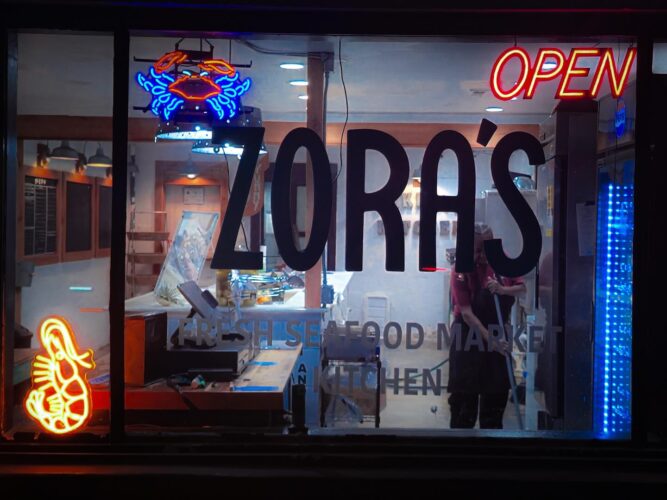
WILMINGTON — James Beard Award nominee Dean Neff is more than a chef; he believes food — particularly seafood — tells a story. That’s why he and his wife, Lydia Clopton, who also own Seabird in downtown Wilmington, purchased Ronnie’s Crab Shack at Zora’s in the fall of 2024. The two are preparing a relaunch of its kitchen by the end of the month and started a free fish program last week from its seafood market, in partnership with UNCW’s aquaculture program.
Zora’s at 1411 Castle St. has been around since the 1950’s, once owned and operated by Zora Chesson, often referred to as Big Momma.
READ MORE: Ben and Jerry’s to take over Mayfaire ice cream shop
“She was well-known for her boiled shrimp,” Neff said, noting when Zora’s kitchen reopens Jan. 28, her food will be part of a new menu.
Neff closed the kitchen portion of Zora’s six months ago, though the fish market remained open. Zora’s procures fresh bounty from a dozen local fishmongers, shrimpers and crabbers, pulling in 99% of North Carolina-caught seafood.
“We may get a random salmon in from the West Coast occasionally,” Neff said. “But, really, it’s about being in touch with the source of seafood as close as we can get. It’s about making connections to people.”
As part of Zora’s Market and Kitchen new launch, Neff has begun a free fish program — Zora’s Fish Bank — for people who experience food insecurity. In addition to buying seafood locally from fishermen who work with Zora’s, Neff has become one of three commercial vendors through UNCW’s aquaculture commercial program. The university research team grows black sea bass in tanks using water pumped from the Atlantic, in a controlled, healthy environment, a project that started in 1997.
“The basis of the program is to transfer to commercial users safe and effective methods of doing marine aquaculture, so hopefully one day we are eating saltwater fish from farms just like we are eating cows, chickens and pigs that are farmed,” UNCW research specialist Patrick Carroll said.
When the program started 25 years ago, the sea bass population was stressed due to overfishing, though it has rebounded today. Yet, with the world population escalating by more than 2 billion people in the last two decades, Carroll sees the need to grow fish using aquaculture important.
“The ocean’s not supplying more fish for the population, so we are trying to meet demand,” he said of the team at UNCW’s Center for Marine Research.
Carroll added around 50% of the seafood eaten worldwide is grown in aquaculture, while 80% of seafood in the U.S. is imported.
“That means we’re eating a lot of fish that are coming from areas that we might not necessarily know how they’re growing them,” he explained. “So there’s a security aspect of it — no matter how it’s labeled. But you can come to an aquaculture farm and see how it’s grown and you know it’s local.”
The department began selling its fish first to wholesalers around a decade ago, before opening it up to restaurants three years ago. It has farm-raised sea bass, grouper and seabeans — a plant called “solicornia” that helps filter waste from the water.
Neff also purchases the department’s seabeans, which he calls a “succulent-like herb with irony properties and natural omegas,” to mince and make butter with anchovy, herbs and garlic.
“Or we saute them down to put them in salads,” he said, adding chefs are demanding the product more, often purchasing seabeans from the West Coast.
According to Carroll, the department has had varied eateries work with its program but currently YoSake, three10 and Seabird are its primary vendors. Almost two dozen or so fish a month are sold to the establishments, with fish also given to UNCW for its catering needs. The university program doesn’t exist to turn profit, as all funds go back into research.
However, some fish aren’t suited to go to the restaurants. According to Carroll, the program turns out “runts” from the black sea bass population that, for some reason or another, don’t grow to full size and take up more resources in the research team’s tanks. Carroll said the restaurants often want larger fish, though the small sea bass are still perfectly edible.
When Neff found out about the overrun product, he pitched his idea for Zora’s Fish Bank to help prevent waste while also aiming to help underserved populations or people who fish to feed their families. The program gifts two fish per person weekly as supplies last.
“The fish we give away weigh about a pound or a pound and a quarter,” Neff said. “They’re not huge but they’re meaty, so two can feed a family of four. And fish is not really represented in what the local Food Bank offers.”
The program works like this: Interested parties can sign up at any time on Wednesdays at Zora’s, ”no questions asked,” Neff said. The fish market calls the recipients of its weekly giveaway on a first-come, first-serve basis and they pick up the fish on Thursday and Friday. Neff said the Zora’s staff will filet it or cut it to the customer’s liking for easy preparation.
In its inaugural week, 20 fish were given away.
“Twenty fish may not seem like a lot,” Neff said, “but if you look at it over the course of the year, it adds up. We’ve already seen that there’s more people that need this fish than fish we have, so we’re going to continue to try to figure out ways to scale it up and grow as we go — rotate people in and out to make it as equitable as possible.”
Neff said the program touches all points he admires about serving a community-focused restaurant, with food and equity at its core. Zora’s has always been a spot intent on helping others remain fed. The restaurant always accepted EBT payments, which Neff will continue honoring. The reason he had to close the kitchen after purchasing it from Ronnie and Revonda Williams of Ronnie’s Crab Shack at Zora’s was to refile paperwork to the government as the new owner, in order to continue serving EBT customers.
Neff has a goal to reach further into the community upon Zora’s relaunch. First, he renamed it to Zora’s Market and Kitchen after the Chesson family gave him their blessing and even brought in one of the family members to help Neff carry on some of Big Momma’s recipes.
“People have deep traditions of cooking fish in this area,” he said, “and we wanted to honor that.”
The new menu will offer a shrimp burger, barbecue swordfish sandwich, clam chowder, and even seafood steam bags — filled with shrimp, crab, clams, potatoes, sausage, and corn, served with hot chili butter. Neff also will have “spots and grits” plates and hopes to have community conversations and other events planned at Zora’s.
“I’ve always liked farmers’ markets because there is this other level of appreciation and you can have conversations about an ingredient,” he said about his own goals at the fish market.
“Take spots — they’re interesting, just in the sense that at most fish markets, you see them in the ice year-round, but the season for them is not year-round,” he said. “I feel like as long as you’re transparent and you talk about it because, despite misbeliefs, freezing certain things is not all bad in the seafood world. We’re talking about doing it in the right way — much like putting up and canning vegetables you’ve grown and using the freezer in that capacity. I feel like it has a lot of benefit and it offers year-round fish.”
Working with UNCW’s Aquaculture Department has been in line with his personal outlook when it comes to sustainability as well. The chef served on the North Carolina Fish Consumption Advisory at Duke University, which held a campaign more than five years ago to “stop, check, enjoy,” in regards to how people could properly assess for contaminants in the fish they caught.
“We were observing that people were fishing in the Lower Cape Fear River in waters that are polluted,” Neff said.
This was in 2019, two years on the heels of news spreading that the Cape Fear River was ground zero for PFAS contamination.
Fast forward to 2023 and the North Carolina Department of Health and Human Services released advisories on consuming freshwater fish from the Cape Fear River. Last fall, a study also was released finding PFAS in some saltwater fish in the Cape Fear River. However, still many locals aren’t fully educated on PFAS and 1,4 dioxane flowing there and still fish from the waters. Neff hopes Zora’s Fish Bank offers one safe alternative.
Zora’s Market and Kitchen opens 11 a.m until 7 p.m. Wednesday through Friday and 9 a.m. to 5 p.m. on Saturday, with fresh seafood deliveries coming in every Wednesday and Thursday. The fish bank takes new sign ups Wednesday at 10:30 a.m. throughout the day.
Neff also sells Zora’s seafood to his flagship restaurant, Seabird, located at the corner of Front and Market streets. Having opened in 2021, it, too, is undergoing an expansion to help accommodate larger parties. Construction has been underway for a while at 9 South Front Street, once home to Caffe Phoenix and Platypus and Gnome. Upon its opening, the eatery will host specialized events and pop-ups, according to Neff, though the extension remains nameless currently — ”because you can’t name the baby before it’s born.” He expects it to become operational by September.
At Port City Daily, we aim to keep locals informed on top-of-mind news facing the tri-county region. To support our work and help us reach more people in 2026, please, consider helping one of two ways: Subscribe here or make a one-time contribution here.
We appreciate your ongoing support.
