


WILMINGTON — An exhibition at the Cameron Art Museum tackles some of the biggest issues North Carolina endures today — from stronger storms to overdevelopment. Gathering artists, both native to North Carolina and in love enough with the state, explore its landscapes in “From Mountains to Sea,” telling a story of destruction, community and rebuilding.
READ MORE: Trailer drops for holiday movie filmed in greater Wilmington area
ALSO: NC film leaders push for better incentive in next state budget, boost for indie production
On display in the Hughes Wing, the exhibit contains sculptures, animation, paintings, collage work and photography, and is open through May 10. While some work focuses on connectivity to the environment, others capture the devastation from events like forest fires, Hurricane Helene, and infrastructure projects.
‘Ever Behind the Sunset’
Jason Mitcham, a graduate from East Carolina University’s art program and the University of Florida’s masters program, grew up in Greensboro, North Carolina. Over the years, his childhood home, where he played basketball in the driveway and romped around with his sister, has become unrecognizable.
“The state of North Carolina took that land in an active eminent domain to widen High Point Road into Gate City Boulevard,” he recounted. “They took the land and they razed the houses. They just cleared it and made a highway over.”
The government took two plots of land — with his childhood home and father’s business positioned on it — in 2009. All that remained was the old barn his family once owned, decaying. Mitcham’s mother ended up selling the remainder of the property when his father died in 2020, as she could not afford it. Mitcham and his mother ended up moving to South Carolina.
He described the events inspiring his animated short film, “Ever Behind the Sunset.”
“It was so much about loss,” Mitcham explained, but not just of his home or father but a connection to North Carolina.
Mitcham explained his interest in the American landscape dates back decades and ties to concerns with political landscapes too. He described America’s founding as “predicated on continuous growth” thanks to colonialism, and infrastructure and the housing economy was a part of that.
“We have to just keep building more to sustain it,” he said.
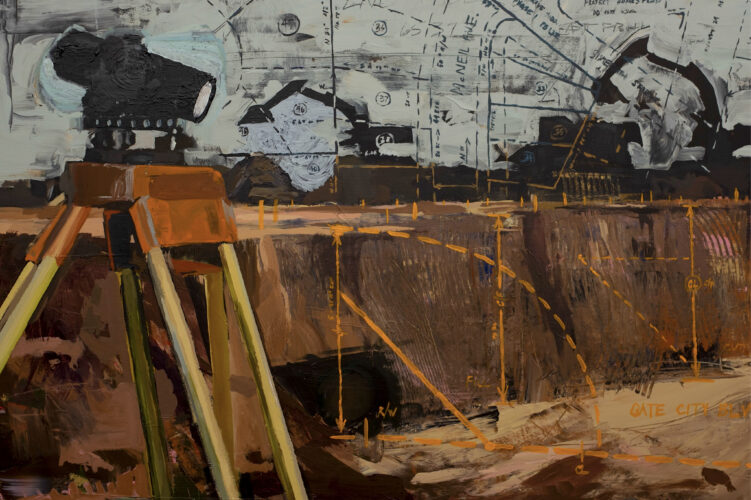
His piece is an oil-painted animation, all done by hand. Mitcham started creating it in 2021, and the CAM exhibition acted as his self-imposed deadline to finish it. The process, he said, included preliminary sketches and involved 18 to 20 canvasses ranging in size, as small as 10-by-15 inches and as large as 7-feet wide.
He said the smaller canvases were for more complicated scenes, like those recreating his childhood, while the larger ones were for the construction of Gate City Boulevard or maps once featured on his father’s desk; his dad was a civil engineer and owned his own land surveying firm.
The film opens with a panoramic shot of a construction site, the land being cleared. The camera pans over a gray and dismal atmosphere for viewers to see a once-lively and green lot being bulldozed. The animation then takes the audience through a recounting of Mitcham’s childhood with his sister. Foreshadowing the future destruction of their childhood home, the two are seen digging in a sandbox together at one point.
The animation ends with a lullaby, which Mitcham explained to Port City Daily was his mother’s voice, who passed away last week.
“It was already this piece about loss, and with my mother’s passing, it’s just a whole other wrinkle on that,” Mitcham said.
His mother was able to see the piece before her passing, he assured: “She was super excited that it was going in the museum and that she was in it. She was like, ‘Oh! I’m going to be famous.’”
The title of the piece, “Ever Behind the Sunset” was inspired from Thomas Pynchon’s book about the American West and the manifest destiny doctrine, coined in 1845, guiding America’s expansion.
A quote from the book, which reminded Mitcham of his father’s photograph of his childhood home’s demolition during sunset, also prompted the final scene. It closes on a sunset behind a traffic sign: “Gate City Blvd.”
“My mom commented, ‘Oh, look at that beautiful sunset,’” he recalled. “My wife looked out the window and it was actually the traffic light, which was where the sun had just set.”
‘Buddy-Buddy’
Mitcham wasn’t the only artist with roots in North Carolina. Or, in this instance, saplings.
Sculpture artist Patrick Dougherty was born in Oklahoma but raised in North Carolina. While his education was originally in hospital and health administration, Dougherty eventually returned to North Carolina to attend the graduate art program at the University of North Carolina in Chapel Hill.
He said he always enjoyed creating; with skills in carpentry, he wanted to pursue a career in sculpture.
“My dad said it was a documented case of downward mobility,” Dougherty recalled — until he gained success, of course.
He has been creating for more than 40 years and has over 330 structures exhibited around the country, and some international, in Scotland and Japan for example.
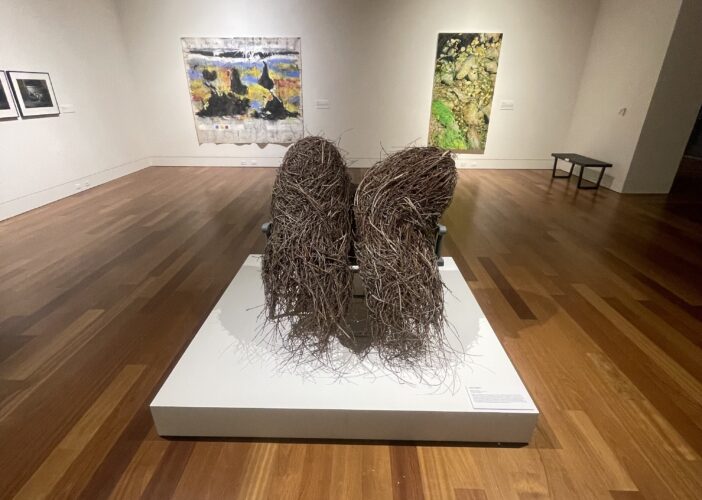
Known for large structures formed from sticks and tree saplings, Dougherty’s creations look like warped cocoons; usually, the structures are large enough to walk around or inside. Sometimes, they form giant objects, like a serving pitcher.
The saplings, he said, are strong, flexible, and durable. Dougherty pointed out how indigenous tribes once used them for baskets, homes, and boats; the same characteristics also make the saplings good sculpting material. Some, such as maple, have colored tips, with red or white at the top, allowing for layers of color and depth in Dougherty’s work. It reminded the artist of traditional drawing.
For the Cameron Art Museum exhibit, the sculptures are more human, as opposed to presenting as buildings or inanimate objects. “Buddy-Buddy” depicts two figures sitting on a bench leaning against one another and do not have many discernible features.
Dougherty said he wanted them to be universally representative.
“It could be any kind of situation: people sitting at the bus stop, people sitting in a park,” Dougherty commented. “They’re relating to one another in a quiet, speechless way. It makes a viewer feel like they’ve been there.”
The two-figure sculpture took two weeks to create and is made of maple tree saplings that he and his son collected from Duke Forest in Durham, North Carolina with express permission from forest staff. No material of any kind can be otherwise collected from Duke Forest. Dougherty often chooses trees native to the installation’s location, using debris from the trees and branches and sticks that would normally be pruned or need tending to.
His son has been acting as an assistant, particularly due to Dougherty’s “semi-retired” status, as he described it.
Dougherty’s goal is for audience members to feel a sense of nostalgia. Much of his work is a callback to childhood, he explained, when, as kids, people would play with sticks. He finds them representative of positivity and wanted to recreate the feeling of walking through the woods as a child, spending days wandering among the trees, through the grass, and embracing nature.
At the heart of it all, though, is connectivity.
“The figures are woven because sticks want to tangle with each other,” Dougherty explained.
The material, much like the sculptor’s message, knots together, connected like two friends, and like the viewer with the piece.
‘Eggshell Work Glove’
Erika Diamond also seeks to explore connectivity in her work.
Diamond was living in Asheville, North Carolina when Hurricane Helene hit. She described seeing the land destroyed and broken down: debris everywhere, needing vast clean-up and recovery efforts, still ongoing.
Diamond and her neighbors began helping one another to clean up the debris and gather up soiled material from their own neighborhood and other parts of town.
“One of the items we needed were work gloves,” she explained, “because you couldn’t wash your hands, and there was toxic stuff out there.”
She described work gloves as this “ubiquitous object for personal protection” tying her to community. Getting into the “muck” of things to rebuild for herself and neighbors became a symbol of healing.
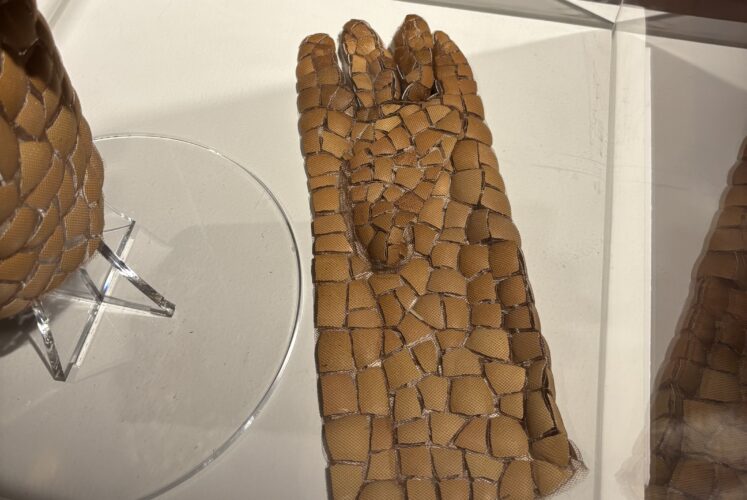
For the CAM exhibit, Diamond showcases gloves made of eggshells she collected independently, woven together over sheer fabric. The shells are linked together with string, with the broken shells round and scale-like in shape. Delicate, they are displayed in a glass case to protect it from harm.
Though only the pair are featured in the exhibit, the eggshell gloves are part of a larger series of eggshell clothing Diamond is creating. As an example, she made an eggshell shirt, so any time someone would give the wearer a hug, the eggshells forming the shirt would break, evidence of care and human connection.
Diamond explained sometimes she forgot the shells were supposed to be fragile. She quilted the eggshells together in between a guide made of sheer fabric, and found it to be simple, even when they did crack. The eggshell gloves took a few weeks to complete, with some breaks in between.
“For as fragile as they are, once they become this pliable cloth, it’s manageable to hold it or move it around,” she said.
Diamond thought of the eggshell garb as indicative of the human experience.
“People think of it as fragile, but it’s actually a protective device,” she said, pointing to its natural purpose. “Just like our rather fragile skin is the thing that holds us together.”
Before and After
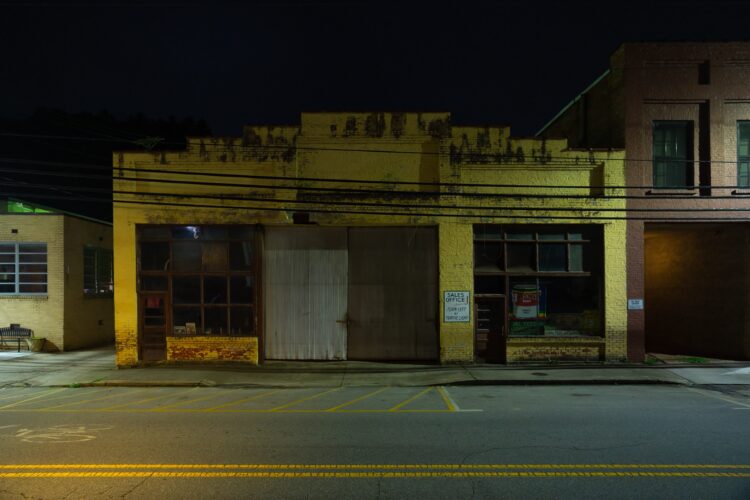
Hurricane Helene affected over 4 million lives when it swept across North Carolina in September 2024, causing $59.6 billion in reparations and assistance, up to 30 inches of rain in some areas, and 2,000 landslides.
Bill Green has three sets of two photographs on display — before and after shots of the same structures — showing the transformation of land after the storm.
Green captures architecture in its natural state — “truthful and unadorned,” he said. The photographs weren’t originally planned to become a before-and-after series. The befores were taken when Green was traveling across North Carolina, visiting the rural South.
He spent three years after the Covid-19 pandemic traversing rural towns in North Carolina, South Carolina, and Tennessee, documenting overlooked small town life, looking for dilapidated or mundane buildings, Green paid attention to the lighting. Not a fan of sunny days, the photographer prefers overcast skies, as it allows for more natural photographs without overexposure risks.
“I was sitting on a trove of images that people wouldn’t even have looked twice at, but now due to their damages post-Helene, the drama and context made them stand out more than they ever would have,” Green said.
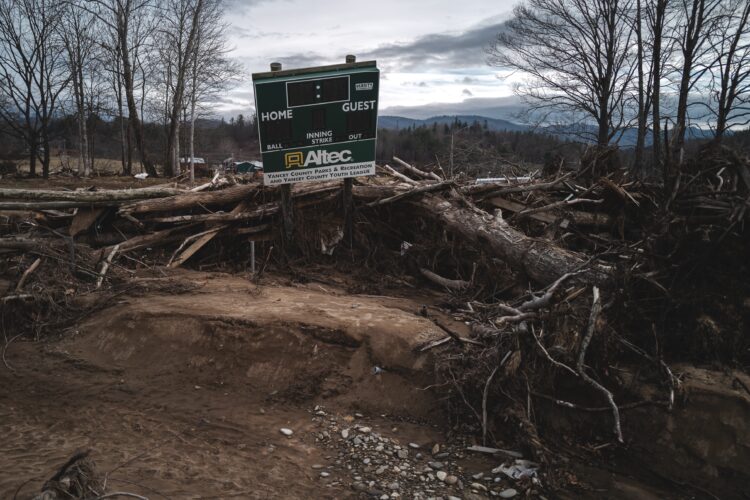
One photograph, for example, was of a baseball stadium’s scoreboard in Burnsville, North Carolina. Next to it is a photograph of a destroyed field with trees everywhere. While not ripped to pieces, the scoreboard no longer stands atop the two poles that once held it up.
Right before Hurricane Helene hit, Green was in Marshall, North Carolina, and described the time after the hurricane as being a “warzone.” Buildings he had just photographed were almost entirely wiped away, like they were never there.
In another set of photographs, a post office in Micaville, which once stood quaint but inviting, no longer shed light or advertised stamps. Broken down and wrecked, the post office is unusable and uninhabitable now.
A photo titled “Awash” features an old yellow building, once a store,but now with boarded-up windows. In its place is an empty lot and a wide gap between two brick buildings.
There’s more incoming from Green. He doesn’t want the current batch of photographs to only be befores and afters. He envisions a larger series, connecting the dots.
“I want to keep returning to tell the story of the growth and rebuilding of towns,” he said, “so it’s not exploiting someone else’s tragedy.”
[Ed. note: The article was updated to clarify that Patrick Dougherty had express permission to collect saplings and debris from Duke Forest, and collecting material from Duke Forest is not allowed without permission from Duke Forest staff.]
Have tips or suggestions for Emily Sawaked? Email [email protected]
At Port City Daily, we aim to keep locals informed on top-of-mind news facing the tri-county region. To support our work and help us reach more people in 2026, please, consider helping one of two ways: Subscribe here or make a one-time contribution here.
We appreciate your ongoing support.
