


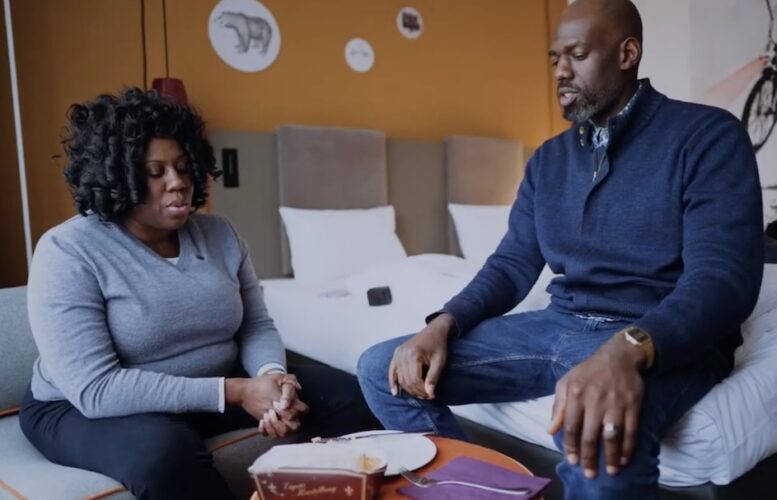
WILMINGTON — There is cultural identity and belonging in foods indulged upon at a family’s dinner table. Justin Robinson, an award-winning violinist for the Carolina Chocolate Drops, decided to explore his genealogy through soul food he grew up eating and in the process learned he can’t talk about Southern cuisine without putting German influence close to its center.
READ MORE: Trailer drops for holiday movie filmed in greater Wilmington area
Robinson is bringing “German Soul” to Thalian Hall on Friday, Nov. 21, 8 p.m., as part of a live documentary performance during the 31st Cucalorus Film Festival. The festival kicks off Wednesday, Nov. 19, and runs through Sunday, Nov. 23, featuring almost 100 films, plus live performances.
Robinson’s piece is a blend of both documentary footage captured so far during the making of “German Soul,” with live original music he scored for the project, narration, food and plenty of emotion. The story is one of Robinson’s own discovery, filmed to date in Nigeria, Germany, and North and South Carolina.
“This is almost like learning your grandfather, who you love dearly, isn’t your biological grandfather,” Robinson told Port City Daily in a phone interview Tuesday.
The impetus for “German Soul” began after Robinson kept mulling questions like: Why does the food we eat look and taste the way it does? Where else in the world does food taste like this? And what if the food we eat doesn’t match who we are?
Robinson said he struggled with digestive issues his whole life after eating Southern food he grew up with in the Piedmont region, specifically Gastonia, North Carolina. Collards with ham hock, stickies, mac and cheese, barbecue, fried chicken — the standards that everyone worldwide now associate with the South.
He studied Native American cuisine for three or four years and learned about its influence, such as squash and onions commonly cooked in cast-iron skillets in plenty of Southern kitchens.
“But the indigenous influence didn’t make up the bulk of Southern food,” Robinson said, also noting his travels to England didn’t turn up anything of similarity.
He then traveled to Ghana and Nigeria. After eating the cuisine in West Africa for a week or so, he noticed a few connections to Southern food, like the use of okra. But what he took away more: He didn’t have digestive issues.
Upon returning, Robinson did a genealogy test, which linked him to Africa but also Germany.
“And I was like: What’s this about?” he recalled.
The tests showed he had three German lines from his paternal grandmother, which he learned were the Oesters of Lincoln and Gaston counties, the Braunewells of Pennsylvania, and the Souters of the Dutch Fork community of South Carolina.
Then after watching a Food Network show of someone frying country fried steak and making a comment about its likeness to Wiener Schnitzel, something clicked in Robinson’s head.
“And then it was on,” he said.
Robinson and his sister, Ariel, traveled to Germany to meet with long-lost relatives but also brought along film director D.L. Anderson that Robinson had worked with previously. The two creatives met doing a series called “The Land of Fish and Grits,” to explore Black roots in Southern cuisine, but the series didn’t work out.
However, as to not abandon the topic completely, they switched gears to zoom in from Robinson’s own genealogical background and point of view.
Robinson said once he stepped off the plane in Germany and took one bite of schnitzel, he recognized the flavor profiles immediately: “It tasted like home.”
There was grünkohl, a greens dish — usually made of kale, cooked in vinegar, with a piece of pork or sausage to create a rich pot liquor. An ethnobotanist — with a degree in linguistics from UNC-Chapel Hill and a masters in Forestry and Environmental Science from NC State — Robinson said collards, kale, broccoli, cauliflower, Brussels sprouts, cabbage and the like are all the same species from the Mediterranean.
“Grunkohl is suspiciously familiar to collard greens,” Robinson said. “Even videos I watched before I was there of people making them sounded suspiciously similar — about ‘waiting ‘til the first frost hits before you eat them.’ I was like: ‘Is this my great uncle talking?’ It was just note-for-note some of the same exact things you hear people in the South say.”
While in Germany, he said he tasted ham similar to the South’s country ham, often popular in rural farm areas and dry-cured without refrigeration needed. A fried fish and tartar sauce dish elicited dishes serviced in popular fish camps and fish fries held in the Piedmont — even a piece of pound cake and barbecue tracked with his taste buds.
“Have you ever heard of R.O.’s Bar-B-Cue?” Robinson asked, a popular joint well-established in the Gastonia area. “If so, you’re eating Frankfurt food. We had R.O.’s barbecue in Germany. It tasted exactly the same — not ‘kind of’ the same. It was the same texture, the same seasoning. It was only presented differently: on the bone there, instead of off the bone here.”
Robinson said he did a quick genealogy test of R.O.’s business owners and saw the same family surname trace back near Frankfurt.
Sauce wasn’t necessarily at the forefront of pork dishes in Germany, unlike vinegar barbecue sauce in the South, particularly popular in North Carolina. But Robinson said vinegar and pork still went hand-in-hand there; pork that isn’t salt-cured, he learned, often was soaked in vinegar or sauerkraut three days before cooking.
“We don’t do that anymore in the United States, though we should because it has some really good health benefits,” he said — probiotics from fermentation helps with gut health and immunity support.
While seeing similarities in the cuisine was fascinating on its own, Robinson said origins and etymology in general has always grasped his attention, noting everything has a lineage — a family tree, if you will. He explored this with his Grammy Award-winning band Carolina Chocolate Drops, when he and his fellow musicians, including Pulitzer Prize winning multi-instrumentalist Rhiannon Giddens, studied the history of the banjo and its founding in West African roots.
In the instance of “German Soul,” Robinson is trying to understand how soul food has became synonymous with African-Americans. From his studies so far, he said it’s apparent Southern cuisine is really a hodgepodge of flavors, most of which are heavily influenced by central Europe.
“We see something different emerging,” Robinson said. “What we call Southern food is from Germany, Switzerland and Austria. This changes the story. Southern food is just not our — Black people’s — ancestral food.”
Robinson said he goes back to how he felt after eating West African flavors when traveling to Ghana and Nigeria for the first time and recognizing lifelong digestive problems subsiding. He equates it to findings of some studies — including from the National Library of Medicine — that show Indigenous people eating from their traditional food systems can lead to positive health outcomes.
From his point of view, Robinson said this matters with Black populations and regions they originally come from to help tackle myriad diseases plaguing them: metabolic, diabetes, cardiac problems, hypertension, sodium retention or kidney.
In the trailer of “German Soul” he mentions his grandmother died prematurely of a stroke and reiterated on a phone call with PCD his grandfather and father have also suffered digestive issues their whole lives. He hopes the documentary can become an educational opportunity for people to weigh their own outcomes and shape their own beliefs.
Yet, he also wants to highlight historical implications, as the foods grown and prepared in the South were influenced by settlers. Some brought in royal dishes, Robinson said, like fried chicken; he called it a staple of Austria that “only aristocrats could eat it.”
“Just connecting all of this shifts everything — it makes the South a multi-lingual place, a multi-ethnic place, a place where you have all these different European immigrants, all these West and Central African people coming, indigenous people were already here — you have a much richer history to dive into. But it’s all been flattened.”
During his research he found that though Germans immigrated to the South and did own slaves, it was at a lower rate than the English and Scottish.
“Especially when they were in German communities,” Robinson said. “However, when they were a smaller proportion of the population, they tended to follow the plantation model of their neighbors. In the Dutch Fork community in South Carolina, when German and Swiss people enslaved folks, they tended to do in it pairs — where the enslaved woman would serve the wife and the enslaved man would serve the husband.”
The filmmaking crew have received some grant funding to complete the documentary, including from the Filmed in NC awards given out during the 2024 Cucalorus Film Festival.
According to Cucalorus director Dan Brawley “German Soul” is a good example of how the festival and its foundation builds relationships with artists from start to finish when it comes to creating new works.
“Works-in-progress events give audiences a chance to take a peek into the process which is always fun,” Brawley said. “It also gives people a connection to a project so that when it pops up again down the road, you feel invested. And I guess that’s really at the core of the Cucalorus community: long-term investment in creative success for artists.”
Robinson added “German Soul” is also self-funded. He hopes to have the documentary completed by next year, but there needs to be more travel done to Austria and Switzerland and back to Nigeria.
“This story is across the world,” he said. “We tend to think of the South as a contained place. But the South has always been a part of the world, influenced by and influencing others.”
At Cucalorus, the live documentary will have Robinson narrating his findings, as images of his travels screen and he plays music with Justin Harrington (Giddens’ nephew). An MC, banjoist and bones player, Harrington goes by “Demeanor” and blends hip-hop with American roots music.
Chef Adé Carrena, known for blending West African flavors with North Carolina ingredients, is serving bites as well and the audience will engage in a question-and-answer session afterward. Brawley called it the perfect example of an “expanded cinema experience,” one not replicated elsewhere.
Robinson agreeed: “When everyone is seeing the same thing at the same time, you get a community event.”
The live documentary is screening for the third time — the first two happened in Durham, where Robinson lives today. But all are different because new information is constantly coming to light and being presented as Robinson continues his research. He explained Friday’s performance as a meta experience, really; crews will be there to film the live doc, with footage that could make it into the final cut.
But what he has taken away from these screenings has been more eye-opening and mind-widening. Audiences have embraced his research, while also showing a greater representation of growth and diversity in his home state: “This is a very different North Carolina than what I grew up in and I’m glad for it.”
Want to read more from PCD? Subscribe now and then sign up for our morning newsletter, Wilmington Wire, and get the headlines delivered to your inbox every morning. You can also sign up for our text club and get updates straight to your phone; text JOIN to 910-800-6397.
