


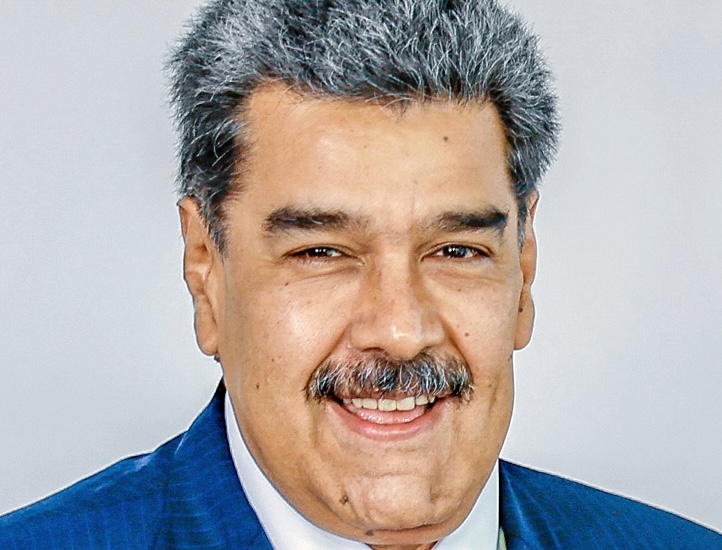
On Monday afternoon, clad in prison garb and seen publicly for the first time since his arrest, Venezuela’s president and his wife pleaded not guilty on narco-terrorism, among other charges, as accused by the United States. After their first hearing, nine countries denounced the U.S. actions to capture and extradite the Venezuelan president; however, North Carolina representatives stand by the Trump administration’s decision.
“I am still the president of my country,” ousted Venezuelan leader Nicolás Maduro told Judge Alvin Hellerstein Monday afternoon in the Southern District of New York. “I’m innocent. I’m a decent man.”
His wife, Cilia Flores, also claimed her innocence.
The U.S. government believe Maduro and his allies provided cover and support to the Sinaloa Cartel and Tren de Aragua gang, among others, and used the guise of diplomacy to give passports to and provide flights for drug traffickers. The government also believes Maduro committed voter fraud and took the presidency illegitimately.
U.S. special forces captured Maduro and Flores Saturday morning in a surprise mission in Caracas, Venezuela, wherein seven bombs were dropped at several locations, including the office of the president, the legislative building and military bases and ports. At least 40 people were killed in the attacks.
In the first hearing since Maduro’s extradition, the U.S. indicted him on charges including narco-terrorism conspiracy, cocaine importation conspiracy, possession of machine guns and destructive devices and conspiracy to possess machine guns and destructive devices.
His capture has resulted in a series of mixed reactions, including signs of celebration on the streets in Venezuela, with some people happy to be free from Maduro’s regime for the first time since 2013. However, on Monday there were protests and counter-protests in front of the Manhattan courthouse. Some celebrated the liberation of Venezuela, a socialist country, while others shared concerns about abuse of power, U.S. intentions to take ownership of oil reserves in Venezuela, and U.S. imperialism.
In North Carolina, area leaders have shown support for the administration taking on “Operation Absolute Resolve.” Congressman David Rouzer (R-7) and Senators Thom Tillis and Ted Budd all released statements clarifying approval of Maduro’s arrest.
“Nicolás Maduro’s capture and transport to the United States is a win for freedom in Venezuela and justice for America,” Rouzer said in a press release. “Maduro is an indicted, illegitimate dictator, which is an important distinction. President Trump’s leadership is sending a clear message to those seeking to harm the United States: regimes that flood our communities with illegal drugs, fuel cartel violence, and undermine U.S. security will be held accountable. President Trump’s decisive action puts America’s safety first and provides a real opportunity for stability, freedom, and a democratic future for Venezuela.”
Tillis and Budd both published their statements on X Saturday morning.
“For years, Nicolás Maduro has led a narco-terrorist regime that fueled the drug trade in our communities. President Trump’s decisive action will finally bring this dictator to justice and end the decades of corruption and crime in Venezuela,” Tillis wrote.
He continued to thank the U.S. service members who completed the mission in bringing Maduro and Flores into the United States, where they are being held in Brooklyn Metropolitan Detention Center.
Budd posted on Saturday the Trump administration’s actions would end Maduro’s “brutal regime” and also save American lives “from the deadly drugs his thugs have brought to our shores.” He also defended the legality of the action.
“These actions are within the President’s Article II authority and send a clear message to America’s enemies our nation will not allow threats to our safety and security to continue unchecked,” Budd said.
Article II, among granting the president other powers, puts the Commander-in-Chief in charge of the military.
Per international law, the arrest and removal of a head of state is only technically permitted if it is made by the International Criminal Court — which does not have jurisdiction over Venezuela. Otherwise it needs approval by the United Nations Security Council, of which the United States is a permanent member with veto power over any action it disagrees with. Foreign heads of state have diplomatic immunity, no matter the possible charges.
During his trial hearing on Monday afternoon, in response to the judge, Maduro claimed he had been kidnapped by the United States and called himself a “prisoner of war.”
The U.S. now faces legal and diplomatic challenges from the United Nations, until or if the government can prove that Maduro was not a legitimate head of state, including litigation over immunity and jurisdiction concerns. No legal case has been brought against the U.S. by the Security Council, which met Monday to condemn the Trump administration for violating U.N. Charter 2(4); this insists countries refrain from threatening or the use of force against the territorial integrity or political independence of any state.
While no formal decisions were made, the U.S.’s actions were notably denounced by South Africa, Brazil, Colombia, Cuba, Eritrea, Russia, China, Mexico, and Spain.
Sérgio França Danese, the Brazilian ambassador to the UN, said at Monday’s meeting: “These acts constitute a very serious affront to the sovereignty of Venezuela and set an extremely dangerous precedent for the entire international community.”
Budd, Rouzer and Tillis did not respond to Port City Daily’s questions on how they thought the U.S. should move forward, nor have they stated support for the U.S. to “run” the country, as Trump told media on Saturday would happen.
Secretary of State Marco Rubio walked back the sentiment Sunday, telling mainstream news outlets that while the U.S. will not be taking over for the day-to-day affairs of Venezuela, it would continue to enforce an oil quarantine for an unspecified period of time.
However, Trump has not ruled out further military action, telling The Atlantic “if they don’t behave, there will be a second strike.” He also threatened interim president Delcy Rodriguez, saying she will “pay a very big price, probably bigger than Maduro” if she “doesn’t do what’s right.”
Trump has claimed Venezuela stole from U.S. oil companies, referring to nationalizing the country’s oil reserves in 1976; this move kicked out American oil companies not willing to give a controlling interest to the Venezuelan government. Now with Maduro facing charges in Manhattan, Trump wants American companies to make billion-dollar investments into upgrading Venezuela’s oil industry.
It is unclear exactly what action the U.S. government will take next, international law does not permit it to govern Venezuela, install leadership or occupy territory.
Raymonde Kleinberg, the head of the Department of Public and International Affairs at the University of North Carolina Wilmington, told Port City Daily Monday Congressional approval would be needed should the United States undergo a prolonged military occupation of Venezuela.
“At the moment the U.S. has not occupied Venezuela and is working with the acting government,” she said.
The War Powers Resolution stipulates prolonged military occupation cannot extend past 60 days and the president must notify Congress of military action 48 hours ahead of time, though this wasn’t followed before Saturday’s strikes.
Sen. Chris Murphy from Connecticut told the Guardian: “The message they sent was that this wasn’t about regime change … They said this is just a counter-narcotics operation.”
The administration let the “gang of eight,” or the top congressional leaders from each party, know about the mission only after the operation had begun.
Maduro has been the president of Venezuela and the head of the United Socialist Party of Venezuela since 2013, after stepping up from vice president following the death of then-leadere Hugo Chávez, Maduro’s mentor. Under the Maduro regime, the Venezuelan people have experienced abject poverty and famine, while the president allegedly took money for himself and his allies; Venezuelans have also undergone a blackout, unable to communicate outside of the country, and there have been disappearances traced back to Maduro’s forces.
Most notable recent events in Venezuela include the 2024 protests following the presidential election in which many claim Maduro unfairly won via voter fraud. Nearly 2,500 protestors, activists, journalists and the like were arrested as a result, part of Maduro’s pattern to arrest political opponents and dissenters.
Kleinberg commented the 2024 election was not the first time Maduro’s legitimacy was questioned. In 2019, Juan Guaidó, in opposition to Maduro, announced himself as the acting president and was backed by 50 countries, including the United States.
“There have been many human rights violations under Maduro and increasing poverty and economic collapse,” Kleinberg commented. “Hence, nations attempting to reinstate Maduro would be facing a great deal of political pressure globally.”
Kleinberg added that Russia and China would be most likely to “attempt diplomatic or material countermeasures” but given their own actions in Ukraine and Taiwan respectively, they would be unlikely to follow through.
Both China and Russia denounced the U.S.’s actions at the Monday Security Council meeting. China’s representative referred to Saturday’s strike as “unilateral, illegal and bullying acts” from the U.S. The Russian Federation claimed the United States seeks control over Venezuela’s natural resources and its actions against the country generate “fresh momentum for neocolonialism and imperialism.”
Have tips or suggestions for Emily Sawaked? Email [email protected]
At Port City Daily, we aim to keep locals informed on top-of-mind news facing the tri-county region. To support our work and help us reach more people in 2026, please, consider helping one of two ways: Subscribe here or make a one-time contribution here.
We appreciate your ongoing support.
