


NEW HANOVER — Following a September vote denying a mixed-use project, the New Hanover County Board of Commissioners and the county now face a lawsuit filed by a prominent developer.
READ MORE: NHC commissioners toy with 2-year property revaluations, solicit public input
ALSO: Newly elected council members talk housing goals, other candidates discuss political futures
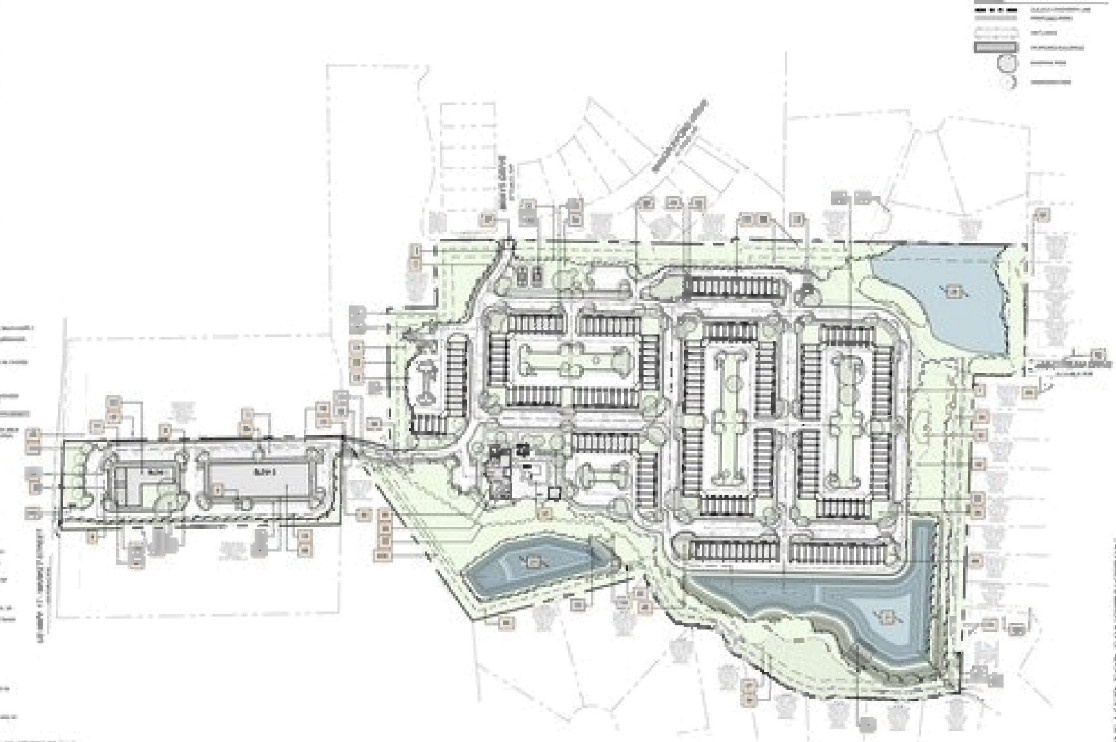
Bayshore Townhomes LLC, an affiliate of Greensboro-based development firm The Carroll Companies — behind the 525-unit mixed-use development The Avenue off Military Cutoff Road — filed a lawsuit against the county on Oct. 16 to overturn commissioners’ unanimous decision to deny two special-use permits required to move the Bayshore Townhomes project forward. Bayshore was requesting one for an additional dwelling allowance to exceed the base number of homes allowed, and another to add multifamily units to the mixed-use portion of the development. The proposed project, slated for the 8100 block of Market Street, would include 242 row-style dwelling units, 62 multifamily units, and 1,800 square feet of commercial space.
Commissioners voted unanimously to deny both special-use permits, reasoning the project would create unsafe transportation conditions and not be in harmony with the surrounding area.
Gary Shipman of Shipman & Wright LLP is representing Bayshore Townhomes LLC and property owners Bee Safe Porters Neck LLC and Herbert Parham; Bayshore wants to purchase their 33 acres combined to develop. He said commissioners violated the developers’ constitutional due process rights by failing to remain impartial.
“This is so far divorced from the concepts of due process that it simply has to be challenged,” Shipman told Port City Daily. “No citizen in the county should feel comfortable if this is what this board defines as due process.”
The special use permit process is strict and commissioners are not supposed to receive outside communication ahead of the quasi-judicial hearing to approve or deny the permitting. However, Shipman alleges commissioners received and considered 200 pages of documents from opponents ahead of the vote, making them impartial rather than basing their decision solely on evidence provided at the hearing as the special use process mandates. The lawsuit states the board didn’t follow “established principles” in the county’s Unified Development Ordinance as well.
The commissioner board is legally required to act like a judge during a special-use permit process, basing its decision only on substantial evidence presented at a quasi-judicial hearing. Commissioners can only approve an SUP if the applicant demonstrates the proposed use will:
- Not create a material risk to public health and safety
- Fully satisfy the technical requirements of the zoning laws
- Maintain or enhance the value of adjacent properties
- Be appropriate and compatible with the neighborhood’s existing character.
However, in August the board voted to approve a text amendment changing the process for additional dwelling allowances from quasi-judicial to legislative. This means more public input will be allowed moving forward, whereas in a SUP only people with standing can speak on the record and must prove the development will negatively impact them.
Commissioners wanted to change the SUP process because they felt the quasi-judicial format was too restrictive. The Bayshore application was submitted prior to the change, so it was grandfathered in and subject to the quasi-judicial process.
Yet, the suit alleges the SUP change of process was made, at least in part, in response to the pending Bayshore Townhomes application. The lawsuit states that during the text amendment vote, commissioners voiced fixed opinions against additional dwelling allowances, which the petitioners allege indicates a pre-determined bias against the Bayshore project.
The developer’s petition provides specific examples of supposed procedural failures, including ex parte communications — private information given to the decision-makers outside of the public hearing.
During the Sept. 2 meeting, Shipman was the first to bring up alleged ex parte communication between commissioners and people against the development. According to the lawsuit, opposition emails came from many with “no standing” and were provided by county staff to commissioners prior to the hearing.
The lawsuit states commissioners received emails primarily from members of the Marsh Oaks Homeowners Association. The Marsh Oaks neighborhood is directly adjacent to the proposed development and the HOA opposed the project, with concerns of traffic congestion, school overcrowding, and increased stormwater runoff.
Template letters produced by the Marsh Oaks HOA for residents to send to commissioners and county planning staff were included as evidence in the lawsuit.
At the podium in September, Shipman repeatedly told the board he objected to the emails factoring into the commissioners’ decision. County staff and commissioners never explicitly responded to receiving the correspondence during the hearing.
“Don’t get me wrong, these ex parte communications were welcome information to the board, even though the board should have been told that they could not consider them and couldn’t read them,” Shipman said via phone Wednesday. “And if they did read them, they were required to on the record state it. That was incumbent upon the county attorney to flesh that out.”
Shipman contends when the issue of the 200 pages of ex parte communication was raised, the county’s legal team had an obligation to act immediately. The lawsuit points to County Attorney Jordan Smith for failing to properly advise the board during the hearing. Specifically, it states he needed to explicitly instruct the commissioners they could not consider the unsworn citizen communication.
Deputy county attorney Karen Richards provided commissioners with an overview of the quasi-judicial process at the start of the hearing and conditions of approval, but did not state commissioners were unable to consider ex parte communication.
Furthermore, the suit alleges at least one commissioner had an “associational relationship” with opponents, which legally warranted recusal from the vote to maintain objectivity and fairness. Although the specific commissioner is not explicitly named in the lawsuit, Shipman pointed to Stephanie Walker, who lives in the area of the proposed development.
Commissioners and the county were unable to provide comment on the pending litigation.
This is the developer’s second attempt to gain approval for the site. Bayshore Townhomes was originally proposed in 2023 for 348 units but was withdrawn due to unfavorability among commissioners and the public. After the initial proposal was unsuccessful as a legislative approval, the developers switched to the SUP process as it legally forces commissioners to approve the project if it meets the four required technical criteria, thereby overriding public opposition.
Shipman explained the developers subsequently “went back to the drawing board” to change site plans, reducing the overall density for the project by 44 units to the current 304 units. Changes to the plan also included a reduction in impervious surfaces, increased buffers, and an improvement to current drainage on the property. The development team planned to add two additional retention ponds to the one already there.
“The completion of this project would enhance the stormwater characteristics of this site and the adjacent areas more so than if the site remains completely undeveloped,” Shipman explained.
Shipman added the commissioners did not read or consider the evidence he presented to them in binders during the hearing. In it were affidavits and reports of sworn evidence from professionals stating the Bayshore project met required SUP criteria.
“The video clearly shows they didn’t read any of the materials that were submitted,” Shipman stated. “There’s nothing that required that this board immediately vote. They absolutely could have taken a break and read the material provided not only by us, but by the ‘opposition.’ They didn’t do that.”
Shipman argued the commissioners’ denial directly conflicted with their own adopted policies, specifically the 2016 Comprehensive Plan. The Bayshore Townhomes site includes land zoned low-density R-15 and B-2 Business Development, but its future land use map designation is Urban Mixed Use.
He contended the project’s requested density of 8.37 dwelling units per acre adheres to the long-term goal. He noted the density falls below the R-15’s maximum allowable density of 10.2 units per acre when granted an additional dwelling allowance.
At the hearing, Shipman told the board that the Urban Mixed Use classification “promotes development of a mixture of uses at higher densities,” arguing the project is a superior option compared to what could be built under the current zoning, such as a gas station or auto repair store.
Yet, the lawsuit claims county commissioners had expressed publicly on separate occasions “there would be no increased density in an R-15 zoning district.”
Ultimately, the developers are seeking the Superior Court judge to compel the county to issue the special-use permits immediately.
The suit also includes a claim for monetary damages for the costs and delays the developer has endured.
Port City Daily asked the county specifically how much money has been spent in defense of the lawsuit to date, how much is anticipated to be spent, and what fund the money is coming from. An answer was received after press from county communications coordinator Alex Riley, who stated, “There are no costs to date and no projected costs. The county’s legal department will be representing NHC in this matter, therefore all costs would be considered standard staff compensation.”
The developer’s primary goal is obtaining the permits. If the county were to issue them now, the main conflict would be resolved, avoiding court. Shipman indicated while the permit approvals are the immediate goal, the fight is in-part over principle.
“This deliberate indifference to the law cannot be tolerated and will not be tolerated,” Shipman stated.
He confirmed the site will not remain completely untouched, stating there will be “development activity” between now and the time the legal process is complete, at least on the portion of land zoned B-2. Because B-2 zoning allows for some activity by-right, land-clearing and minor construction will be done in preparation for the initial build-out.
Have tips or suggestions for Charlie Fossen? Email charlie@localdailymedia.com
Want to read more from PCD? Subscribe now and then sign up for our morning newsletter, Wilmington Wire, and get the headlines delivered to your inbox every morning.
