



WILMINGTON — The Covid-19 outbreak, and government restrictions put in place to slow its spread, have radically upended everyday life for nearly everyone in the Cape Fear region. The story continues to evolve quickly, with changes to restrictions, enforcement, and the ‘new normal.’
What follows is a snapshot that, at least for the time being, covers some of the major moving parts of the Covid-19 situation: testing and results, restrictions and ‘states of emergency’ (and questions about enforcement and authority), plans for government assistance (from federal aid to local initiatives), and how local healthcare facilities are preparing for increases in the number of cases.
How long?
This week, Governor Roy Cooper announced new restrictions for essential businesses and new efforts to help laid-off workers. The steady drumbeat of increasing restrictions have prompted the question: how long will this last?
It’s the second week under a state-wide ‘stay at home’ order. Not yet halfway through the order’s duration, it’s not clear if Governor Cooper or local officials will extend the restrictions on businesses and public gatherings. However, the state has released a study modeling the effects of relaxing restrictions at the end of April or maintaining them through May. The study is a prediction, not an official order, but it definitely appears that Cooper’s office is angling towards a longer shutdown, not a shorter one.
The lack of a specific endgame isn’t just a local problem — from the federal level, to hard-hit areas like New York City, to local towns and counties, people are asking themselves what a return to normal will look like, and when it will happen. So far, there haven’t been any hard and fast answers.
Resources, reporting
If you’re looking for resources, you can find some useful ones here: Covid-19 resource roundup: Wilmington-area small businesses, childcare, health, info [Free read]. If you’re looking for what’s still open, you can find a directory of local businesses here.
Of course, it’s hard to recap the whole week, so you can find all of Port City Daily’s free reporting on Covid-19 here. We also encourage you to send comments, questions, and concerns to [email protected].
Cases, casualties, recoveries, hospitalizations, and the ‘curve’
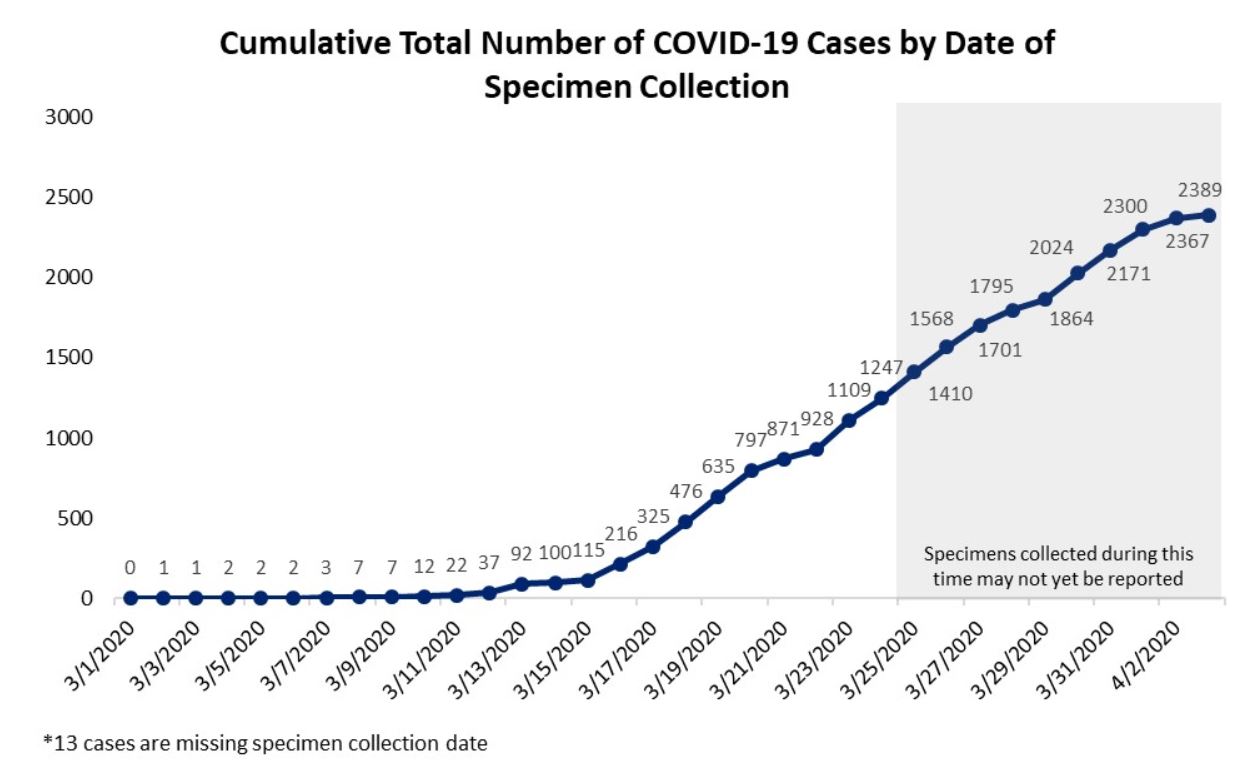
As of Saturday, April 11, around 11 a.m. North Carolina Department of Health and Human Services (DHHS) was reporting 4,312 positive Covid-19 cases out of 60,393 private and public tests; there have been at least 80 deaths.
These numbers include at least 55 cases in New Hanover County, 33 cases in Brunswick County (including one death, last week, and four cases in Pender County). Another death was reported involving a non-resident who tested positive while visiting Brunswick County. The individual passed away while isolating in Brunswick County and household contacts are currently self-quarantining, according to county officials, who also noted that no children were involved.
Last week, North Carolina had 2,402 cases out of 38,773 tests. Two weeks before that, North Carolina had 184 positive cases out of 5,276 tests; at the time, there were six cases in Brunswick and four cases in New Hanover. Nationwide, there have been about 500,000 cases and 29,100 deaths. Last week there were roughly 300,000 cases and over 8,000 deaths. Two weeks before that, there were 15,219 cases and around 200 deaths.
Rumors of ‘underreporting’ spread rapidly in Pender County this week when Microsoft’s Bing search engine showed 12 cases (at the time, quadruple the three cases being reported by county officials). It turns out Microsoft’s search engine had faulty data — possibly from Wikipedia, which the website uses alongside government sources. It’s an example of how attempts to stay on top of rapidly changing numbers can causes problems, and the importance of using reliable sources.
There’s a nationwide debate about the importance of reporting ‘recoveries’ alongside infections and deaths. Some have accused the media of ‘fear-mongering’ by not reporting data showing the estimated 98% recovery rate — making more than ten times as deadly as the seasonal flu, but less dangerous than other outbreaks like MERS or Ebola. Others have pointed out that, at that rate, 6 million Americans would die if everyone in the country eventually became infected.
It’s worth noting that many with Covid-19 deal with symptoms for a considerable amount of time, so there is a delay in recoveries to report. While New Hanover and Brunswick counties have started reporting recoveries, North Carolina isn’t including that data in its daily recap. Google’s Covid-19 database is tracking nationwide recoveries.
Currently, 32 of 55 New Hanover cases have recovered, 19 of 33 Brunswick cases have recovered, and 18,711 recoveries have been tracked by Google nationwide.
At the state level, DHHS is reporting 362 patients hospitalized with Covid-19. According to county emails, New Hanover Regional Medical Center has declined to release the number of Covid-19 patients currently being treated. HIPPA does not prohibit de-identified or aggregated data and the hospital has not cited a specific state statute that protects this information; however, NHRMC Chief Physician Phillip Brown indicated that the hospital was releasing all permissible information.
It’s also important to note that the daily increase in cases doesn’t track the spread of the virus in realtime. Public and private tests have different lag times. Add that to an incubation period that can stretch up to two weeks, and it’s still probably too early to say, based on the current data, if efforts to ‘flatten the curve’ have been successful. The efficacy of ‘social distancing’ measures are likely to be hotly debated as state and local officials consider whether to extend the current stay-at-home order and other restrictions.
The state, as well as Brunswick and New Hanover counties, have all seen ‘community spread’ or ‘community transmission,’ meaning that public health officials were unable to trace the infection’s origin to travel or another patient. This, according to both Governor Roy Cooper and DHHS Secretary Mandy Cohen, has continued to move the state’s reaction from containment to mitigation and suppression.
Questions about enforcing restrictions
Governor Roy Cooper’s executive ‘stay at home’ order was broad and, in places, vague. Cooper told reporters he and Attorney General Josh Stein believed he had the authority to issue the order, which carries a Class 2 Misdemeanor penalty for violations. However, when it came to enforcement, Cooper’s office left it to local District Attorney’s offices and public health agencies to determine the best course of action.
The order left questions about which businesses were considered essential — Cooper’s order included an option for businesses excluded from this category to petition the state to be considered.
Locally, in New Hanover County, there were also questions about the enforcement of additional restrictions put in place by an executive action taken by County Commission Chairwoman Julia Olson-Boseman. This included what areas of large retailers needed to be ‘roped off’ because they were deemed non-essential (for example, the cookware aisle in Walmart.) The county later clarified this issue — but, to date, officials have not provided an explanation of why golf courses remain open while nearly all other sports facilities have been shuttered.
In Brunswick County, meanwhile, officials said there were no plans to add additional restrictions on top of Cooper’s order.
Across the region, from Surf City to the South Carolina border, beaches are closed — but it remains unclear if local municipalities have the statutory or constitutional authority to do so.
There was also the issue of Easter service — one of the most important religious holidays for Christian denominations. Many local churches had planned ‘drive-in’ services (not unlike a drive-in movie), but the Wilmington Police Department (WPD) issued a statement saying these would be banned.
Related: Wilmington police walk back ban on ‘drive-in’ Easter church services [Free read]
Following a constitutional challenge from a local law firm, and a letter from Cooper to the state’s Sheriff’s Association explicitly saying drive-in services should be allowed, WPD backed off. The department continues to say the services will be ‘unnecessarily risky’ and encourages houses of worship to conduct virtual services instead.
Government aid
Many continue to struggle to access the North Carolina Department of Commerce’s website and phone lines; however, Cooper has increased the Division of Employment Security’s staff by around 300 people, and has contracted with Cicso’s Rapid Response Team to increase the website’s capacity, improving the situation noticeably.
Still, the sheer number of people laid off due to Cooper’s executive order — over half a million — is staggering, and owner-operators, proprietors, and contract employees continue to report difficulties.
Related: A half-million North Carolinians file for unemployment as state looks to improve system and benefits
There is some good news, though. This week the state’s Division of Employment Security finally announced how it would implement federally-backed assistance packages.
First, the state will begin distributing the additional $600 per week provided by the federal government to those receiving state unemployment by the end of next week, with the first set of planned payments on Friday, April 17.
Next, it will distribute the Pandemic Unemployment Assistance (PUA). “This program provides unemployment compensation for individuals not eligible for regular unemployment insurance, such as independent contractors and self-employed workers, and those who have exhausted any extensions to unemployment insurance,” according to the North Carolina Division of Employment Security, which plans to begin accepting these claims on Saturday, April 25.
There’s also the $1,200 stimulus checks — technically an advanced tax refund for the 2020 year. The IRS will use pre-existing direct deposit data from 2018 or 2019 to send electronic payments where possible, and mail checks to others. More info can be found at the IRS website. There are still questions about certain kinds of workers who might fall through the cracks (if you’ve got questions, email us at [email protected]).
All of this may feel like too little, too late, especially those who may face paying a second month of rent while unemployed.
There’s also a different kind of government aid — meals provided to low-income families by New Hanover County Schools. The program required significant effort, essentially running a major catering and delivery operation. The largely unprecedented program has hit some snags. Officials say they believe things are going well, while others say minorities and at-risk families are the ones getting left out.
Related: As school system misses areas in meal delivery program, some families on verge of hunger [Free read]
PPE preparedness
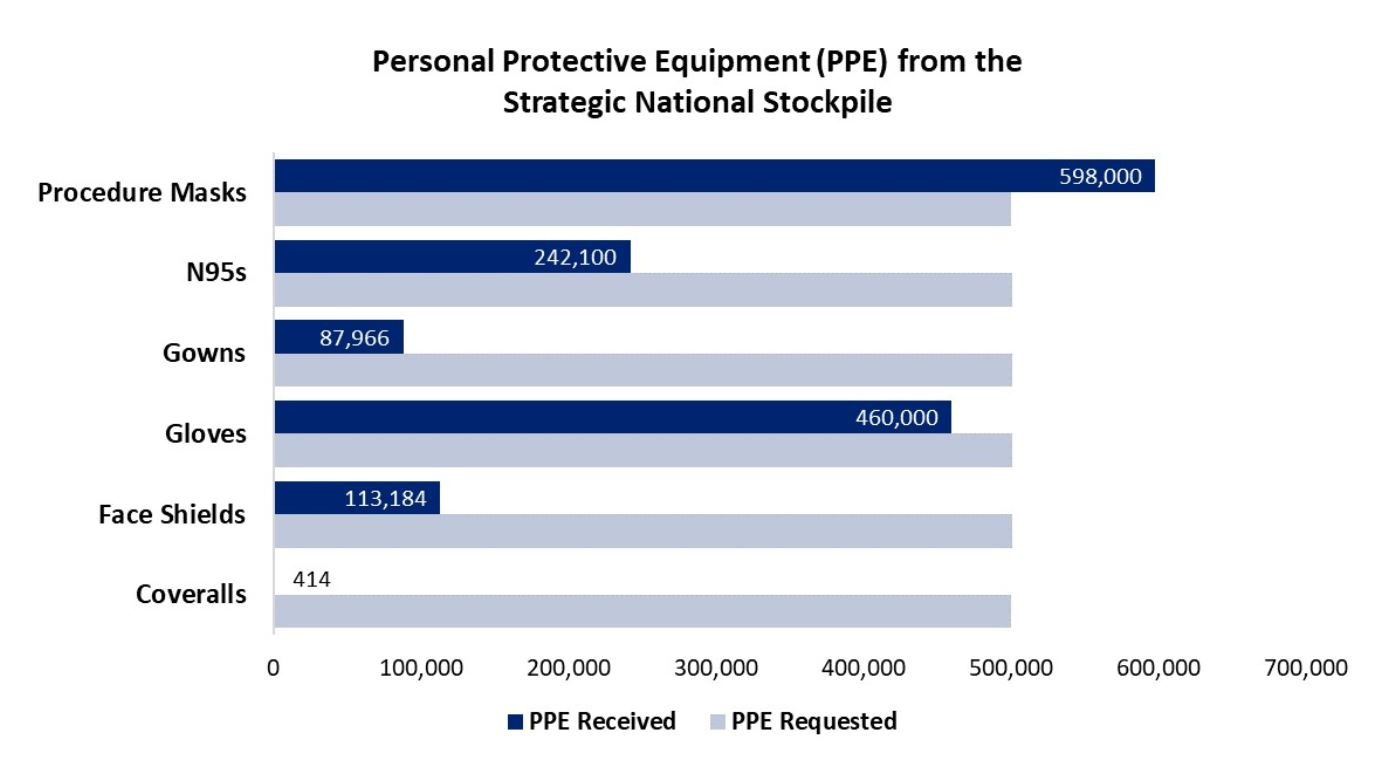
New Hanover Regional Medical Center (NHRMC) and other regional hospitals face a possible shortfall of beds, ventilators, and personal protective equipment that would be needed to respond to a potential spike in Covid-19 cases in the coming weeks.
Last week, Port City Daily crunched the numbers on local supplies and capacity compared to current worst-case and best-case models here: NHRMC and other regional hospitals face potential shortfall in beds, ventilators, and PPE [Free read]
Here’s the condensed version:
- The region may require between 3,000 and 27,700 beds
- The region has less than 1,000 beds
- The region may at least 2,000 ventilators
- NHRMC has about 100 ventilators
Related: PPE roundup — Who’s asking for masks, gloves, and other protective gear? [Free read]
NHRMC has been actively soliciting donations of PPE, and has also set up additional temporary facilities, but the hospital — like most around the country — facing serious shortages and the very real risk of being overwhelmed if cases spike all at once. Other local healthcare facilities are also soliciting donations of PPE.
Send comments and tips to Benjamin Schachtman at [email protected], @pcdben on Twitter, and (910) 538-2001
