


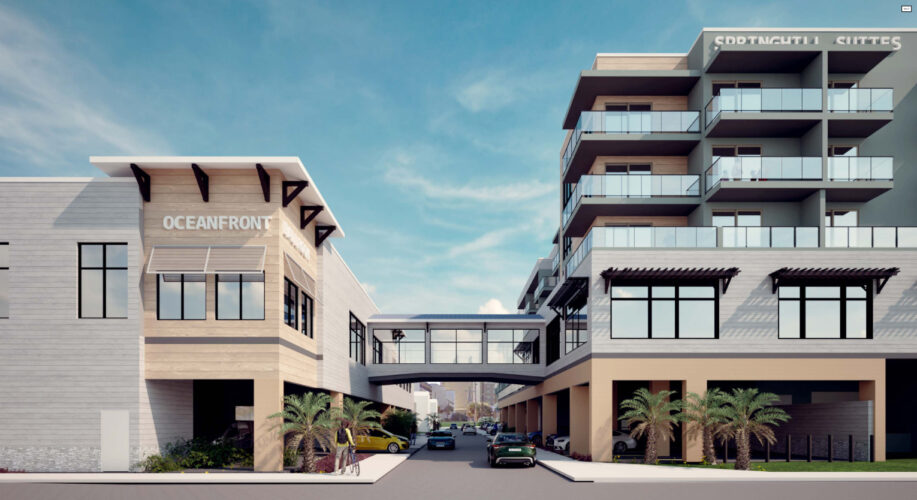
CAROLINA BEACH — A once-controversial development has overcome its first legislative obstacle in Carolina Beach, as Harmony Hospitality has received positive approval from the planning and zoning board.
READ MORE: CB Embassy Suites set for traffic analysis approval, opposed petition reaches 1,500 signatures
Unanimously, the board approved the conditional zoning and plans for the 140-room SpringHill Suites on Oct. 9. Multiple parcels on Carolina Beach Avenue North, also containing SeaWitchCafe and Tiki Bar, needed a conditional zoning in order to construct the hotel and pavilion to exceed the 50-foot height limit in the Central Business District.
In addition to several conditions, the seven-member board noted the project met all the construction, lighting, and permit requirements for approval, as well as gained support from the general public.
Harmony Hospitality bought SeaWitch in January 2024 for $2.6 million, as well as other parcels to build the hotel. They paid $2.79 million for the 234 and 236 addresses, and $2.4 million for the 235, 237, and 239 addresses.
The project has been a contentious one in the beach town, originally proposed in 2024 as Embassy Suites. Due to its scale — then expected to be a 100-foot building and 177-room full-service hotel — it was met with backlash from Carolina Beach residents. Harmony Hospitality has since decreased its size (and even pushed a few different iterations, including a Holiday Inn Express) in response to feedback from numerous community meetings.
The developer landed on SpringHill Suites because of its smaller size and amenities. The building will be around 67 feet tall, though the exit staircase will bring the height up to 73 feet, according to the presentation developers gave at the planning board meeting.
The hotel will be built where the current SeaWitch Cafe and Tiki Bar is located. Across the street, a new SeaWitch and event space and ballroom will be constructed facing the ocean. It will be 39 feet, raised above the ground in order to accommodate for parking underneath the pavilion, and will connect to the hotel with a skybridge.
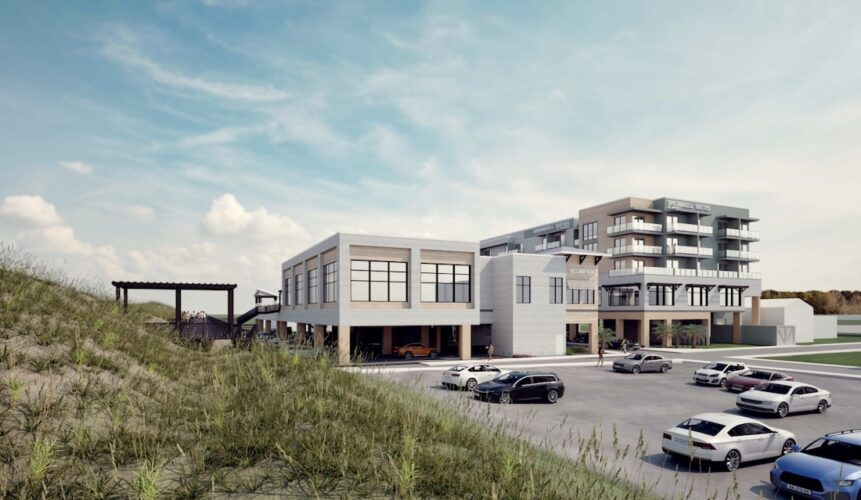
The project still has to be approved by the town council before ground can be broken. Should the proposal pass in mid-November, construction is set to begin in February for the pavilion, including the new SeaWitch. Construction on the hotel would immediately begin at the end of the summer of 2026, according to Page Johnson, president of Harmony Hospitality.
Two meetings were held ahead of the hotel going before the planning board. This was part of the process to obtain conditional zoning approval; Carolina Beach requires developers to bring their plans to the public at least once. Mayor Lynn Barbee said the conditional zoning practice has only been in place for the past few years. The first time it was implemented was in 2021.
“I think it’s turning out to be everything we hoped it would be,” he said, “because those residents get the first shot at it and then the developers take that feedback, absorb it, and come back with projects that are much better than the original view. I think it’s fantastic to see the community have their say in it, not just through their elected officials.”
When Harmony Hospitality first announced it was building Embassy Suites, residents complained about height and infrastructure needs, such as its impact on water supply and traffic, as well as not aligning with the small-town feel of Carolina Beach. A petition garnering 1,500 signatures was circulated against the move.
Johnson noted they received a lot of comments during their second public meeting and took them into consideration in devising a new plan.
Following the two public meetings, Harmony also asked Carolina Beach residents for feedback in a survey filled out by 246 people; 73% of respondents said they wanted a hotel and 52% said they wanted a full service hotel, which most notably includes having a restaurant. While SpringHill is technically a select-service hotel, having SeaWitch across the street fulfills the desires of the town survey, by having a restaurant, and one that is beloved by locals.
Wayne Rouse, planning board chair, said much of the project’s unanimous approval came from how the company listened and implemented resident concerns into their new proposal.
Only one person spoke at the planning board meeting on Oct. 9. Natalie Evans wasn’t against the development as a whole, but expressed a few concerns still.
“The one thing I didn’t hear was how we will reduce environmental impacts in our coastal town and I didn’t hear recycling,” Evans said. “I didn’t hear eco-friendly, sustainable sourcing, working with the community through local businesses. That’s the only thing I didn’t like about it.”
Alexander Torres, who started the petition to stop the proposed Embassy Suites, expressed a more positive response to the SpringHill Suites proposal.
“I think it’s wonderful the developer really listened to the residents and actually changed what the original plans were to the newer plans. I think most of us are pretty OK with what’s happening now,” Torres said.
His only issue remained with water supply, which would be in higher demand due to the hotel’s need for potable and nonpotable water. When the original proposal went out, the town’s planners suggested Embassy Suites would need to build a water storage tank first. SpringHill has not included as much in its plans, according to Johnson — though he said it wasn’t a decision on his part, rather the town’s.
Mayor Barbee noted the downsized plans fit into the water supply capacity the town currently has.
The town’s community development director, Jeremy Hardison, said SpringHill Suites would use 20,000 gallons a day, though he could not provide a number for how much the Embassy Suites was set to use.
Carolina Beach’s water supply comes from the 13 wells they have that draw from the Pee Dee aquifer and the Castle Hayne aquifer. While the Pee Dee aquifer does not have a published number for how much water it contains, the Castle Hayne aquifer holds 60 million gallons of potable water. Carolina Beach’s wastewater management is also 3 million gallons per day.
The Castle Hayne aquifer wells yield between 200 and 500 gallons per minute typically, Hardison said, but can exceed 2,000 gallons per minute. The Peedee aquifer wells yield up to 200 gallons per minute.
The town also uses water storage tanks as to not overwhelm the wells by demanding too much water. Doing so would leave the well dry. The storage tank is used to help in times of emergencies — like fires or storms — and to supply the town.
“We don’t want to over pump the aquifer and it to run dry. We want it to have time to replenish itself before we go pumping more water, so then in our water towers is where we have water storage available,” Hardison said.
Stormwater runoff was also troublesome to many, as flooding is common in the area. Johnson said he and his team are looking to improve the drainage system. According to Rob Allen of Paramount Engineering, also working on the project, the hotel will have an underground stormwater basin, of which the planning board asked for a “layman’s” explanation on how it would work.
“Currently, today, what happens is, rain hits the ground, and it just runs off and gets to the nearest inlets in the road,” Allen responded. “We’re going to contain any rain that we get on site, from roofs, that come down and get to the underground system.”
Johnson explained the first quarter inch of stormwater runoff was made up of contaminants and pollutants that harmed the environment — oils, heavy metals, dirt, and bacteria — so the SpringHill Suites plan would be an improvement to what’s currently there.
Allen added the system would be able to hold more water than required, so during a hurricane, because of a bypass diversion system to be put in place, the new plans would be able to control stormwater runoff better. Before, water would just disperse randomly.
In addition to obtaining all required permitting from the federal, state and local government, as well as meeting flood standards, Harmony Hospitality had to agree to other conditions before the project was approved for rezoning:
- Reach a maintenance agreement or easement with the town for a public sidewalk that is partially on the the property where the hotel is to be situated
- Install lighting for the streets and sidewalks, angled downward to prevent driving hazards
- Bury electrical lines
- Plant 13 trees
- Pave Pelican Lane
- Add 5-foot sidewalks around the building
- No parking spaces, signs, shrubs, trees, poles, or anything else will obstruct the street and sidewalk corners located at the intersection of N Carolina Beach Avenue and Pelican Lane
- Recombine plat — parcels at 223, 225, 235, 237, & 239 N Carolina Beach Avenue will become one to build the hotel.
The developer also will install flashing lights at the Pelican Lane crosswalk to improve pedestrian safety.
For the project, Harmony Hospitality used the traffic impact analysis done for Embassy Suites. It indicated 1,495 total daily trips, though that number is suspected to decrease with a smaller footprint. The new total could not be provided because a new traffic analysis wasn’t conducted when the plan switched to SpringHill. It wasn’t discussed at the planning board meeting, nor did Johnson have new numbers.
Increased foot traffic was also notable to officials. Rouse and Barbee both commented on how the new project could draw in more people to the area.
According to Barbee, the hotel’s location near the marina and downtown region of the Central Business District will help bridge a gap between two disjointed areas. While both are filled with amenities, especially after the millions of dollars put into improving the marina, there was nothing to really entice people to walk between the two locations.
“I see it as reunifying those two sections of our downtown,” Barbee said. “I think it’s very important for the redevelopment of our Central Business District. I think whether it’s SpringHill Suites — or whatever goes into that space — is going to be very important for us.”
Johnson said his goal is to improve the aesthetic of the area and potentially draw in more businesses as well.
He and his wife love the area and have frequented Carolina Beach — and the SeaWitch — on vacation.
“That’s where we run to just get a break on Sunday afternoons,” Johnson said.
As part of its plans, Harmony intends to keep current staff onboard, who wish to stay employed there, once the new SeaWitch opens.
“They’re able to keep their jobs and the continuity of the service and relationships that they built with their management and the other employees,” Rouse said. “I think the public got what it wanted.”
The town council meeting to decide the fate of SpringHill Suites and Pavilion will take place on Nov. 12.
Want to read more from PCD? Subscribe now and then sign up for our morning newsletter, Wilmington Wire, and get the headlines delivered to your inbox every morning.
