


BRUNSWICK COUNTY — Monday night the Brunswick County Planning Board unanimously approved three proposed project developments during a meeting fraught with criticism.
READ MORE — ‘Slow down new development coming in’: Residents push back on Brunswick rezoning requests
The public hearing was front-loaded with furor which simmered throughout as the meeting moved along. Many residents spoke against the developments and nobody spoke in favor except the developers.
It helped that the almost 3,000-home Midway Tract was dropped from the agenda prior to the meeting. Many people had shown up only to speak in opposition to the immense development, now an absent target. Though there were plenty of resident concerns directed at the wider state of development in the county, like future flooding or school overcrowding, rather than specific elements of the other three projects. Chairman Jason Gaver at one point had to ask them to stay on topic.
Gaver and board members Clifton Cheek, Richard Leary, and H. Richard Ishler voted in favor of the projects. Absent from the meeting were William Bittenbender, Joy Peele Easly, and Ron Medlin; alternate member Ishler stood in.
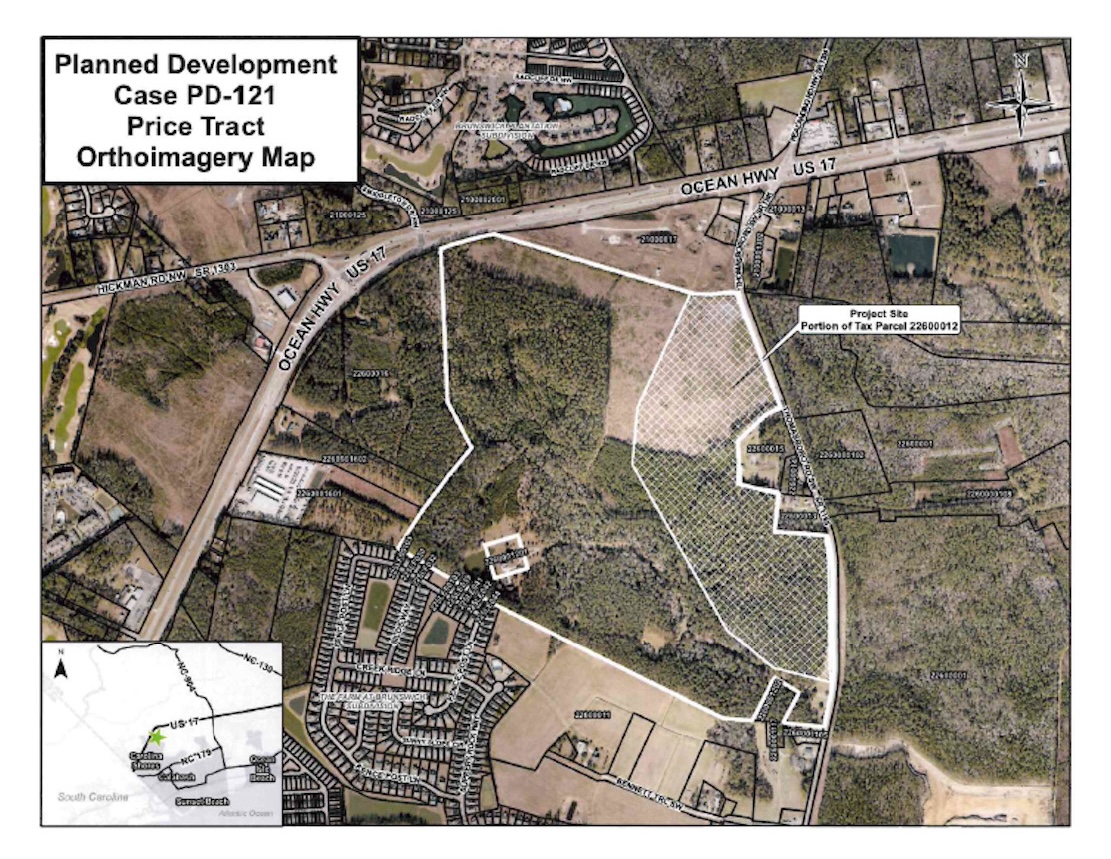
Headwaters Engineering of Cape Fear owner Thomas Scheetz presented the sprawling Price Tract, a plan drawn up for 164 single-family homes, 22 townhouses, with 5 acres set aside for commercial development. The estimated density is 2.26 dwelling units per acre, with recreation space 10 times the requirement at 21.81 acres and open space also exceeding its mandated 16.43 acres to 24.68.
The development also includes an extensive walking trail and 5 acres of commercial development. It is slated for the South Carolina-North Carolina border, located to the east of Carolina Shores and estimated to increase traffic in the area by 1,698 daily trips.
Marianne Schmitt included the frequent public refrain about overloading infrastructure with traffic and a desire to see this particular development stopped. She asked: “Why can’t this one wait?”
Longtime resident Terry Alston and and 16-year-old Lily Knox mentioned the prospect of school overcrowding, with Knox asking the board to consider the effects of the development on future generations. Alston followed up asking if the builders have any responsibility to the schools during public comment.
During the unanimous approval vote, there was a shout of, “Go ahead and rubber-stamp that,” from a member of the crowd.
Also presented by Scheetz was Leaning Pine — to feature 38 single-family houses on 11.71 acres with a density of 3.25 dwelling units per acre. It will be built on Leaning Pine Road Southeast, north of Varnamtown.
Staff approval criteria included the majority of the land be used for the homes with a minimum of two parking spaces. It suggested 2.92 acres of required open space, which the developer plans to exceed with 3.44 acres; recreation space will also be more than the requirement: 0.57 acres instead of 0.44. At build-out, the development will generate roughly 360 trips every 24 hours.
Gaver homed in on the absence of sidewalks in the development. Scheetz explained their addition did not seem necessary or cost-feasible; it drew derisive laughter from some members of the crowd.
The chairman recalled his own experiences of living in a neighborhood without sidewalks, briefly characterizing a residential street void of safe pedestrian paths as dangerous. Scheetz agreed to include sidewalks and retain vegetation in the plan — the latter brought up by several residents who were concerned with clear-cutting forested areas.
The development will not be built in a flood zone and includes a 30-foot buffer, 0.6 opacity used with existing vegetation. Residents expressed concern with headlights shining into nearby residences from the increased traffic.
The expansion of the Cedar Crossing also was put forth Monday by Norris and Tunstall, represented by company namesake and civil engineer Phil Norris. Cedar Crossing was originally approved last December as a 79-home development over nearly 28 acres. Since that time, the proposed plans increased by 50 homes, stretched across roughly 45 acres; the density is 2.9 dwelling units per acre.
According to an email from Norris and Tunstall to Brunswick County Principal Planner Marc Pages, there was general concern at a Jan. 16 neighborhood meeting about expanding to 129 homes and the effect it will have on area traffic. In the email, civil engineer Joseph Bland wrote he anticipated community pushback at the planning board meeting.
Wetlands were among the concerns aired by the first member to speak Monday meeting. Resident Brandon Simmons of Longwood singled out wetland preservation as a reason for opposing further development.
Norris told the public the wetlands shown on the site plans stretching across the northeast side of the lot would not be harmed. Stormwater ponds would be constructed to treat a 100-year event.
He added sidewalks would be located along all the streets and traffic impact analysis had been conducted. It’s expected to bring in 1,234 vehicle trips a day.
The engineer couldn’t have drawn more arrows of ire with a bullseye painted on his blueprints. His remarks were often punctuated by laughter from the crowd, even veering into name-calling, wherein a resident yelled “scum.” Norris responded to an accusation that his plans were always approved by the board, saying projects had been turned down, though he did not provide specific examples.
Gaver’s announcement of the removal of Midway Tract was the lone wave of applause at anything said by the board. According to the chairman, Midway Tract had been attracting attention even before the meeting — more so than the other project removed from the agenda, the Village in the Meadows subdivision. Gaver did not know why the 47-house nearly 50-acre Village development had been dropped.
Port City Daily reached out to Norris and Tunstall to see if they knew why the Midway Tract was stricken from the agenda as well, but no one responded by press.
The planning board also approved two rezonings, with considerably less input from the public. One included 7.66 acres off Green Swamp Road in the vicinity of Supply from rural residential to commercial low density. Staff noted the rezoning request by David Summerlin III of South Brunswick Development was reasonable and would be consistent with the Blueprint Brunswick 2040 Comprehensive Plan, and identified the land as acceptable for commercial development and not endangering natural heritage.
Another rezoning request by Summerlin of a vacant area on High Hill Drive near Shallotte was also approved unanimously by the board. It changes the zoning from neighborhood conditional to commercial low density, with no conditions or site plans proposed.
The vacant area rezoning was also judged consistent with the goals and objectives of the comprehensive plan, specifically those to support development in areas with good prospects for opportunities in the future, the concentration of development for efficient infrastructure use, and expansions of jobs in the county.
Tips or comments? Email [email protected].
Want to read more from PCD? Subscribe now and then sign up for our morning newsletter, Wilmington Wire, and get the headlines delivered to your inbox every morning.
