


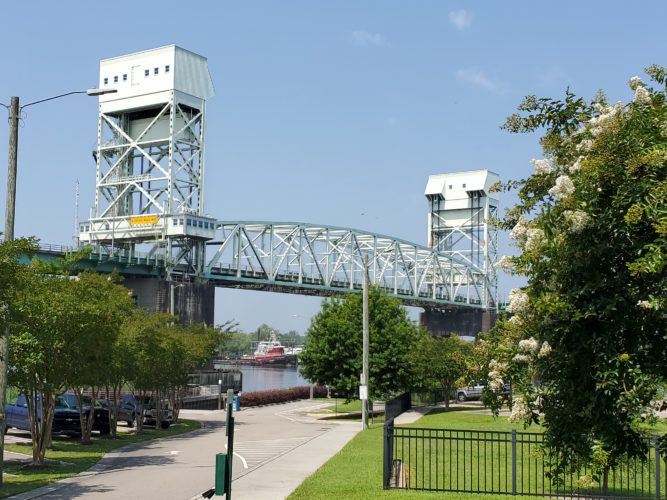
WILMINGTON — The Federal Highway Administration is advancing an agreement determining how it will study the impacts of the Cape Fear Memorial Bridge replacement project on downtown Wilmington’s historic resources. The City of Wilmington has a few qualms.
Section 106 of the National Historic Preservation Act requires federal agencies — in this case the Federal Highway Administration — to evaluate how a federally-funded infrastructure project will impact historic buildings, sites or districts.
To satisfy this provision, the Federal Highway Administration is requesting a programmatic agreement with the North Carolina Department of Transportation, the Advisory Council on Historic Preservation and the State Historic Preservation Office. The document determines what area to study and how mitigation will be handled for adverse impacts due to bridge construction.
As a local government entity whose residents are affected by the replacement project, the City of Wilmington has been asked to provide feedback on the agreement and be a concurring party to its execution. Thus, a city representative will continue to provide input and attend meetings going forward.
After review from staff and the Wilmington Historic Preservation Commission, suggestions to the agreement include an expansion of the agreement’s study area beyond just Front Street, Third Street, and Fifth Avenue to encompass downtown proper. Another request is for the agreement’s mitigation efforts to include corridor plans addressing how traffic changes will impact downtown roadways.
Also, the city is asking the agreement language to acknowledge a 135-foot fixed span bridge will have greater adverse traffic impacts as opposed to a 65-foot movable span bridge. However, it is also asking for an admission the 65-foot option will still have adverse impacts on the area, even though it could be built in the existing bridge’s footprint. NCDOT has not yet determined which height option will move forward.
Per the city’s request, mitigation methods should include vibration monitoring — or using sensors to measure vibration of a structure when movement is acted upon it.
Ultimately, council voted 6-0 to sign off on the agreement with staff’s suggestions, but not before venting some frustration over the various processes to get a new bridge.
“It has taken so long that if they’re just going to tell us how to do it, can they at least do it timely?” council member David Joyner said at the meeting.
The replacement of the Cape Fear Memorial Bridge, built in 1969, has been in discussion since 2020, though the project didn’t score high enough for state funding until it was submitted as a tolled project in 2024. At the time, the 135-foot fixed bridge option was estimated at $453 million; NCDOT has put forth $80 million and was awarded a $242-million federal grant for the project, though since 2024 the cost has been adjusted to $1.1 billion for both the 135-foot and 65-foot design options.
The reason for the programmatic agreement — as opposed to the traditional Section 106 process — is intended to save time and complete the Section 106 analysis in line with deadlines associated with the federal grant. The project needs to be “shovel ready” by September 2027 to keep the grant.
The traditional Section 106 process involves determining what the impacts are and ways to mitigate them, though it must be done in sequential order, requires consultation with stakeholders for each step, and thus, can be lengthy — complex projects can take months to years.
Programmatic agreements are common alternatives for federal agencies looking to delegate authority to states or to streamline repetitive processes for complex, multi-phased projects.
Complicating the evaluation process further, the draft agreement acknowledges Section 106 conclusions will vary depending on the height selected for the bridge and if it is tolled. Thus, the Federal Highway Administration and its consulting parties believe the customized programmatic agreement process allows for more flexibility.
“This is so complex to the point where it’s just unreasonable,” Joyner said at the meeting. “There’s so much bureaucracy here.”
The council member said he was prepared to vote in favor of the agreement if staff thought it was the best way forward while doing four things: keeping local input intact while supporting a bridge with an “appropriate span for commerce,” environmental protections and no tolls.
On behalf of staff, Planning Director Linda Painter explained to council Tuesday the agreement only pertains to the project’s impact on historic resources. NCDOT is conducting a separate environmental assessment designed to study broader impacts to the natural environment, as well as the social, economic, cultural, and human health impacts of the bridge replacement.
The North Carolina Department of Transportation confirmed this draft assessment — anticipated to be scheduled for a public hearing sometime this summer — is complete. It has not yet been published.
However, in Tuesday’s discussion, Painter said another city request would be for the Federal Highway Administration to extend the timeline of the federal grant, in order to allow NCDOT to complete an environmental impact statement, rather than an assessment.
An environmental assessment is considered a preliminary document. If an assessment finds a project would not have a significant impact on surrounding areas, a full environmental impact statement — an exhaustive, in-depth study — would not be necessary.
Painter said Tuesday a complete environmental impact statement would help the public understand the “full impact of the two alternatives, whether it is environmental resources, historic resources, traffic, [and] what that is going to mean in terms of improvements that the city would need to do.”
Council member JC Lyle said she would imagine the 135-foot fixed bridge option — designed to deposit traffic onto Fifth Avenue rather than Third Street like the current and 65-foot option — would cost the city “tens of millions” in improvements. The city completed $15.75-million worth of improvements to Fifth Avenue in December, including the installation of new water and sewer utilities and the conversion of a driving lane into a dedicated bike lane in each direction.
Both Joyner and Lyle lamented both the National Environmental Policy Act and Section 106 processes getting further and further away from local decision makers. Mayor Bill Saffo applauded staff for requesting additional work and acknowledgment from the Section 106 process.
“We’re going to take the brunt of this, and we should thoroughly evaluate it,” Mayor Bill Saffo said. “We deserve that as a community, instead of just saying you got to take it the way it is.”
At Port City Daily, we aim to keep locals informed on top-of-mind news facing the tri-county region. To support our work and help us reach more people in 2026, please, consider helping one of two ways: Subscribe here or make a one-time contribution here.
We appreciate your ongoing support.
