


WILMINGTON — North Carolina’s state budget now requires Charlotte and surrounding municipalities to pay back millions of dollars after voting down the addition of toll lanes to Interstate 77; tri-county officials that make a similar choice could face the same consequences.
The state budget, passed July 2, includes a provision to claw back money spent on state-funded transportation projects if the local leaders vote to remove it from the state-mandated transportation plan or “prevent the project from being delivered or funded in the manner originally programmed.”
The provision was added into the budget after the Charlotte Regional Transportation Planning Organization voted to rescind its approval for toll lanes on U.S. Interstate 77 after mounting public pushback on the project.
“They took a situation and a reaction to something that happened in one jurisdiction and created a statewide policy on it,” Brunswick County Commissioner Frank Williams said in a July 29 WMPO meeting.
Williams serves on the Wilmington Urban Area Metropolitan Planning Organization, which invited consultant David Ferrell of Maynard Nexsen PC to discuss the provision’s implications on the tri-county at its meeting last week.
Ferrell explained local planning organizations will need to work more closely with NCDOT on amendments to any projects and analyze fiscal impacts of any potential changes in the beginning stages of a project. If the project is removed at NCDOT’s direction — or per federal action or court order — clawback stipulations would not apply.
Port City Daily asked Sen. Michael Lee (R-New Hanover), as the Senate Majority Leader and co-chairman of the appropriations committee, how it was decided to apply the provision statewide. He did not respond by press.
Local transportation projects receive state funding by submitting projects to be scored in the North Carolina Department of Transportation’s State Transportation Improvement Plan. NCDOT scores projects in three rounds: statewide, regional and division; the highest-scoring projects in each category are awarded state funding. These projects are then included in a local planning organization’s Metropolitan Transportation Improvement Program, basically a subset of the statewide STIP.
The budget provision states any local government that votes in favor of removing or modifying a project funded in the statewide category “shall reimburse the department for preliminary costs incurred by the department.” These could include engineering, environmental studies, consultant fees and labor costs.
In Charlotte, it means the local governments who supported the May vote to rescind the 1-77 toll lanes would be on the hook for $60 million in NCDOT preliminary expenses. The Charlotte Regional Transportation Planning Organization has 90 days to reverse its decision before the state seeks reimbursement.
“Unless the legislature comes back and repeals it, this [provision] will be the law going forward, irrespective of the decision in Charlotte,” Ferrell said.
Mike Kozlosky, executive director of the WMPO, stressed the provision only applies to projects funded at the statewide tier. He added he has asked the state to provide a cost summary for local plans currently in the works. Construction projects include access management improvements at Market Street and MLK Jr. Parkway, along with College Road and Shipyard Boulevard to Wilshire Boulevard (which will also have a lane addition). Also included is the upgrade of College Road to a super street ,from Gordon Road to New Centre Drive.
“Just so the board is aware, because you’ve been receiving a number of public comments regarding the Military Cutoff and Eastwood [grade-separated interchange], Military Cutoff and Eastwood was a project that was funded at a statewide tier, and so it would be subject to this provision of law,” Kozlosky said.
The $81.4 million-project will place an overpass, or “flyover” as residents refer to it, over Military Cutoff Road as part of a grade-separated interchange replacing the existing intersection, which currently operates at the lowest level of service per NCDOT’s measurement. Construction is set to begin in the fall or winter of 2027; residents have recently been outspoken in opposition, some not being present for the public meetings held beginning in 2015.
NCDOT told Port City Daily the agency has spent around $19.9 million to date on the project.
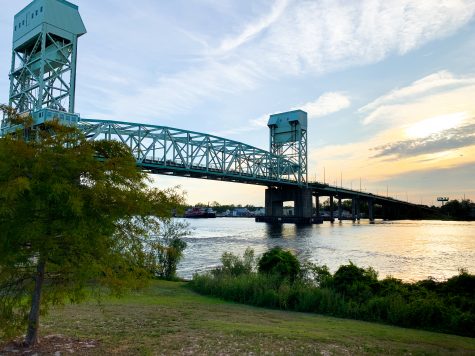
Another controversial project also funded in the statewide tier — the Cape Fear Memorial Bridge replacement.
In January 2024, the WMPO board voted to submit the replacement bridge, estimated to cost $1.1 billion, as a tolled project in the State Transportation Improvement Plan. Though some leaders voted against it, the decision was made to move the project and give it the best chance for state funding; NCDOT did not score an untolled version high enough to receive money.
NCDOT officials made clear they would seek federal grants in hopes of avoiding the toll, something they would not be able to do if the bridge replacement didn’t score high in the STIP.
“It is the intent of [doing] everything I can do not to go into an actual toll,” Division 3 Engineer Kimes said at the January 2024 meeting. “But it’s critical to go after these grants to continue having that conversation about a potential toll.”
Kozlosky also assured the board it could withdraw its approval of the toll project at any time until construction contracts are advertised. As reported by Port City Daily last month, the deadline for the board to withdraw the tolled bridge replacement from the STIP would be February. This deadline would give the WMPO and state enough time to get the project “shovel ready” by September 2027, a requirement to keep its $242-million federal grant.
Under the new law, it doesn’t appear the WMPO will be able to withdraw the project without consequence. NCDOT told Port City Daily it has spent around $26 million on the project to date.
Port City Daily asked the WMPO if the provision applies to the Cape Fear Memorial Bridge replacement.
“Because this is a new provision, we’re going to seek clarification on how it would apply before taking any action,” spokesperson Tessa Jones said. “At this point, we can’t confirm whether it would apply specifically to CFMB.”
Ferrell made clear NCDOT still has to work out how the law will function administratively. The law states the cost burden of a removed or amended project would be based on each municipality’s weighted voting percentage within its MPO.
The WMPO includes the following members, each with equal voting power:
- Lynn Barbee, mayor of Carolina Beach
- Frank Williams, Brunswick County commissioner
- Charles Bost, mayor of Belville
- Brenda Bozeman, mayor of Leland
- Ken Dull, mayor of Wrightsville Beach
- Brad George, Pender County commissioner (soon to be replaced due to George’s resignation)
- Allen Oliver, mayor of Kure Beach
- Bill Rivenbark, New Hanover County commissioner
- Stephanie Walker, New Hanover County commissioner
- Cassidy Santaguida, Wilmington council member
- Kevin Spears, Wilmington council member
- Rose Terry, mayor of Navassa
- Landon Zimmer, NCDOT representative
Under the new law, if seven of these individuals voted to remove a project from the WMPO’s MTIP, only the municipalities they represent would be on the hook for 1/7th of the reimbursement costs. For example, if Barbee voted against the removal, Carolina Beach would not be implicated.
At the WMPO meeting, Santaguida questioned what would happen if she and Spears, the City of Wilmington’s two representatives, voted opposite each other. Ferrell said the bill does not address this and it would need to be worked out administratively.
Santaguida also asked when the tab starts, as the provision states only after the “commencement of pre-development activities.” Ferrell didn’t have the answer.
He did explain the state has several ways to enforce the law, which stipulates NCDOT must withhold Powell Bill funds from municipalities that voted in favor of the project removal until reimbursement is made. The Powell Bill provides money to state municipalities for maintaining, repairing, and resurfacing local roads.
Additionally, NCDOT may not initiate any new STIP projects, including pre-development, within the boundaries of those local governments that vote in favor of removal until reimbursement.
All reimbursement payments are to be deposited into the State Highway Trust Fund.
[Ed. Note: The language in this piece has been updated to reflect the Military Cutoff/Eastwood Road intersection project is not simply a flyover, but a grade-separated interchange where an overpass will be constructed over Military Cutoff Road.]
At Port City Daily, we aim to keep locals informed on top-of-mind news facing the tri-county region. To support our work and help us reach more people in 2026, please, consider helping one of two ways: Subscribe here or make a one-time contribution here.
We appreciate your ongoing support.
