


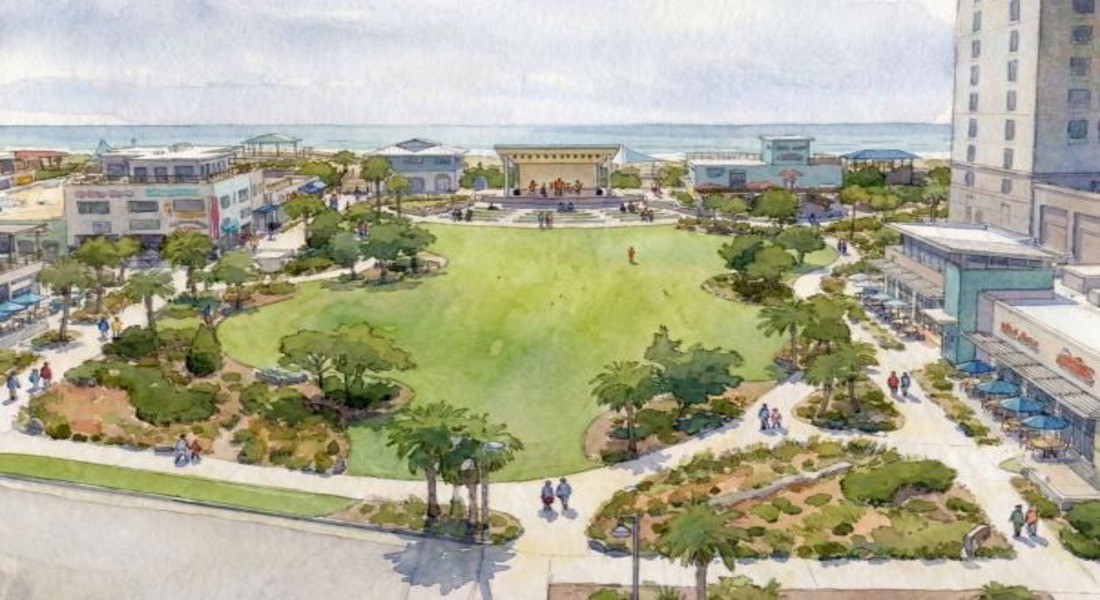
CAROLINA BEACH — The Carolina Beach Town Council met Tuesday morning to hear about ways to approach its beachfront park development, slated for the nine properties in the heart of downtown. The town purchased them for $12 million in a lawsuit settlement earlier this fall.
Professionals from the Development Finance Initiative at the UNC School of Government presented its ideas to the Town of Carolina Beach, noting it could help guide design plans, find and contract developers for the properties located along the Carolina Beach Boardwalk. DFI partners with local governments across the state for community and economic development projects, helping secure investments, whether through grants or loans, including from private institutions. Council will take up a vote Tuesday night to allow staff to continue working with DFI.
Should Carolina Beach choose to go with the group, it would pay $114,700 — with funds from its $3.5-million The Endowment grant — according to Town Manager Bruce Oakley. It would be paid over two years for services for the design of the beachfront park only, which takes up five parcels. Under $50,000 will be spent on a separate firm to create the actual designs and renderings.
READ MORE: CB secures $3.5M Endowment grant for beachfront park, $12M land purchase
ALSO: A lawsuit and leaseback agreement: Inside Carolina Beach’s boardwalk deal
However, the town wants to bring in commercial projects for the other properties.
“As you know, the town does not need all the land we purchased to build the public park portion of the land,” Town Manager Bruce Oakley told Port City Daily. “DFI will help us identify potential commercial projects that could be developed in partnership with a private developer. Once potential projects are identified, we would request proposals from the private sector. This could help us offset the debt on the properties and increase our tax base. It could also create a project that enhances the public portion of the project and increases property values and encourages more investment in the area.”
Oakley explained the $114,700 only covers part of DFI’s services, and that the balance will be ‘at risk’ and paid as a fee from the developers of each successful commercial project, which is 1% of the total project cost.
Mayor Pro Tem Dec LeCompte pointed to other projects completed by DFI, which includes building storied units, including residential. She said it wasn’t aligned with the town’s vision about the properties remaining commercial, to which the rest of present council agreed.
“When you talk to the folks sitting out here, the whole reason we purchased it was to keep high-rise condos out of our downtown,” LeCompte said, gesturing to the residents in the audience. “I look forward to seeing what you guys can help us with.”
DFI has collaborated on other projects in nearby areas. It contracted with Oak Island on a feasibility study for a public-private partnership for town-owned land around the upcoming rec center, and with the City of Wilmington on the parking deck on Water Street over a decade ago.
It’s not the first time Carolina Beach has worked with the UNC School of Government; the school’s land use planning department helped the town devise its Land Use Plan in 2018 and update its unified development ordinance in 2024.
“We have a history with you guys, and it’s been great,” council member Jay Healy said at Tuesday’s workshop. “The land use plan took 18 months. We scrubbed our ordinance, our UDO, and that was a year.”
DFI Director Marcia Perritt and associate director of design Eric Thomas suggested it could take nearly two years from January 2027 to secure a contract with a developer to construct the boardwalk park, and about a year for council to receive a proposal it can vote on.
“We had hoped to start putting shovels in the ground by the end of 2027 season,” Mayor Lynn Barbee said. “Looks like, by their schedule, that might be a little optimistic.”
DFI added it also would remain involved over the next decade.
The nine properties the town wants to tackle are located along Carolina Beach Avenue, Canal Drive, Cape Fear Boulevard and the Boardwalk. The parcels were owned by Carolina Beach Land Holdings LLC, but the town settled a 2023 lawsuit over a sidewalk easement disagreement regarding one of the properties.
Thomas gave a breakdown of what the process would look like for devising and identifying possible site layout options and project types.
“We’re gonna follow essentially the process that a private developer would follow when evaluating the commercial development opportunities,” he explained.
DFI’s planning work would include conducting market research, an overview of the site history and conditions, financial models or the cost and possible return on investment for the development, what makes the space attractive to private developers and what tools would improve that attractiveness.
However, the most important part of the process, Thomas and Perritt both emphasized, comes with public engagement.
“What is the community hoping to achieve with the development?” Thomas asked rhetorically.
DFI said it would host town halls between March and October 2027, pull demographic and economic data for the town, and generally receive public feedback for the properties’ use.
“We are experts in real estate development, but not in Carolina Beach,” Perritt said.
According to the timeline presented and if council agreed, engagement would likely start in April 2027 and be ongoing until DFI recommends how the council should proceed. This is estimated to be around January 2028.
“We’ve got some real visionary people that live here as well, and to take that input and to leverage that is going to be great,” Councilmember Vince Losito said.
Perritt assured council DFI would continue to collaborate and aid the town in its development over the next 10 years. She said DFI will be around during the town choosing its developer, construction and other needs.
No vote was taken, but Mayor Pro Tem Deb LeCompte encouraged residents to give feedback at the regular council meeting Tuesday evening as well. The meeting with DFI took place during a council workshop, which doesn’t have a public comment period.
DFI will kick off the project at the start of 2027, and town council will be asked to vote to approve the collaboration with the group.
Have tips or suggestions for Emily Sawaked? Email [email protected]
At Port City Daily, we aim to keep locals informed on top-of-mind news facing the tri-county region. To support our work and help us reach more people in 2026, please, consider helping one of two ways: Subscribe here or make a one-time contribution here.
We appreciate your ongoing support.
