



NEW HANOVER COUNTY — The developer behind the controversial Hilton Bluffs is asking the state to overturn a county decision and allow the development to vary from fire code requirements.
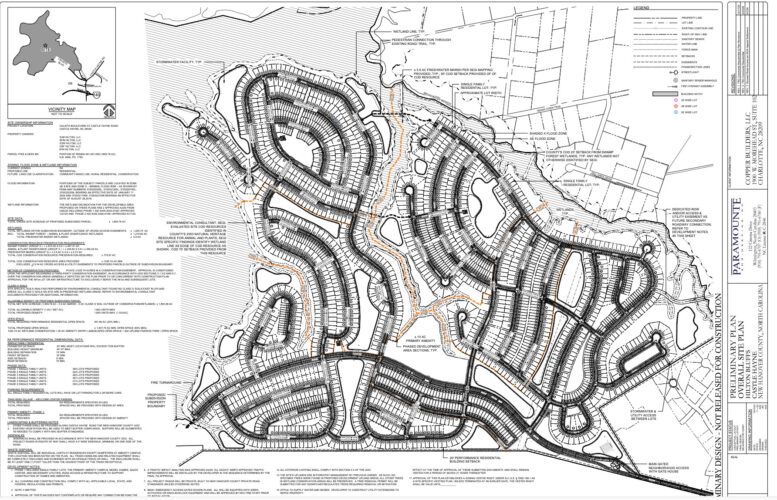
The latest iteration of Hilton Bluffs, an 1,800-home development on 600 acres of Sledge Forest, features one access point to the subdivision, a reduction from three in the original plan. The state fire code requires two access points for large developments; however, fire marshals have the authority to make an exception to this rule for developments where this is “technically infeasible.”
In a June 24 determination, New Hanover County Fire Marshal David Stone granted Hilton Bluffs the ability to construct one access point. Almost a month later, he rescinded the decision.
Copper Builders has now appealed to the state, asking it to uphold Stone’s original decision. The state’s affirmation would allow it to move forward with its current site plans, scheduled to be taken up by the county’s technical review committee on Sept. 2.
READ MORE: Copper Builders reaches deal with Hilton Bluffs neighbors, SELC complaint still active
While fire code requirements are typically discussed during the committee’s meeting, a county spokesperson confirmed property owners can also work with the fire marshal’s office outside this process. The spokesperson pointed to one recent example — Trinity Landing, a senior living community off Masonboro Loop Road with 208 units.
However, access to Hilton Bluffs in particular has been a hot button issue due to both traffic and safety concerns. The current site plans note the entrance as one long road between adjacent properties and connecting to Sledge Road.
If Copper Builders are allowed to move forward with this access point, nearly 15,000 projected daily trips will have to enter and exit there. Additionally, if this road is blocked for any reason — flooding is a large concern by nearby residents due to the development’s proximity to the Cape Fear River — emergency vehicles could be prevented from reaching residents, who could also be prohibited from leaving in emergencies.
For Copper Builders, permission to build out only one access point could make or break the project. The land tract is largely bordered by either the Northeast Cape Fear River or wetlands, which would require federal permits to build upon. The remaining land is private property and Copper Builders says their attempts to gain easements have failed.
Its last two access options — connections into the Wooden Shoe and Marathon Colony neighborhoods — were also eliminated last month. Copper Builders made an agreement with neighborhood residents, who were suing the developer over the proposed access points, to abandon the connections.
The agreement was made with the fire marshal’s initial determination letter in hand, meaning when Copper Builders gave up its attempts to connect Wooden Shoe and Marathon Colony, the developers thought they could move forward without them.
Now, they’re in limbo.
The deal
Though it was not publicly disclosed, the fire marshal’s approval of the single access point was always a prerequisite to a deal made with Wooden Shoe and Marathon Colony representatives last month.
“Seeking his determination was the necessary first step toward resolving the neighbors’ own stated concerns,” Copper Builders founder Wade Miller wrote in an email to Port City Daily Monday.
The agreement settled one of two appeals on July 20, filed earlier this year in response to the county TRC’s preliminary approval of Hilton Bluffs; the site plan then included three access points to the Wooden Shoe and Marathon Colony subdivisions along with Sledge Road.
One appeal was filed by Wooden Shoe and Marathon Colony residents, arguing the connections to their subdivision violated restrictive covenants binding plots to residential purposes only. The other appeal was filed by the Southern Environmental Law Center on behalf of other Castle Hayne residents.
Both appeals were set to be heard on July 20; it was at this meeting Sam Franck, Copper Builders’ attorney, presented an agreement with the Wooden Shoe and Marathon Colony neighbors to abandon the subdivision connections. In exchange, the residents withdrew their appeal (and civil suit) against the development. There was no mention of the fire marshal’s determination letter.
Port City Daily asked Franck after the meeting if Copper Builders would need to look elsewhere for additional access points. Franck said the details of the revised plan “are not resolved yet.”
Southern Environmental Law Center attorney Liz Rasheed, whose appeal still stands pending per new site plan submittals, said it was her team’s assumption Copper Builders would then have to find other access points to replace the ones subject to the agreement.
“We didn’t know that they had been working behind closed doors all along to try to get some sort of go-ahead to not have those access points at all,” Rasheed said.
Port City Daily asked Miller if the Wooden Shoe and Marathon Colony parties understood there would only be one access point proposed as a result of the agreement. Also asked of Miller: Why wasn’t Copper Builders open with the public about the fire marshal’s determination and single-access point plan being the path forward?
After publication, Miller said the board of adjustment hearing was not a forum to review a revised plan, but rather an appeals’ proceeding.
“We would never raise the hopes of the neighbors who wanted and advocated for this change before thoroughly vetting every requirement, not just the Fire Marshal’s,” Miller wrote in an email to Port City Daily Tuesday.
He said a single primary access is “neither new nor reckless, despite Ms. Rasheed’s suggestion otherwise.”
Additionally, Miller said most of the people who appealed Hilton Bluffs have dropped their complaints after the deal made on July 20. He also pointed to Copper Builders deal with Coastal Land Trust, involing the transfer of 3,200 acres of the 4,000-acre Sledge Forest tract to the trust contingent on the approval of the 1,800-home Hilton Bluffs subdivision.
“Most of them see that for what it is, and combined with removing the traffic connections through their neighborhoods, it is why forty of the appellants dropped their appeals,” Miller wrote.
No other ways in?
In Miller’s view, as articulated to both Stone and the state, there are no feasible secondary access options at this point.
Documents submitted to the state detail the abutting, non-wetland properties aside from Wooden Shoe and Marathon Colony. These include land owned by Nuclear Fuel Holding Co., Inc. (General Electric) and three individual property owners — Robert Jr. and Laurie Payne, Kevin Hommes, and D. Webster Trask.
In its report sent to the state, Copper Builders claims it spent 14 months seeking easements with the three property owners to no avail. In addition, the developer says the General Electric property “involves sensitive materials, controlled operating conditions, and site security requirements” that rule out its viability.
At the time it requested the fire marshal’s permission to build only one access, Wooden Shoe and Marathon Colony were technically still on the table — it would be a month before Copper Builders officially retracted the two connections from consideration in its deal with the neighbors.
This technicality formed the basis for Stone’s decision to rescind his initial determination, which he made three days after the July 20 board of adjustment hearing where the deal was made. Miller said he was surprised by the rescission.
In his rescission letter, Stone wrote the information Copper Builders shared at the time of the initial determination “did not fully reflect” the status of the site plans at the time.
According to Stone, Copper Builders told him surrounding property owners had denied any easement through their properties. Though this was true for the three individual property owners not in Wooden Shoe or Marathon Colony, Copper Builders actually did gain permission from the homeowners in Wooden Shoe and Marathon Colony to use their properties for roadway easements. The problem was the restrictive covenants in the neighborhood did not allow the property owners to agree to the easement.
Despite the revocation, Stone told Copper Builders it could reapply for another determination with updated information. Copper Builders did so on July 27, and when a determination wasn’t reached, the developer appealed to the state on July 31.
Too late to rescind?
Copper Builders is now asking the state fire marshal to uphold Stone’s original determination, in effect invalidating the rescission.
Firstly, Copper Builders argues Stone’s initial determination became final after 10 days without objection from anyone — neighboring property owners, New Hanover County or otherwise.
Port City Daily asked the county to confirm the fire marshal had 10 days to revoke his determination.
A spokesperson provided: “A local government can update a development approval under NCGS 160D-403(f). Under this provision, the fire marshal has the ability to rescind a determination if new information is obtained; and a timeframe for issuing a revocation or rescission is not outlined.”
Copper Builders also argued Stone did not find an error in his initial determination and his one-access allowance was made in accordance with state law.
According to statute, in developments where compliance is technically infeasible, the fire code official “shall either not require two fire apparatus access roads or allow for alterations that provide for fire apparatus access road remoteness to the maximum extent technically feasible.”
In his revocation letter to Copper Builders, Stone says it was “premature” to conclude Copper Builders met these conditions because the developer “had not yet exhausted the potential for two additional fire apparatus access roads at the time the determination was requested and issued.”
In its appeal to the state, Copper Builders argues it is under no requirement to exhaust all options, but rather meet the “technical infeasibility” standard. Per state law, technical infeasibility could occur due to road connectivity limitations, real property dimensions or limitations, real property acquisition constraints, or environmental constraints.
The appeal also notes Copper Builders proceeded in its development plans — including the deal with Marathon Colony and Wooden Shoe representatives — with the understanding that Stone’s determination was valid.
Thus, attempts to unwind the determination, according to Copper Builders, would “significantly prejudice Copper Builders and implicate valid claims for vested rights, estoppel, and reasonable reliance” — all legal claims that could form the basis of a legal suit.
“We have great respect for the Fire Marshal, the County’s staff, and the administrative review process, and we will continue working with all parties to resolve this matter appropriately and move the project forward,” Miller wrote to Port City Daily.
Port City Daily asked the county if Stone would be making another determination and if so, when. A spokesperson said the fire marshal’s office will review the update site plans in the upcoming technical review committee meeting and provide comments, guidance and any determination then.
At Port City Daily, we aim to keep locals informed on top-of-mind news facing the tri-county region. To support our work and help us reach more people in 2026, please, consider helping one of two ways: Subscribe here or make a one-time contribution here.
We appreciate your ongoing support.
