


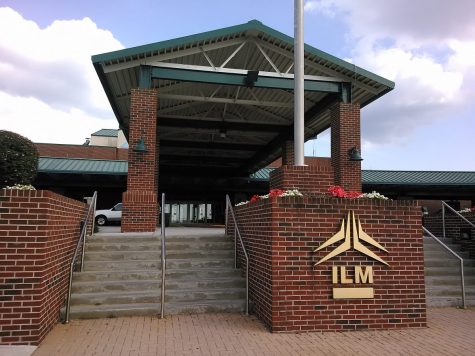
WILMINGTON — The North Carolina Department of Transportation has released the results of its latest State Transportation Improvement Program, inclusive of two projects aimed at boosting safety issues at the Wilmington International Airport. These two projects won out among dozens of other local projects submitted for the 2028-2037 STIP by the Wilmington Urban Area Metropolitan Planning Organization.
Two projects have been allocated $500,000 apiece.
The first is for ILM to upgrade its visual approach aids, such precision approach path indicators — low-light visual aids on the side of runways — or runways 6 and 24. It tied for second place with a widening of U.S. Interstate 40, with a score of 88.47 out of 100 points. All funded projects scored between 88.8 and 76.59 points.
The STIP notes the installation will resolve “documented, non‐coincident alignment issues.”
The second project is the replacement of runway 35’s wind cone, which has reached the end of its service life. The airport will also relocate this runway’s precision approach path indicator and its power supply outside the runway safety area, per Federal Aviation Administration standards. This project scored 78.85 out of 100, ranking it 27th among funded projects.
Port City Daily asked the airport for more information on the projects but did not get a response by press.
Since 2016, NCDOT has used a three-tiered scoring method to prioritize which projects receive its funding. It provides funding in three categories — statewide mobility, regional impact and division needs. The scoring released recently is for statewide mobility. Scoring criteria includes safety, congestion, freight, accessibility, and local input to prioritize projects; the STIP spans roughly 10 years, but is updated periodically after passage.
In the last STIP, spanning 2026 to 2035, a tolled version of the Cape Fear Memorial Bridge scored ninth among NCDOT’s funded projects. The NCDOT has committed $85 million to the bridge’s $1.1-billion price tag, also supported by a $242-million federal grant.
The airport projects were the only two WMPO-submitted improvements included in the statewide mobility category of the next STIP. Though, the state also provides money for regional impact and divisional needs. District 3 — encompassing New Hanover, Brunswick, Pender, Onslow, Duplin and Sampson counties — has $31 million for highway and bridge projects as of May 2028, though this amount could fluctuate.
The statewide category included 43 funded projects — 25 highway, three aviation and 15 rail. WMPO’s two funded projects are the lowest funding amounts in the STIP. However, other projects receiving funding include both the Burlington-Graham MPO and Gaston-Cleveland-Lincoln MPOS, with two each, the capital area for six, and Charlotte Regional TPO with nine. Winston-Salem received five, while the Greensboro and High Point MPOs secured four.
The highest scoring project is the $36-million construction of a rail crossing in Charlotte; the second is a $513.2 million road widening in the U.S. Highway I-40 in Buncombe and Haywood counties. The road is set to be widened and tolled from Exit 44 (Smokey Park Highway) Exit 27 (U.S. Highway 23/74).
The funded projects include several interchange improvements and rail crossing upgrades in the state’s cities. Other notable projects in the STIP include a $91.5 million express lane on Charlotte’s Highway I-85, the $765 million construction of a new freeway in Forsyth County, and $131 million in motorway improvements on I-40 in Wake and Durham counties.
The unfunded improvements submitted by the WMPO include upgrading N.C. Highway 74 between Maco Road and Mount Misery Road to interstate standards for $375.8 million, improving the intersection at College Road and Oleander Drive to a “grade-separated quadrant design” for $184.6 million and a tolled version of the Cape Fear Crossing coupled with roadway improvements on Shipyard Boulevard and Carolina Beach Road for a $1.6 billion.
Next in the STIP process, NCDOT will rank projects submitted in the regional impact category; scoring for this will be released in September. Division needs will be identified between December and January, while the final STIP will be released in summer 2027.
At Port City Daily, we aim to keep locals informed on top-of-mind news facing the tri-county region. To support our work and help us reach more people in 2026, please, consider helping one of two ways: Subscribe here or make a one-time contribution here.
