


[Ed. note: This was updated after press to reflect the outcome of the House vote on Tuesday, June 30.]
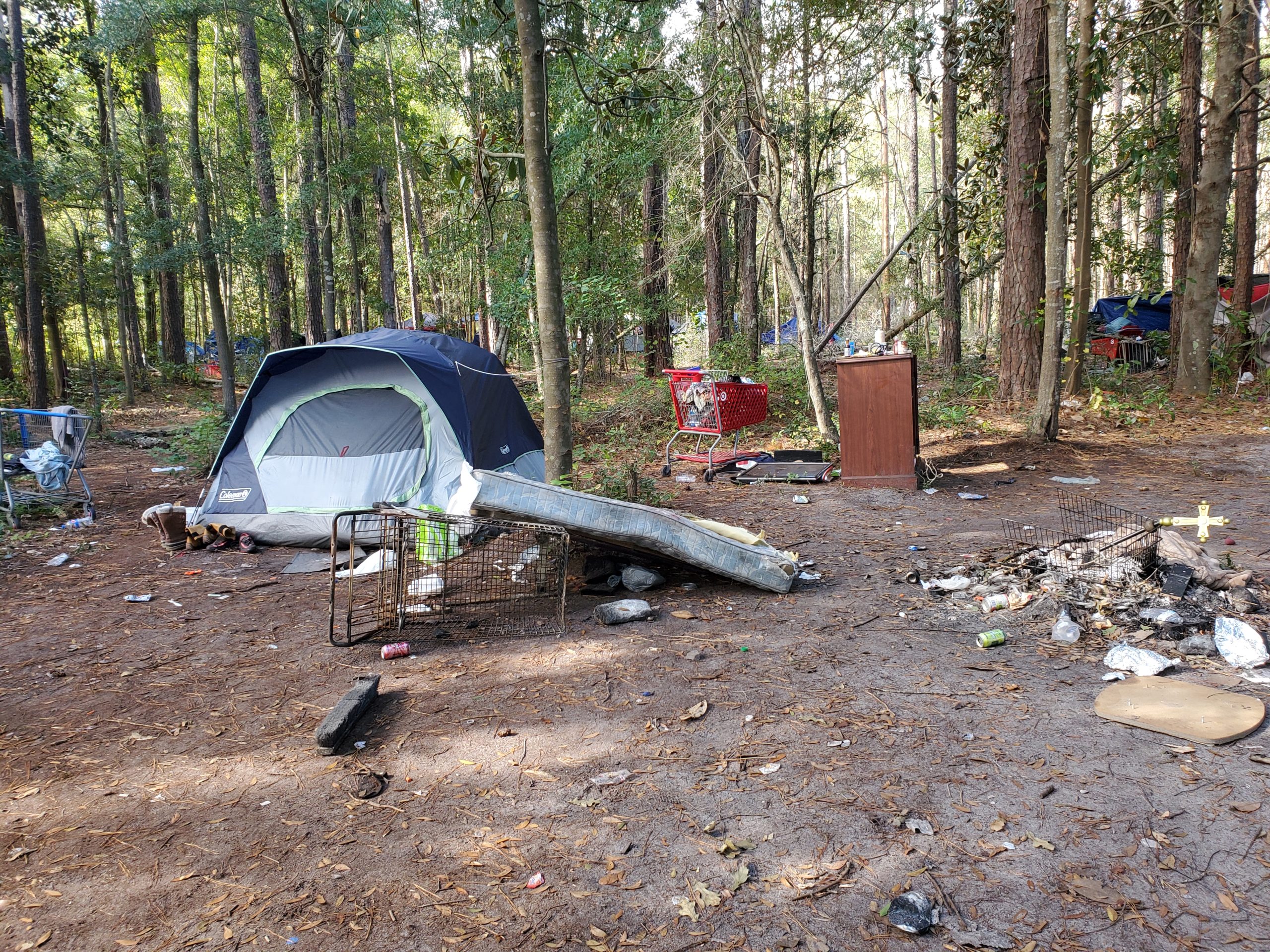
NORTH CAROLINA — The state is one step closer to prohibiting people from camping on publicly owned property in an effort to thwart homeless encampments from setting up in cities. The move comes as some legislators have cited concerns over public safety, while critics say it criminalizes unhoused individuals.
House Bill 437 — titled “Drug-Free Zones/Unauthorized Public Camping” — passed through the North Carolina House in a 73-40 vote Tuesday, June 30. The bill is now on its way to Governor Josh Stein’s desk where it is unclear whether or not he will sign it into law.
The bill previously passed the Senate on June 24 in a 26-16 vote; no Democrats voted in favor of the bill. However, local representatives Micheal Lee (R-New Hanover), Bill Rabon (R-Brunswick), and Brent Jackson (R-Pender) favored it in the Senate.
ALSO: Wilmington council passes anti-camping ordinance, green space resolution with little discussion
CATCH UP: After failing to pass last year, councilman wants to re-approach downtown public camping ordinance
The bill bans unauthorized public camping or sleeping on any public property, expanding statewide the anti-camping ordinances already in place in New Hanover County and Wilmington.
Rep. Marcia Morey (D-Durham) debated this portion of the bill on the floor Tuesday, saying she appreciates the sentiment behind the legislation but does not view it as helpful.
“It doesn’t help the homeless, it relocates them out of sight,” Morey said. “This bill doesn’t give you one new housing unit for a homeless family. It doesn’t give you any treatment for someone with addiction problems. It doesn’t give you mental health counselors. It doesn’t help anyone pay rent.”
The bill also creates “drug-free homeless service zones,” within a 100-foot radius surrounding homeless shelters or other service providers where there are increased penalties for drug use.
Currently, possession of small drug amounts is only a felony when the drug is a Schedule I, which includes heroin and LSD. Possessing small amounts of others — marijuana, cocaine, prescription drugs — is currently a misdemeanor, but these now become felonies in a “drug free homeless service zone” with the exception of possessing 5 grams or less of marijuana.
Primary sponsors of the bill are Heather Rhyne (R-Lincoln), Allen Chesser (R-Nash), and Ray Pickett (R-Watauga). Rhyne views the bill as a way to protect the unhoused population from those who aim to sell them controlled substances.
“It’s time to stop the drug deals in the homeless shelters and really try to protect this vulnerable population — that’s the heart behind this bill,” she said during a June 10 Senate Judiciary committee. Distribution of controlled substances — outside of 5 grams or less of marijuana — is already a felony in North Carolina.
Under the bill, anyone who is 21 or older who commits a drug offense in one of these zones is guilty of a Class E felony, which can result in up to four years in prison. Employees of these zones who are found to have permitted drug use can be found guilty of a Class H felony, which can result in up to two years in prison.
While the bill originally just included the drug-free zone provisions when filed in March 2025, the inclusion of the anti-camping provisions were added in June of this year. Sen. Brad Overcash (R-Belmont) after the bill initially passed the House in 2025, equating the issue to a “public safety crisis.”
“In the last few years, we have seen in every region of this state a proliferation of homeless encampments in our large cities, in our small towns and everything in between,” Overcash said during the June 10 committee meeting.
Other counties in North Carolina, such as Wake County, Mecklenburg County, and Gaston County, already have anti-camping ordinances or similar policies. New Hanover County and Wilmington passed its public camping ordinance in 2023 and 2025 respectively. Many of the ordinances followed a June 2024 Supreme Court ruling that cities can implement bans on public sleeping and camping. The ruling passed in a 6-3 vote.
The statewide bill bans sleeping on any municipal or county property outright, without listing a timeframe, but it does list exceptions. One is allowing local government land to be used for public camping for no longer than one year. The government entity will be required to provide sanitation, behavioral health services, and prohibit drug and alcohol use on the land.
For public camping to be permissible, the local government must show the Department of Health and Human Services, that the property is not zoned for residential use, would not affect property value of nearby residential or commercial land, a plan to satisfy all requirements, and there not being enough beds in homeless shelters.
Another amendment to the bill was introduced on June 24. It would have changed the minimum age requirement to 21 to buy tobacco and nicotine products, in line with the federal regulation, as well as intensifying consequences for drug trafficking, establishing a task force with state and federal governments collaborating to end drug trafficking, requiring mandatory opioid detection training for all law enforcement officers, and making appropriations for opioid use disorder education, prevention, treatment, and recovery services.
The amendment was tabled but other changes were made. Under the current version, residents and business owners can bring forward civil action if they feel their government has violated the bill’s provisions. Rather than the initial five business days for the local government to amend an alleged violation, it has been changed to 15.
Prior to Tuesday’s vote, Rep. Deb Butler (D-New Hanover) told Port City Daily she had yet to read the latest version of the legislation however, she did give insight on where she stands.
“I am generally opposed to anything that criminalizes homelessness because I don’t think that’s the way we tackle that social issue,” Butler said.
She voted against the bill Tuesday evening.
Rep. Ted Davis (R-New Hanover) voted for the bill when it first went through the House and again during the final vote.
The anti-unauthorized public camping sections of the bill mirror ordinances passed in Wilmington and New Hanover County. Both ban sleeping, camping, or placing tents, cooking equipment or bedding on city parking decks and lots, entries to city facilities and associated areas, between 10 p.m. and 7 a.m. The city ordinance is not applicable to people sleeping in their cars, which is in line with the proposed state legislation.
Before the city passed its ordinance in 2025, interim police chief Ralph Evangelous shared a majority of proposed anti-camping ordinances were already covered in city code and wouldn’t change much with officer response. He said officers can ask someone to pick up their belongings and leave, but unless they have somewhere else to crash, officers are liable to encounter them shortly thereafter in another area.
Port City Daily reached out to the Wilmington Police Department for an update on enforcing the anti-camping ordinance. WPD representative Brandon Shope explained, when responding to a violation of the city ordinance, officers generally issue a warning first. However, upon further violation a citation will be written before escalating to possible arrest.
Two social workers did begin working with WPD a little over a month ago; these positions were added at the behest of Mayor Bill Saffo upon passage of the anti-camping ordinance to focus on street outreach alongside officers.
As social workers just began their collaboration with the city, exact numbers on 911 calls regarding homelessness are not yet available but will be in the future. Currently, Shope said WPD and EMS calls pertaining to homeless individuals can reach up to 1,000 a month.
Front Street Brewery owner Tom Harris’ called homelessness a nuanced issue best solved at a local level and not the state; however he is in support of putting stronger focus on supporting substance use treatment programs.
Harris said after implementation of city and county anti-camping ordinances were in place, he has seen a difference in the number of homeless people outside his restaurant.
“I think there has been an incremental improvement,” Harris said. “I would not call it a large improvement. I would call it small.”
Harris has proposed the city ban camping within a certain radius of residential properties, business and schools as opposed to a complete public camping ban.
“That would have been a more humane approach to helping solve the negative impact on the homeowners and business owners in Wilmington,” Harris said. “We need common sense restrictions on where individuals experiencing homelessness are allowed to camp and not allowed to camp.”
He added that until enough shelter beds are available the city and county should provide dumpsters and portable toilets for homeless individuals rather than banning public camping.
“I would absolutely support a total ban of camping on city and county property but until they have an adequate number of shelter beds in place I do support the buffer approach,” Harris said.
His recommended buffer approach includes camping allowed in areas least impactful to homeowners and businesses, which is a part of the exception in the proposed state bill.
Currently, there are not enough emergency beds for homeless individuals, according to Andrea Stough, homeless services director for County in the Cape Fear Homeless Continuum of Care — the lead homelessness agency in the area. As of June 30, there are 342 emergency and transitional shelter beds, though 90% are at capacity.
Stough didn’t answer whether she supported the state bill, but said the few vacancies available can be “attributed to specialized populations and unique service considerations,” such as certain beds only being for children. Stough added availability of affordable housing, rising costs, and limited long-term and permanent housing options has increased the time period individuals remain homeless.
House Bill 437 is the first statewide bill to implement these restrictions. If codified into law, it would become effective December 1, 2026.
Have tips or comments for Sophia DePhillips? Email [email protected]
At Port City Daily, we aim to keep locals informed on top-of-mind news facing the tri-county region. To support our work and help us reach more people in 2026, please, consider helping one of two ways: Subscribe here or make a one-time contribution here.
