


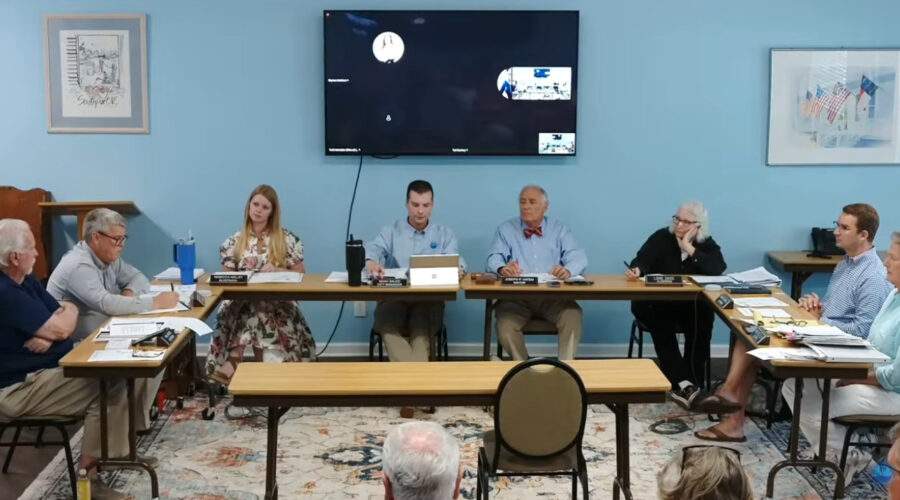
SOUTHPORT — After three weeks of budget discussions, the Southport Board of Aldermen voted unanimously to approve the new budget, with no tax increase and no cut to employee benefits. In order to balance the budget, city manager Noah Saldo factored in expenditure cuts and used the city’s savings to cover increased costs.
On June 17, the board voted unanimously to approve the roughly $28.1 million budget. The tax rate will be 31 cents per $100 value instead of 32.5 cents, which was previously floated. However, also on Thursday, Mayor Joe Pat Hatem was required to break a tie on changing employee merit bonuses from a $500 flat rate for everyone and instead making it a 1.5% compounded bonus to base pay; aldermen Rebecca Kelley, Paul Gross and Lowe Davis voted against the 1.5% bonus while aldermen Robert Carroll, Karen Mosteller and Marc Spencer voted in favor. The three dissenters were concerned about the bonus eventually resulting in increased costs for taxpayers.
Gross argued the flat rate was more cost effective for both the city and the taxpayers. The percentage-based merit would be 1.5% of an employee’s total pay (salary plus benefits); the lowest salary for a city employee is roughly $40,000 and the highest salary for a city employee is roughly $150,000.
READ MORE: Southport budget: Aldermen debate tax-rate increase, employee benefits, park and recs cut
While the balance was previously budgeted to include a $68,000 fund balance appropriation, the aldermen needed to vote to approve an additional savings transfer of roughly $50,000 to cover the new merit bonus. However, the aldermen recognized their method of balancing the budget was not a viable long-term solution.
“It’s not realistic to think that we’re not going to have to, in the future, raise these taxes,” Mayor Pro Tem Karen Mosteller said. “It’s not sustainable to keep dipping into the fund.”
Aldermen met on June 8 for a budget workshop, wherein Kelley called the fund balance appropriation a “Band-Aid.”
The fund balance is typically used in emergency situations. However, local governments have the option of appropriating savings, usually gained by bringing in excess revenue, to supplement rising costs and unbalanced budgets. Southport is currently setting aside roughly $120,000 to cover the cost of the aldermen’s decision to not raise taxes but still provide robust employee benefits and pay. At the May 27 budget meeting, the aldermen were presented with a 1.5-cent tax increase, which garnered concern from aldermen, including Gross and Kelley.
Gross has been adamant about not increasing the city’s tax rate, repeatedly pointing out Southport’s standing as having the second highest tax rate in Brunswick County at 31 cents per $100 value. Bald Head Island currently has the highest tax rate at 65 cents per $100 value. The county has a tax rate of 34.20 cents per $100 value.
“We have 4,200 residents that we have to answer to on our taxes,” Gross said on June 17.
Employee benefits also increased in this year’s budget, with 2.75% cost-of-living adjustment, 50% healthcare coverage for dependents and no premium costs for staff. Previous iterations of the city manager’s draft budget included decreasing dependent coverage from 50% to 25% coverage and charging employees a $35 monthly premium, whereas they currently don’t pay one.
On June 8, the board decided against changing both items in a 4-2 vote, with Kelley and Gross dissenting. This resulted in a deficit around $11,000.
Removing the tax increase brought forth an additional $252,000 shortage. By the time they voted on the budget on June 17, staff added a code enforcement contract for $50,000 and a police vehicle upfit for about $20,000; thus, the deficit escalated to about $333,000.
To make up the projected shortfall, staff were able to cut expenses or add funds in the budget. This included increasing revenue projections from the community building’s rentals and events for an additional $15,000 and removing a part-time employee request from the community relations department for about $20,000. Finance Director Joey Kronenwetter also explained vehicle insurance premiums were adjusted to reduce the deficit by more than $230,000.
Despite aldermen concerns, few at the June 11 public hearing addressed the possibility of a tax-rate increase. Most pushed for further funding, staffing and support, particularly for first responders, like the fire and police departments.
The passed budget includes funding four new police officers, to be hired in a staggered manner — two in September and two in January. This will save more than $12,000. Former mayor Rich Alt spoke during the public hearing to inquire into the necessity of adding four new officers, which garnered a response from Chief Todd Coring.
“I’m asking for four officers because I need them, not because I might need them,” Coring said.
Mosteller noted during the June 17 meeting the increase in employee costs was not because of widespread employee additions. She noted, prior to the June 2024 water and sewer merger with Brunswick County, some employees were paid through enterprise funds. Kronenwetter explained the water and sewer fund covered a third of board, admin and finance departments, or 17 employees. It also paid the salaries for 60% of streets maintenance staff, or six people, and two public works administrators.
All of these employees have now been transferred to the general fund. The electric fund, the city’s remaining enterprise fund, pays for portions of those salaries as well.
While normally enterprise funds are only permitted for the costs of operating utilities and services outlined in the fund — so the electric fund only covers electric utilities costs, for example — the city’s finance director pointed to North Carolina General Statute 159-13(b)(14), which allows any surplus enterprise revenue to be allocated for other purposes, like employee salaries.
Tips or comments? Email Emily Sawaked at [email protected]
At Port City Daily, we aim to keep locals informed on top-of-mind news facing the tri-county region. To support our work and help us reach more people in 2026, please, consider helping one of two ways: Subscribe here or make a one-time contribution here.
We appreciate your ongoing support.
