


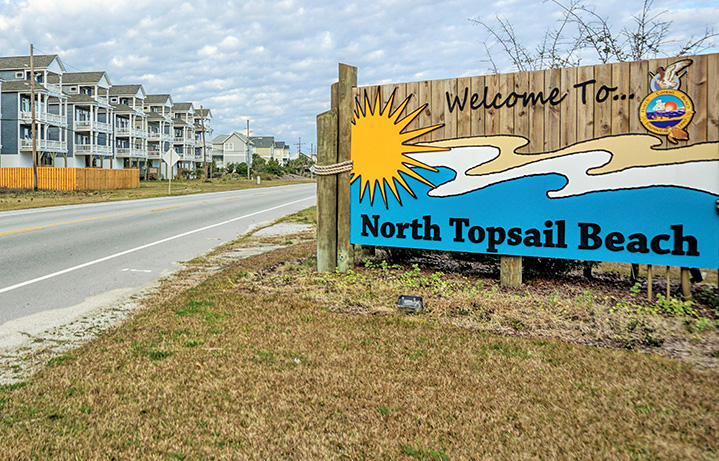
NORTH TOPSAIL BEACH — North Topsail Beach has introduced two tax rates for next year’s budget as its board of aldermen awaits potential impacts should the North Carolina House vote on a property tax moratorium. If it passes, the bill could cost the town $314,886 in ad valorem revenue between 2025 and 2026 property values.
Interim Town Manager Larry Faison presented North Topsail Beach’s $17.5-million budget on June 3. The balanced budget offers two tax rates: 33 cents per $100 value and 43 cents per $100 value. The first is based on 2026 ad valorem revenues calculated on Onslow County’s 2026 revaluation and the second on 2025 property values.
“This budget process was akin to a freight train that had left the station,” Faison told Port City Daily. He began his tenure as interim town manager on March 30, after the budget process already began. “I ran really fast to grab hold of the caboose and make my way to the locomotive.”
READ MORE: Commissioners unsupportive of Pender County manager’s tax rate exceeding rev-neutral
Faison prepared two budgets due to Onslow County being wrapped up in a potential legislative moratorium on property revaluations. 2026 is a property revaluation year in Onslow County, which conducts one every four years. Senate Leader Phil Berger (R-Rockingham, Guilford) filed Senate Bill 889 on April 28, which asks for almost a dozen counties, including Onslow, to freeze completed reappraisals until 2027. Counties and municipalities use property values to determine tax rates and revenues. Berger has cited unmanageable increased tax bills affects working-class families and seniors on fixed incomes the most.
2026 reappraisals for properties in Onslow County escalated by 35% to 40% overall. In North Topsail Beach, revals rose by 35.6% since fiscal year 2025-2026; the total amount of property values in N. Topsail exceeds $2.3 billion compared to the previous year’s $1.7 billion because of growth.
The Onslow County Board of Commissioners voted Monday, June 1, in favor of a resolution requesting the county be removed from the moratorium. The final vote was 4-3. Several commissioners expressed concern about the moratorium’s implications for local governments.
“This is about local control,” Onslow Commissioner Royce Bennett said. “I feel like we have a good handle on what the needs of the county are and if we don’t have any authority to serve the needs of the county then I’m not sure why we’re here.”
If the Senate Bill does not pass before June 30, North Topsail residents could be looking at a $0.10 cent tax rate decrease at 33 cents per $100 value in order to be close to revenue-neutral. A revenue-neutral rate is when the municipality brings in as much revenue as it had the previous fiscal year. For North Topsail, increased property values mean a lower tax rate is needed to sustain town functions, as the same amount of money is still collected.
Though the revenue neutral rate for 2026 is technically 32.69 cents per $100 value, the proposed 33 cents tax rate discrepancy is due to collection rates. To calculate the proposed rate of 33 cents, Faison used a 98% collection rate, which was closer to the town’s 98.75% 2025 audited collection rate.
If the moratorium passes, the tax rate would remain at the FY2025-26 level of 43 cents per $100 value.
Essentially, an average home valued at $500,000 in North Topsail is paying $2,150 annually for property taxes with the current rate. However, if that same home is valued 35% more in 2026 at $675,000, the taxpayer would owe $2,278 annually, if using the new 33 cents tax rate.
“If we go to 33 from 43, nobody will remember that we got stuck in this thing,” North Topsail Mayor Richard Grant said at the June 3 aldermen meeting, regarding the moratorium bill.
With the 2025 tax rate North Topsail would receive more than $7.2 million revenue and with the 2026 tax rate it would take in over $7.5 million.
“Putting aside the reval, there has been a slight increase in property values in the town from new builds and other things,” Grant said.
There has been a 3.12% growth in property revaluations value, which comes from the three-year annualized growth rate between North Topsail’s previous revaluation.
The $7.5 million revenue estimate will be divided into the town’s three funds with $4.1 million going into the general fund, $1.1 million into the capital fund, and $2.3 million into the shoreline protection fund.
“I’m hopeful from talking to different people that the Senate is not going to take action, which would be nice,” Grant continued.
Bill 889 went to the House committee of Rules, Calendar, and Operations in mid-May and stalled until June 3 when it was referred to the Committee on State and Local Government, withdrawn and referred to the Committee on Finance, before being re-referred to the committee on State and Local Government.
It was approved, 72-42, on a second House reading on Tuesday, June 9, and must pass a final House vote; the Senate already passed the bill and Gov. Josh Stein would have to sign off if it secures a final House vote. The bill must pass on or before June 30, the day the budget has to be adopted per North Carolina state law or 2026 rates will be used.
The overall budget of $17.5 million has the general fund coming out to $9.8 million, capital improvement $1.6 million, and shoreline protection at $6.1 million. There is a $1.28 million increase from last year’s $16.2 million budget.
The overall capital improvement revenue has decreased by $10,177 from the previous year but expenditures increased by $187,397. The largest expenditures come from paying off debt from Fire Station No. 2 principal payments at $373,344 and $198,091 in interest, as well as $720,435 for future capital improvements which North Topsail’s Finance Officer, Wayne Johannessen describes as “any improvements we identify during the course of the next year.”
Within the capital improvement fund there is also $218,689 going toward a fund for a ladder firetruck.
“It would take two to three years to order it and receive the truck, then we would start paying, but we were going ahead and setting aside that payment for these two years in that window which we would then use as a down payment to reduce the principal that we have when we do actually make the purchase,” Johannessen explained.
As for the shoreline protection, the fund has a budgeted $723,212 increase coming in at $6.1 million compared to last fiscal year’s budget of $5.4 million. The fund’s largest expenditure is debt from the 2022B Special Obligation Bond, which paid off debt from a 2015 USDA SOB to pay for beach renourishment. There is only one payment of $1.8-million remaining as part of the bond, to be remitted in December this year.
The general fund has also had a 3.5% increase from last year’s budget and escalated revenue of $328,747. The fund’s largest expenditure increase is $114,200 for public streets which includes public parking lot maintenance and repair, storm water, and street paving and repair. Employee costs add to the increase as a 2.9% cost of living adjustment and up to 2.4% merit/bonus has been budgeted for staff.
Other major expenditures in the general fund are $206,000 for erosion mitigation and decking repair of town hall, $300,000 for renovating the public works building, and $255,000 for dock and boardwalk maintenance.
While the June 3 meeting did have a public hearing for the budget, no community members came forth with public comment.
Grant explained the budget typically would be passed during the June 3 meeting, but due to the legislation being held up in Raleigh, the board has planned a meeting for June 24, with a backup date of June 30, to adopt the budget. By law, municipalities have until the end of June.
[Ed. note: The piece was updated after press to reflect Senate Bill 889 passed a House vote on Tuesday, June 10, and moves to a final House vote.]
Have tips or comments for Sophia DePhillips? Email [email protected]
At Port City Daily, we aim to keep locals informed on top-of-mind news facing the tri-county region. To support our work and help us reach more people in 2026, please, consider helping one of two ways: Subscribe here or make a one-time contribution here.
