


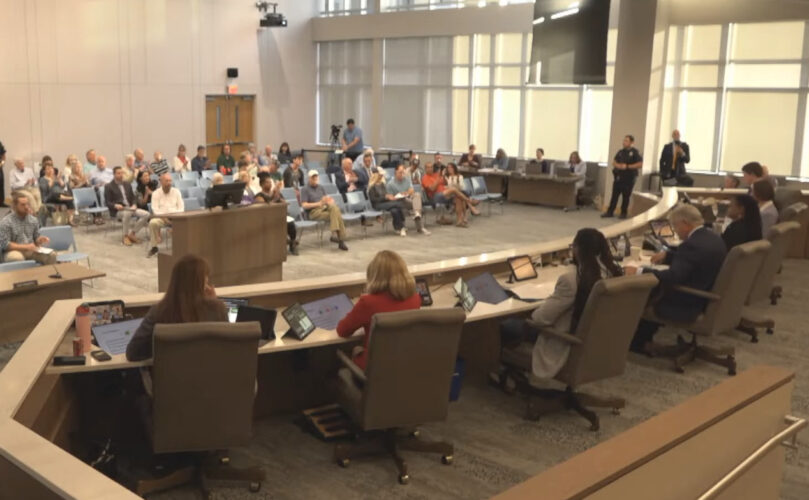
WILMINGTON — The Wilmington City Council moved forward with the first stage of its budget passage Tuesday night with a 4-3 vote on a budget with a 4.9-cent property tax rate increase on top of the current 28.25 cents.
Mayor Bill Saffo and council members David Joyner, JC Lyle and Cassidy Santaguida voted in favor of the budget proposal, which dedicates a majority of tax increase to a “living wage” initiative. Mayor Pro Tem Kevin Spears and council members Salette Andrews and Chakema Clinton Quintana voted against it, though Clinton Quintana and Spears didn’t explicitly say why.
Tuesday’s vote was on the budget’s first reading; it will come back for a final vote on June 16 before taking effect July 1.
READ MORE: Wilmington city manager settles on 5.75-cent increase in budget recommendation
ALSO: NHC passes budget with same tax rate, one commissioner objects
Costing $16.7 million in total, the living wage is a pay philosophy that would tie the city’s starting rate at 60% of the area median income, which is $45,531. The city’s first responders are to reap much of the benefit of increasing the baseline, though they will be capped at a $15,000 increase; all other city staffers will be capped at $12,000.
“We’re trying to be fair to the employees of the city that provide significant services for our community … if nobody picks up your trash, it could get very volatile out there,” Saffo said. “But, also, we take care of parks, 733 acres of park land, we maintain the streets, cut the hedges, the bushes, take care of planning, zoning issues. There’s a lot of things that go into running a city, and just like every, every, every other entity and family, we’re also seeing significant impacts to our budget because of inflation.”
The living wage will improve financial outcomes for city employees — though anyone under 100% AMI would still qualify for federally-subsidized housing — and thus, city staff have argued the city will be a more attractive place to work. The Wilmington Police Department has around 40 vacancies, while the city has other hard-to-fill positions throughout its departments.
At council’s budget session on May 29, City Manager Becky Hawke said the living wage is expected to alleviate high turnover, which ultimately saves the city money. She said the pre-employment cost for one position ranges from $100 to $600 — though this number reaches $192,000 for WPD officers because of the training costs for recruits and equipment outfitted to them.
Aside from the living wage, the increased tax rate will go toward covering millions of dollars personnel health insurance increases, over half a million in additional funding for Wave Transit; 0.41 cents of the increase will go toward the city’s capital improvement plan, which has been experiencing inflationary rises in project costs. The city is also contending with lower property tax and sales tax growth than projected last year.
To pay for all these needs, Hawke’s recommended budget last month came with a tax rate increase of 5.75 cents. At council’s May 29 budget session — a nearly seven-hour meeting where council combed through the budget, line by line — some members indicated they would like to see the rate increase drop below 5 cents. Council member David Joyner plainly said he was prepared to vote on a 4.9-cent proposal.
To accomplish this, Hawke eliminated several line items at council’s behest: $29,000 for software pending an AI policy, $40,000 in reduced costs for extending IT laptop replacement to five years, and $28,500 for replacing surveying equipment.
The 4.9-cent budget also uses $2.5 million from the fund balance to cover $378,886 for mission-ready fire gear and $2.13 million to put toward this year’s cycle of police vehicle replacements. Becky explained while the tranche of vehicle replacements are technically one-time expenses, the city updates parts of its vehicle fleet on a rolling basis. Thus, next year’s replacements will likely need to find a place in the general fund during the 2027-2028 budget cycle.
The 4.9-cent rate, as opposed to the 5.75-cent increase, would save city residents just $5 or less per month. For a home value of $250,000, the monthly difference is $10.25 versus $12. For a $445,000 home value, the monthly difference is $18.17 versus $21.33. For a $800,000 home value, the monthly difference is $33 versus $38.
“To work so hard to get down under five cents, and it still only makes like $1 difference a month,” council member JC Lyle said.
Though they would ultimately vote for the 4.9-cent budget proposal, Lyle and council member Cassidy Santaguida said they were hesitant to take out money from the fund balance, noting the police vehicle replacements could potentially need to be paid for through another tax increase for the 2027-2028 budget.
Council member Salette Andrews also had an issue with using the fund balance, noting she would rather the city preserve the money for funding the homelessness strategy put together in August 2024. The strategy was a joint effort between the county and city, though the county indicated it wouldn’t move forward with implementing the plan in January 2025. At Friday’s budget session, Director of Housing and Neighborhood Services Rachel Schuler informed council that funding the plan would cost $26 million.
“I think this is one of the most transformative things we can do is to implement that plan that we went forward with two years ago and for that reason I’m hesitant to dip into our reserves because I know that we’re going to need to do it eventually,” Andrews said.
The city’s fund balance policy requires the pot of money to remain between 20% and 25% of the general fund amount, even though the state suggests a minimum of 8%. Hawke clarified the $2.5 million pulled would not put the city in jeopardy of violating its policy, though it would reduce one-time money the city could spend on other unexpected costs — hurricane damage, for example.
“I just want to stress that fund balance to balance a budget is not a sustainable strategy, but it is one that under these circumstances, if council is comfortable, we do believe that we can still maintain the policy requirements that we need to,” Hawke said.
Ultimately, four council members got on board with the 4.9-cent proposal.
Santaguida noted the tenets she ran her campaign on — affordable housing, workforce opportunities, public transportation — are all included in the budget. Lyle spoke to the audience about how the tax rate increase would be put toward meeting community service-level expectations.
“We’re asking for a lot, whether it’s 5.5 or 4.9 but we’re also, you’re asking a lot of us, you’re expecting a lot in return, and that is what we will be focused on from here on out,” Lyle said. “No matter which budget we pass [we’re] continuing to ask questions and continuing to make sure that the money goes where it’s supposed to go to make the biggest difference for you in your daily life.”
At Port City Daily, we aim to keep locals informed on top-of-mind news facing the tri-county region. To support our work and help us reach more people in 2026, please, consider helping one of two ways: Subscribe here or make a one-time contribution here.
We appreciate your ongoing support.
